Seeing
Line + MassSighting angles
Hold the pencil at arm's length, tilt it to match the edge, carry the tilt to the paper. Compare to plumb and level, never to the previous line.
Nine out of ten wrong buildings are wrong because an angle was guessed. The cure is sighting. Straighten your arm fully, lock the elbow, close one eye, and tilt the pencil until it lies along the edge you want: a roofline, the top of a wall, the line of a receding street. Hold that tilt, swing your arm down to the paper without rotating the wrist, and draw a line at the same angle. Then check it against the nearest true vertical or horizontal on the page.
The question to ask is never what angle is it; nobody can judge thirty-one degrees. The question is how far off level is it, or how far off plumb. Those two references never lie, and the eye is very good at judging deviation from them.
Sight every major angle in a building before you draw it: the eaves, the ridge, the base line, the top of each receding wall. Sight again after you have drawn it. The second sighting catches most errors while they are still one line.
Visuals
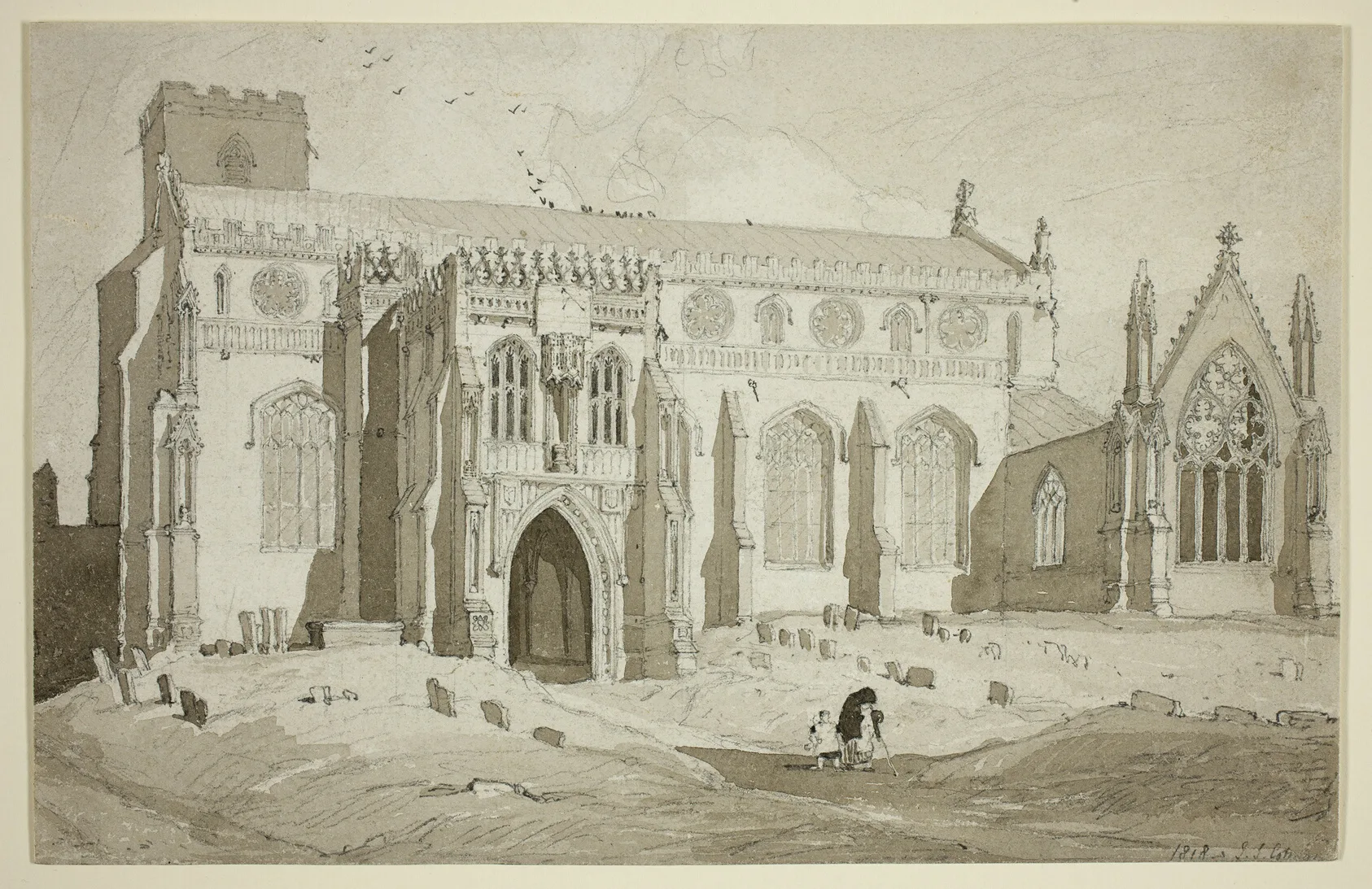
Cotman, Cley Church, Norfolk, 1818. Graphite and gray wash on ivory wove paper.
Cotman, Cley Church, Norfolk (graphite and wash). Every roof pitch and buttress slope here was sighted. Notice the parapet and the eaves are not parallel to the paper's edge; they recede.
The Art Institute of Chicago · Gift of Dorothy Braude Edinburg to the Harry B. and Bessie K. Braude Memorial Collection
Pitfalls
What
Bending the elbow between sightings.
Why
The pencil gets closer or further and every measurement changes.
Fix
Arm fully straight, every single time. Same eye closed.
What
Comparing a new angle to the last line you drew.
Why
If that line was wrong the error compounds.
Fix
Always compare to plumb or level, which cannot be wrong.