Line
LineEye level
The horizon is exactly at the height of your eye. Things above it show their undersides; things below show their tops. Draw the eye-level line first, faintly, on every architectural page.
Stand in a field and the horizon is at the height of your eye. Sit down and it drops with you. Climb a hill and it rises. It is not a line on the ground; it is a line through your eye, and every receding line in the scene converges toward a point somewhere on it. In a street or a nave, where the ground is hidden, you can still find it: it is where the receding window sills (below it, you see their tops) change to receding lintels (above it, you see their undersides).
Draw the eye-level line first, faintly, with a 2H, across the whole sheet. Everything hangs from it. Standing figures on the same ground as you have their heads on it, near or far. The tops of walls above it tilt down toward it as they recede; the bases of walls below it tilt up.
Where you put it on the page is a composition decision (see format and horizon). Where it is in the scene is a fact you cannot change without moving your feet.
Visuals
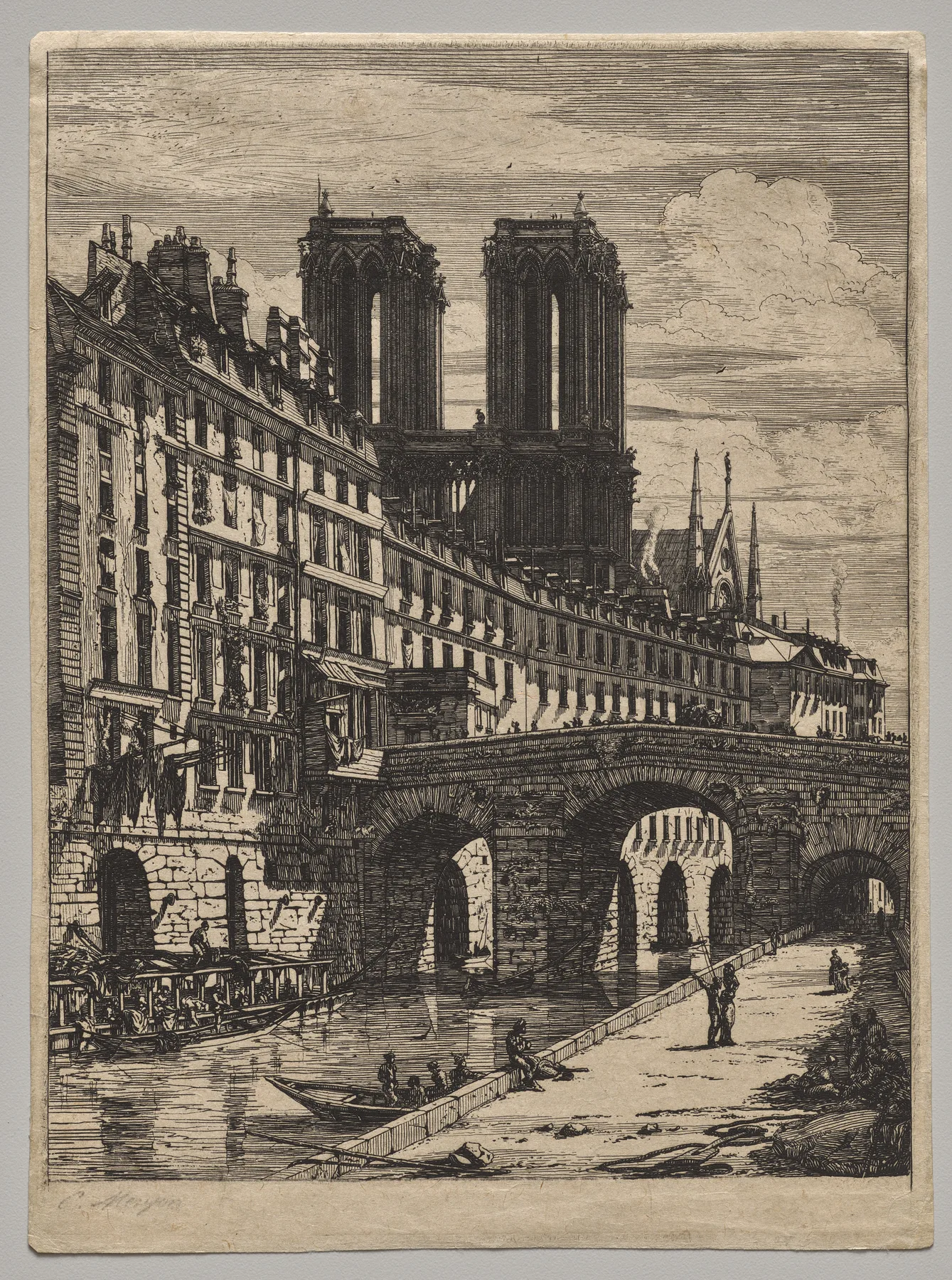
Meryon, The Petit Pont, 1850. etching with engraving.
Meryon, The Petit Pont. Find the eye level: it runs through the heads of the figures on the quay, and every receding line on the buildings tilts toward it.
The Cleveland Museum of Art · John L. Severance Fund
Pitfalls
What
Eye level drawn where the ground meets the sky in a hilly scene.
Why
Hills rise above the true eye level and will make all the perspective wrong.
Fix
Find it with a level pencil at arm's length: whatever the pencil covers is at eye level.