Value
Line + MassSquinting
Half-close your eyes until the detail vanishes and only three or four masses remain. Draw what survives.
Squinting is the single most-used tool in landscape drawing and it is free. Half-close your eyes until the scene blurs. Detail disappears, halftones merge into their neighbours, and what is left is the design: a few flat shapes of light and dark. That is what you draw first. Everything you add afterward has to respect it.
Squint at your reference constantly, and squint at your drawing just as often. If the drawing squinted looks like the reference squinted, the big decisions are right and you are allowed to add detail. If it does not, no amount of detail will fix it.
Two modern helpers do the same job: set your phone to greyscale to remove colour, and look at your drawing in a mirror or upside down to see its design fresh. But the squint is the one you will use a thousand times, because it is already attached to your face.
Visuals
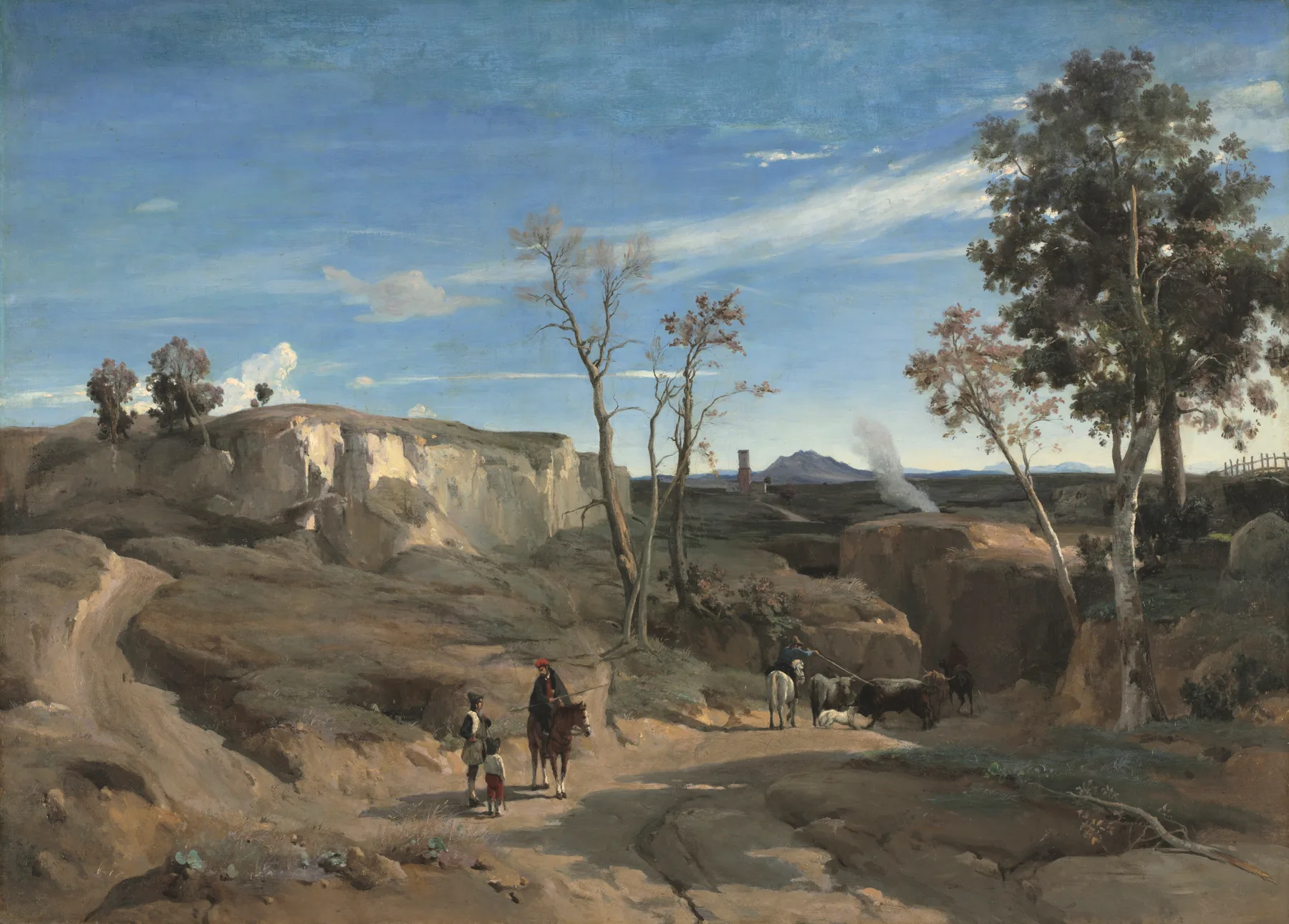
Corot, La Cervara, the Roman Campagna, c. 1830–31. oil on fabric.
Corot, La Cervara, the Roman Campagna (oil). Toggle the squint view and watch a complex valley collapse into light sky, pale distance, mid ground and a dark near shape.
The Cleveland Museum of Art · Leonard C. Hanna Jr. Fund
Pitfalls
What
Squinting at the subject but never at the drawing.
Why
You see the subject's design and the drawing's detail, and they never get compared.
Fix
Squint at both, alternately, every few minutes.