Value
Line + MassNotan: two, three, four values
The arrangement of light and dark. If the design works at two values, it will work finished. If it does not, nothing will save it.
Notan is a Japanese word for the pattern of light and dark in a picture, independent of everything else. Reduce any landscape to two values, black and white, and you can see immediately whether the design holds: is there one big light shape and one big dark shape? Do they interlock? Does the eye go somewhere? At three values you can see the halftone that holds them apart, and at four the picture is essentially finished. More steps add polish, not strength.
Corot composed in three. His foreground is a dark shape, his distance a light one, and his midground the halftone bridge between them. Cotman designed in three or four flat shapes before he drew a single moulding. Train yourself to see every subject this way: squint until it collapses into a few flat shapes, and draw the shapes first.
The practical drill is the two-inch thumbnail: three values, no lines, no detail, done in three minutes. If you cannot make the subject read at that size in three values, choose a different subject or a different crop.
Visuals
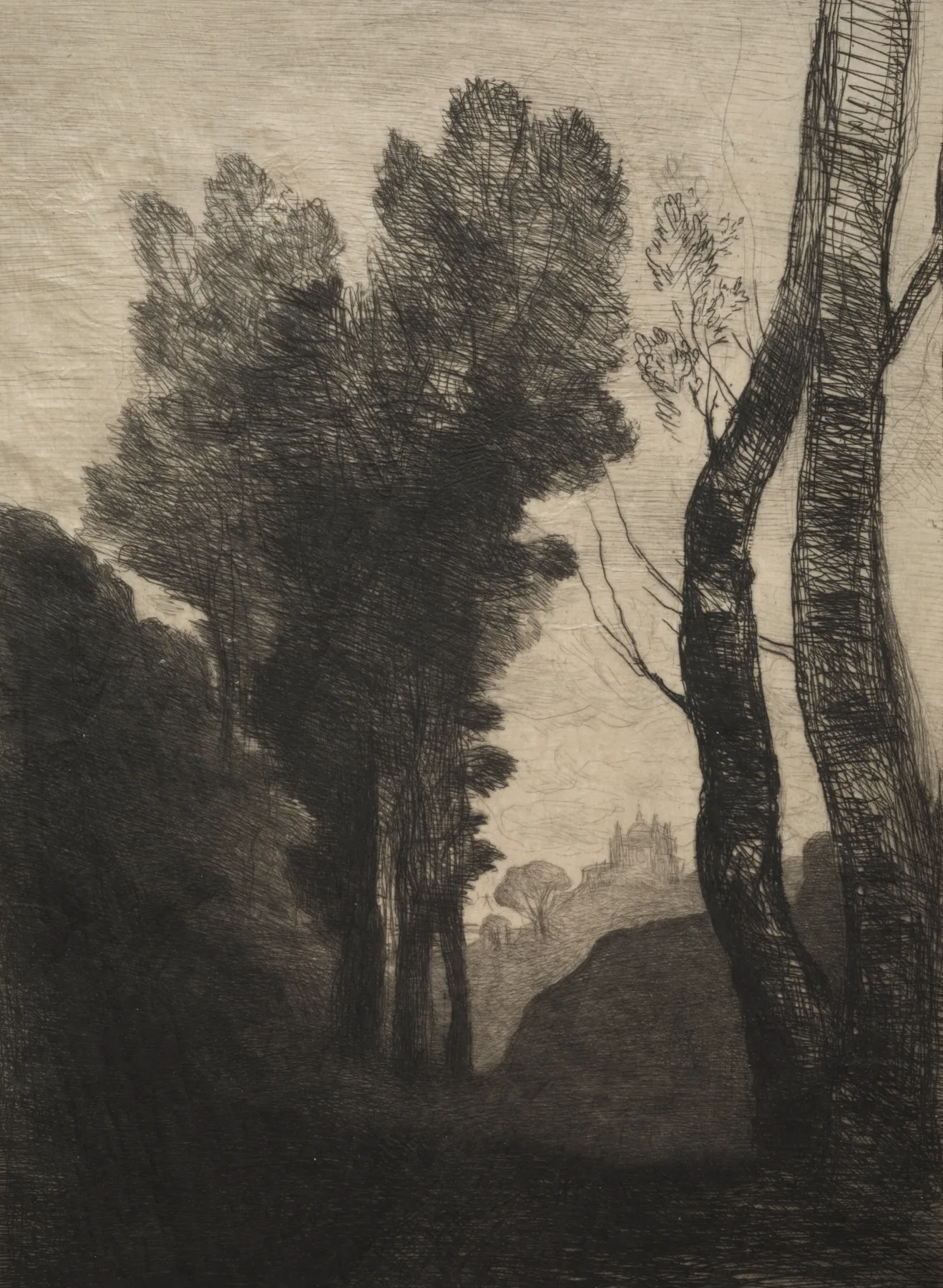
Corot, Environs of Rome, 1866. etching.
Corot, Environs of Rome (etching). Squint: a dark frame of trees and ground, a light sky, a small halftone distance. Three shapes.
The Cleveland Museum of Art · Gift of Frederick Keppel and Co., Inc., The Frederick Keppel Memorial
Pitfalls
What
Starting with detail and hoping a design emerges.
Why
It never does. The values end up scattered evenly and nothing reads.
Fix
Thumbnail first. Three values. Then enlarge the thumbnail, not the subject.