Mass
MassWater as a mirror
Everything reflects straight down from its base. Vertical strokes. Lights a half-step darker, darks a half-step lighter. Then three horizontal ripples to break it.
Still water is a mirror lying flat. Each thing on the bank reflects directly below its base, the same height downward as it stands upward (foreshortened a little if you are above it). The reflection of a light thing is slightly darker than the thing; the reflection of a dark thing is slightly lighter. So the reflected sky is a half-step darker than the sky, which is why water reads as water and not as a hole in the ground.
Draw reflections with vertical strokes, which says liquid, and then break them with a few long horizontal lines left as bare paper, which says surface. Three or four ripples are enough. Edges in a reflection are softer than the edges of the things reflected.
Corot's ponds at Ville-d'Avray are the model: the sky laid flat, a half-step darker, with the grain of the paper left for sparkle and the dark reflections of the trees drawn in soft verticals.
Visuals
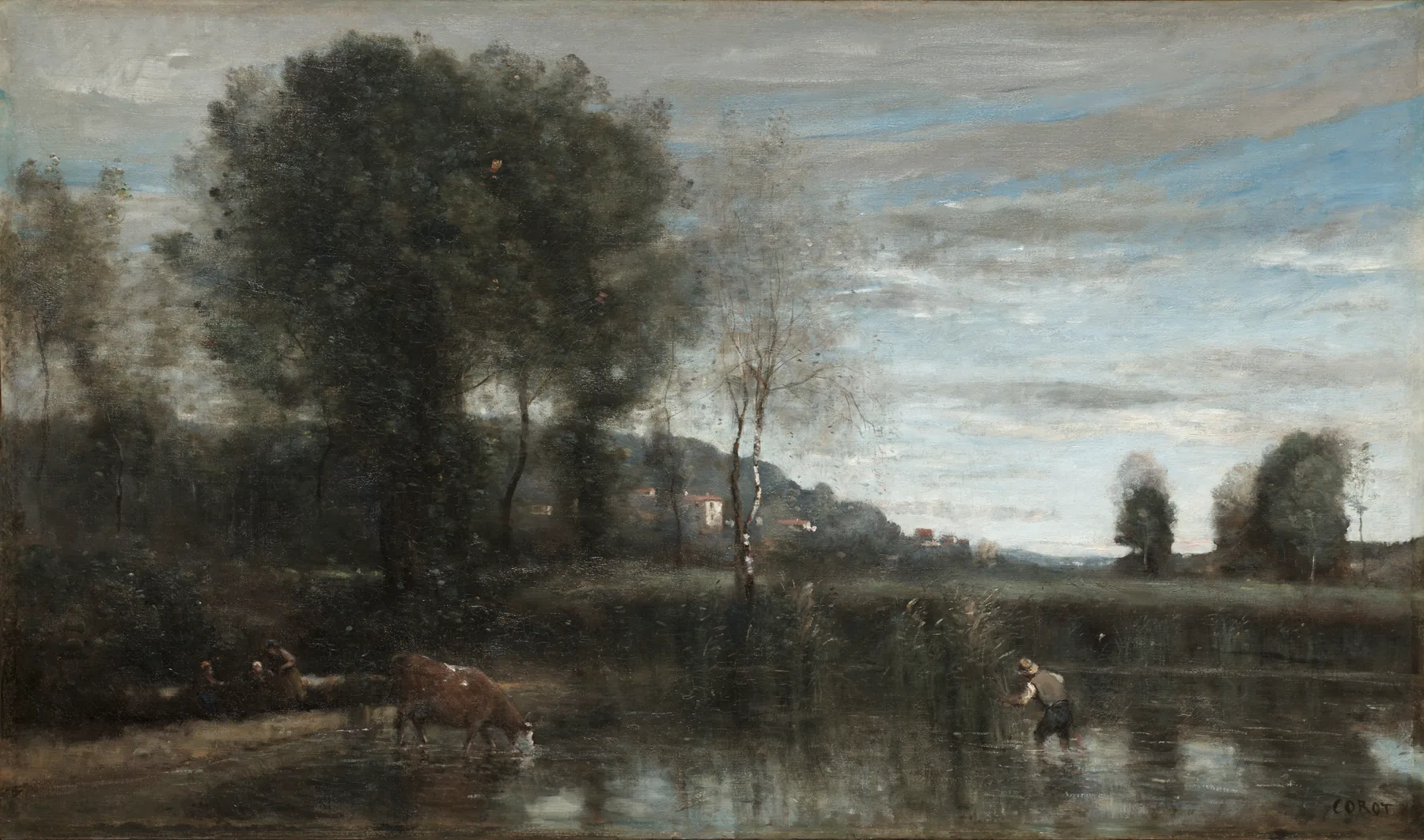
Corot, Pond at Ville-d'Avray, late 1860s. oil on fabric.
Corot, Pond at Ville-d'Avray. The reflected sky is darker than the sky; the reflected trees are lighter than the trees; a few horizontals break the surface.
The Cleveland Museum of Art · Elisabeth Severance Prentiss Collection
Pitfalls
What
Reflections drawn as exact copies of the objects.
Why
The water looks like a second scene upside down, not a surface.
Fix
Soften every edge, compress the values toward the middle, and break with horizontals.