Value
Line + MassHard, soft and lost edges
A hard edge is a cut-out. A soft edge turns. A lost edge is air. Every form needs at least one of each.
Where two values meet there is an edge, and the edge has a character. A hard edge (a crisp line between two values) says the form is sharp, near, in focus and in strong light. A soft edge (a gradual transition) says the form is turning away, or is further off, or is in diffuse light. A lost edge is where two adjacent areas have the same value, so the boundary disappears altogether, and the eye completes it. Lost edges are where a drawing breathes.
A beginner's drawing has hard edges everywhere, which is why it looks like a paper cut-out. Look at Corot's Bent Tree: the trunk is hard against the sky, soft where the foliage turns into shadow, and lost entirely where the ground shadow meets the base. One tree, three kinds of edge.
Use edges to steer the eye. Put the hardest edge at the focal point and soften everything else. Lose at least one edge on every form. In architecture, the sunlit corner of a tower against sky is hard; its shadow side against a shadowed hill should be nearly lost.
Visuals
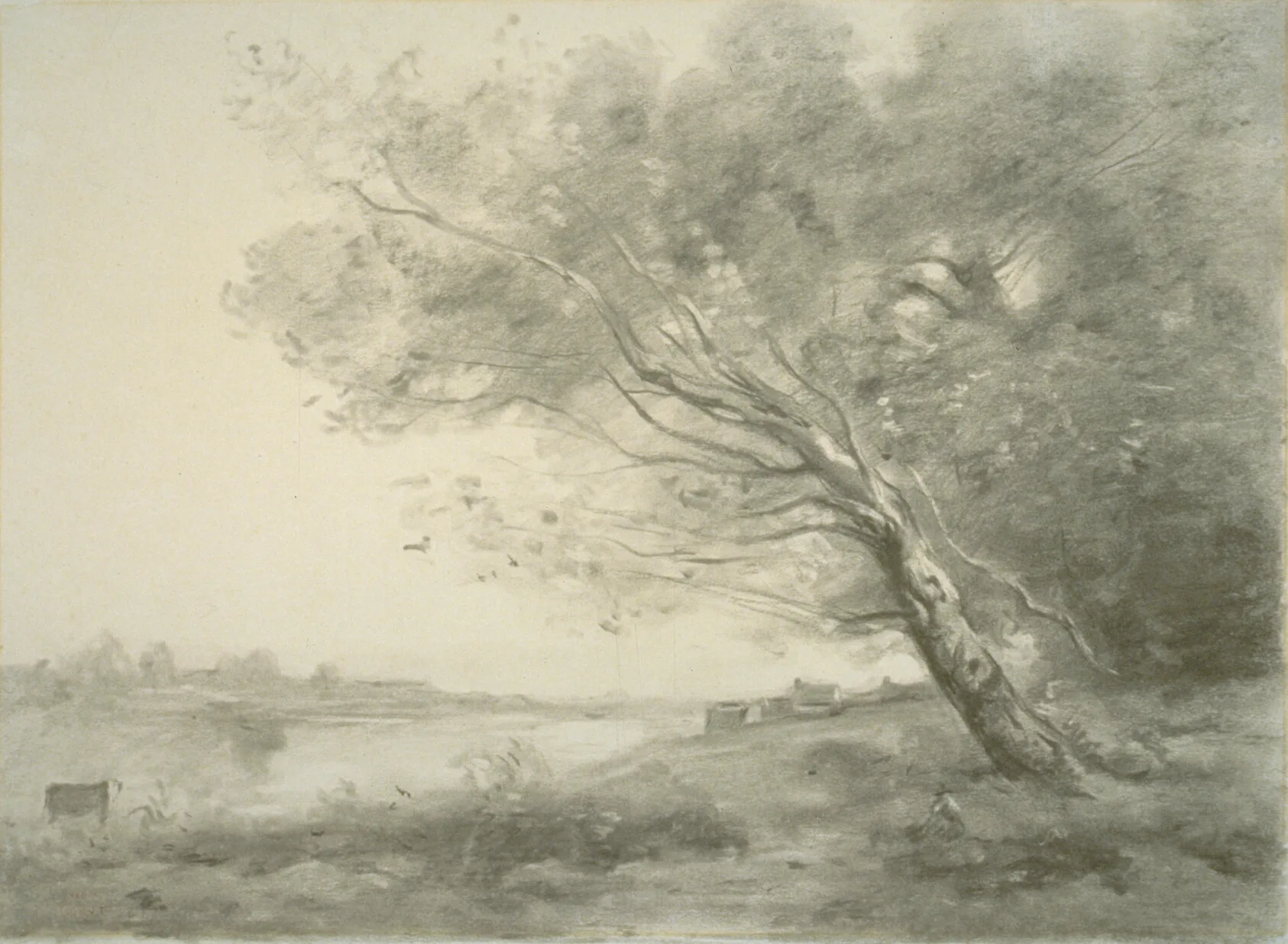
Corot, Bent Tree by the Water, 1860/70. Charcoal, with stumping and erasing, on cream wove paper, laid down on cream board.
Corot, Bent Tree by the Water. Trace the tree's outline with your eye and name each stretch of it: hard, soft or lost.
The Art Institute of Chicago · Harold Joachim Birthday Fund, purchased with funds provided by the Alsdorf Foundation, Mr. and Mrs. William O. Hunt and Frank B. Hubachek
Pitfalls
What
An outline around the whole tree, then tone inside it.
Why
The line forces every edge to be hard.
Fix
Draw the tree as a mass with no outline, then sharpen only the edge against the sky.