Line weight
Line weight
The weighted box
Vary the weight of a contour on purpose to show light, shadow and contact with the ground.
- Master
- David Roberts
- Difficulty
- Time
- about 0.5 h
- You draw with
- HB and 2B, long points
Why this one
- Unit 1 of the program: Instrument Control.
- Four objects whose line alone tells you where the light is and that they sit on a table.
From your kit
The whole kit →- 1Grafwood HB, 2B HB for layout and line; 2B for the darks. Long points from the Blackwing on everything up to B.
- 2Kneaded eraser and the Mono Zero press-and-lift corrections only; the Mono Zero for a single sharp light.
- 3Alpha sketchbook 9 x 6 draw at the book's size and keep the proportions; date the page.
In general, this study asks for
- Drawing pad
- HB and 2B, long points
Watch first
All videos →Shadow shapes as flat masses first. Shown on a portrait, but the principle is identical for a tree or a tower.
YouTube
The plan
4 stages · ~35 min- 1
The dead box
10 minDraw a box in three-quarter view (two sides and the top visible) with the HB, all lines the same weight. Look at it. It floats and it is a diagram.
Checklist0 / 1 - 2
The weighted box
10 minDraw the same box again beside it. Decide the light comes from upper left. Draw the top edges that face the light with the lightest touch, almost broken. Draw the edges on the shadow side with the 2B, firmer. Where the box meets the table, press hardest of all. The box now sits down and has a light on it, and you have not shaded anything.
FigureDead versus weighted. Heaviest at the ground. Checklist0 / 1 - 3
Three more objects
10 minDo the same for a cylinder (a mug without a handle), a cone, and a book lying flat. Each time: light edge lightest, shadow edge firmer, contact heaviest. Then look at the Roberts and find him doing the same on a church.
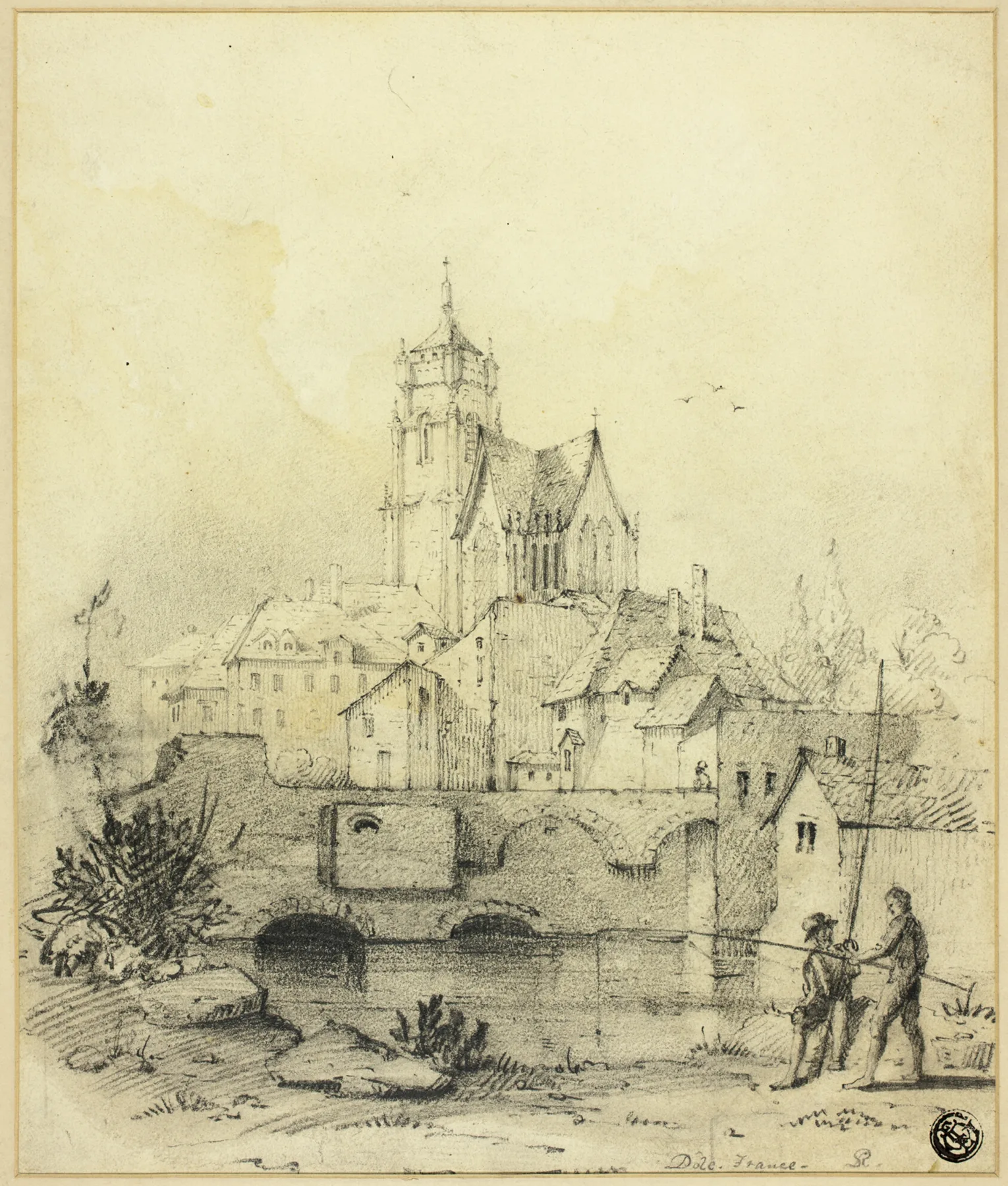
Roberts, Dole, France, n.d.. Graphite and black crayon, on cream wove paper, laid down on tan board.
David Roberts, Dole, France. The outline of the church is lighter on the lit side and heavier at the base and on the shadow side.
The Art Institute of Chicago · The Leonora Hall Gurley Memorial Collection
Checklist0 / 1 - 4
Self-check
5 minTick each item honestly. If one is a no, the session is not finished; go back to that step.
Checklist0 / 2
What it should look like
- Four objects whose line alone tells you where the light is and that they sit on a table.
Where it goes wrong
- Every edge the same weight, but some of them scribbled thicker. Weight was added as a second line rather than built into the stroke. Weight comes from pressure within one stroke. Ghost it, then press more as you reach the shadow side.
Log this session
Start the clock when you pick up the pencil. Stop it when you put it down. Log it. Every session counts toward the box.
Status
How did it go?