49 studies · about 47 hours · 24 weeks at 20 min a day

The full program, in order

All forty-nine sessions of the original course, unit by unit. The long road.
  1. 1
    The same landscape reduced to two values, three values and four values, showing that the design is readable at two and complete at four2 VALUESThe design. If thisfails, nothing saves it.3 VALUESCorot's working number.4 VALUESFinished. More steps addpolish, not strength.Notan: the arrangement of light and dark, Japanese for "light-dark".Squint until the scene collapses to three flat shapes. Draw those first.Every lesson in the Mass unit starts here.A drawing with a good two-value design and bad details beats one with perfect details and no design.

    Foundation · Corot

    How this program works

    A session format, a box of drawings, and the twenty-minute rule

  2. 2
    Nine pencil grades from 4H to 8B with the darkest value each can makeHARD · LIGHT · THINSOFT · DARK · FAT4Hlayout2HlightHcontourHBgeneralBgeneral2Bshadow4Bdark6Bdarkest8BblackH = hard. The higher the number, the lighter and finer. B = black. The higher the number, the darker andsofter.

    Foundation · Corot

    Your kit and your set-up

    The Grafwood row, the Blackwing point, the kneaded eraser, a board, and a light from the left

  3. 3
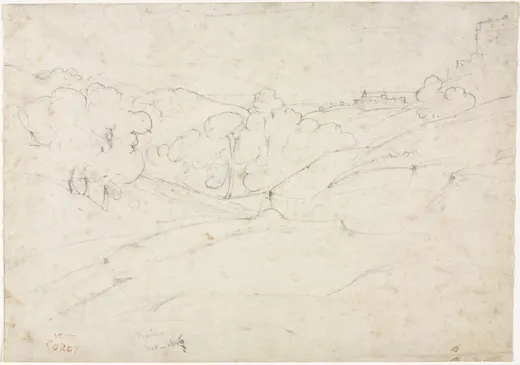
    View of Marino (recto)

    Foundation · Corot

    Meet the two hands

    A looking session: six drawings, no pencil

  4. 4
    The nine-step value scale from white paper to the darkest dark, with a pencil suggestion for each stepTHE NINE-STEP SCALE1paper24H32H4HB5B62B74B86B98BLIGHTS 1 to 3HALFTONES 4 to 6DARKS 7 to 9Most of a Corot lives between 2 and 6. Most of an etching lives between 1, 5 and 8.Beginners use 1 to 4 and wonder why everything looks washed out. Reach 8 and 9 on purpose.

    Foundation · Corot

    The first page

    A value scale and an honest baseline drawing to keep forever

  5. 5
    Ghosting: the pencil rehearses the line in the air several times, then lands once, moving from the shoulderGHOSTING A STRAIGHT LINEstart dotend dotrehearse 3 to 4 times without touchingWRONG · WRIST PIVOT CURVES ITRIGHT · SHOULDER, LOCKED WRISTLook at the end dot, not the pencil point. The hand goes where the eye is.

    Foundation · Corot

    Lines from the shoulder

    Ghosting, straight lines, and parallel sets

  6. 6
    Line weight: the same box drawn with uniform line and with weighted line, heavier on the shadow side and where forms touch the groundUNIFORM LINE (DEAD)WEIGHTED LINE (ALIVE)heaviest where it meets thegroundlighteston the littop edgeA line's weight tells the eye which edge is in light, which turns away, and what is heavy. Vary it on purpose.

    Foundation · Roberts

    Line weight

    The weighted box

  7. 7
    A single continuous band that goes from almost nothing to full dark using pressure alonePRESSURE RAMP · ONE 2B, SIDE OF THE LEADfeather touchfull weight of the handincrease pressure smoothly, never in stepsDo ten of these a day for a week and your hand learns to dial tone like a volume knob.

    Foundation · Corot

    The pressure ramp and layering

    Dialling tone like a volume knob, and why layers beat force

  8. 8
    An even field of tone compared with a streaky one, with the stroke pattern that produces eachWRONG · ROWS AND HARD STOPSRIGHT · OVERLAPPED, FEATHEREDrows with gaps, pencil stopsdeadfeathered ends, each passoverlaps the last by halfLift the pencil as it leaves the paper, like a plane taking off. Hard stops make dark ends.

    Foundation · Piranesi

    Flat tone and the smooth gradient

    A square that looks like grey paper, and a ramp built from layers

  9. 9
    The nine-step value scale from white paper to the darkest dark, with a pencil suggestion for each stepTHE NINE-STEP SCALE1paper24H32H4HB5B62B74B86B98BLIGHTS 1 to 3HALFTONES 4 to 6DARKS 7 to 9Most of a Corot lives between 2 and 6. Most of an etching lives between 1, 5 and 8.Beginners use 1 to 4 and wonder why everything looks washed out. Reach 8 and 9 on purpose.

    Foundation · Corot

    The nine-step scale, properly

    Rebuild the scale with everything you now know, and learn to name values aloud

  10. 10
    Six families of mark: parallel hatch, cross-hatch, contour hatch, scumble, stipple, and the broken lineParallelCross-hatchContour hatchScumble (circular)StippleBroken / wiryCorot: scumble and contour hatch for foliage. The etchers: parallel and cross-hatch for stone. All six live inone drawing.

    Foundation · Corot

    The six marks

    A sampler sheet of every hatch family

  11. 11
    Four swatches of identical line weight whose spacing closes from wide to tight, producing four steps of valueSAME PENCIL AND PRESSURE · ONLY SPACING CHANGESvalue 2value 4value 6value 8Value by spacing is how an etcher thinks. Half-close your eyes: the lines disappear and only the tone remains.

    Foundation · Meryon

    Value from spacing

    The etcher's four swatches, and a cube in counted layers

  12. 12
    Sighting an angle: a pencil held at arm's length is tilted to match a roofline, then the tilt is carried to the paper and compared against a horizontal1 · MATCH THE PENCIL TO THE EDGEarm straight, elbow locked, one eye closed2 · CARRY THE TILT TO THE PAGE≈ 29°compare to level, not to the previous lineMeasure against the two things that never lie: plumb and level.Ask "how far off vertical?" or "how far off horizontal?", never "what angle is it?"Nine out of ten wrong buildings are wrong because an angle was guessed. Sight it.

    Foundation · Cotman

    Sighting angles

    A pencil at arm's length, a door frame, a roofline

  13. 13
    Comparative measurement: thumb on the pencil marks the tower's width, then that unit is counted up its heightPICK A UNIT, THEN COUNT IT1 unit = width2.8 units tallthumb slides on the pencil to markthe unitThe arm must be straight every time or the unit changes. Lock the elbow. Same eye.Nobody can judge "how tall". Everybody can count "how many of these".

    Foundation · Corot

    Comparative measurement

    A mug, a chair, a window: how many of these is that?

  14. 14
    Plumb and level lines dropped through a scene reveal what lines up with what: the tower corner falls on the gate post, the eave aligns with the far hilltower corner sits over the postbarn ridge is plumbunder the chimney?no: offsetbarn eave level with tower windowboth bases on one levelHold the pencil truly vertical or truly horizontal at arm's length and read what itcrosses.Alignments are free accuracy. Find three before you draw a single detail.

    Foundation · Roberts

    Plumb, level and alignments

    What is over what, what is level with what

  15. 15
    Negative shapes: the sky gaps between branches are drawn as shapes, which places the branches more accurately than drawing the branches themselvesTHE BRANCHES (POSITIVE)THE SKY BETWEEN (NEGATIVE)Your brain has a symbol for "branch" and it will draw the symbol. It has no symbolfor the gap. So it looks.Prout and Cotman placed every pinnacle by the shape of sky beside it. Draw the holes.

    Foundation · Prout

    Negative shapes

    A chair by its gaps, a winter tree by its sky

  16. 16
    Blocking in: a church is first enclosed in a simple envelope of five straight lines, then subdivided into big masses, and only then given its details1 · ENVELOPE2 · BIG MASSES3 · DETAIL LASTSpend half your time on stage one. If the envelope is right, nothing after it can gobadly wrong.Beginners start at the window. Masters start at the envelope.

    Foundation · Girtin

    Envelope, masses, detail

    A simple building in three stages, half the time on the first

  17. 17
    Light on a sphere and a cube from the upper left: highlight, light, halftone, core shadow, reflected light and cast shadow, labelledhighlightlighthalftone (the turn)core shadow (darkest on theform)reflected light (never aslight as the lit side)cast shadow (darkest at thecontact)top planelightestfront: halftoneside: shadowEvery building is cubes, every tree is spheres. Decide where the light is before the first mark.

    Foundation · Cotman

    Light on form

    A sphere and a cube under one lamp

  18. 18
    The same landscape reduced to two values, three values and four values, showing that the design is readable at two and complete at four2 VALUESThe design. If thisfails, nothing saves it.3 VALUESCorot's working number.4 VALUESFinished. More steps addpolish, not strength.Notan: the arrangement of light and dark, Japanese for "light-dark".Squint until the scene collapses to three flat shapes. Draw those first.Every lesson in the Mass unit starts here.A drawing with a good two-value design and bad details beats one with perfect details and no design.

    Foundation · Corot

    Squint and notan

    Three thumbnails from Corot, three from your window

  19. 19
    Corot's three divisions of light: a landscape divided into foreground with the darkest darks and strongest contrast, a midground of halftones, and a background of pale, close valuesSKY · 1FAR · 2 to 3MID · 4 to 6NEAR · 6 to 9FAR: narrow, pale, softMID: medium rangeNEAR: full range, sharpestEach zone has its own quality of light. The far zone never borrows a dark from the near zone.

    Foundation · Corot

    The three divisions of light

    Copy the structure of Bent Tree by the Water, then build your own

  20. 20
    Aerial perspective: five overlapping hills, each lighter, bluer-feeling, lower in contrast and softer-edged than the one in front of itnearestfarthestvalue range shrinks with distanceAir is a veil. Each mile adds a layer. Distance is drawn with a lighter pencil, not with smaller detail.

    Foundation · Roberts

    Aerial perspective

    Five hills, then a real distance

  21. 21
    The order of values in daylight: the sky lightest, then the flat ground that faces it, then upright planes, then undersides and cast shadows1 · sky2 · roof (tilted to sky)3 · flat ground4 · lit wall6 · shadow wall7 · cast shadow9 · open doorwayA plane's value depends on how squarely it faces the light. The sky is the light.Flat planes face it: light. Uprights glance it: mid. Undersides turn away: dark.If your ground is darker than your walls on a sunny day, the drawing will feel wrong and you will not know why.

    Foundation · Corot

    The order of values in daylight

    A simple building in sun: sky, ground, wall, shadow, void

  22. 22
    Four stages of a tree: the whole silhouette, then three to five big clumps, then a light side and shadow side on each clump, then leaf texture only along edges1 · SILHOUETTE2 · CLUMPS3 · LIGHT/SHADOW4 · EDGE MARKSEach clump is a sphere with its own light side, shadow side and cast shadow onto theclump below.Never draw a leaf. Draw masses that catch light, then let the edges say "leaves".

    Foundation · Prout

    A tree from masses

    Copy Prout's tree study, then draw a real tree the same way

  23. 23
    Corot's branch logic: a trunk that tapers, branches that change direction at every fork in a zig-zag, and limbs that disappear into the foliage clumps instead of ending in airWRONG · LOLLIPOP, ENDS IN AIRsame width top to bottom, straight limbsRIGHT · TAPERS, ZIG-ZAGS, DIVES INchangesdirection atevery forkvanishes into the massWork from the ground UP, the way the tree grew. Each fork: thinner, and a newdirection.Corot drew the branches zig-zagging upward and disappearing into the leaves. Not one of them ends in open air.

    Foundation · Corot

    Branch logic and sky holes

    A winter tree from the ground up, then a summer tree that breathes

  24. 24
    Still water as a mirror: reflections drawn with vertical strokes, a half-step darker than what they reflect, and broken by a few horizontal ripple lineswater linesky: value 1sky's reflection: value 2 (darker)Everything reflects straight down from its base. Vertical strokes. Lights darker,darks lighter. Then break it with three horizontals.Corot's ponds are the sky laid flat, a half-step darker, with the grain of the paper left for sparkle.

    Foundation · Corot

    Water and ground

    A pond after Ville-d'Avray, and a ground plane that recedes

  25. 25
    A foliage mass against sky and a distant hill, labelled where its edge is hard, soft, and lostHARDcrisp against the bright skySOFTblurred where the form turnsLOSTsame value as the ground: the edge disappearsA drawing with only hard edges is a cut-out. Lose at least one edge on every form.

    Foundation · Corot

    Charcoal: The Large Tree, and the souvenir

    A master copy in Corot's own late medium, then a drawing from memory

  26. 26
    Eye level: a standing viewer, the horizon line at the height of their eye, with things above it showing their undersides and things below showing their topsEYE LEVEL = HORIZONabove eye level:you see its undersidebelow eye level:you see its topstraddles: no top, no undersideSit down and the horizon drops. Climb a hill and it rises. It is always exactly atyour eye.Draw the eye-level line first on every architectural page. Faintly. Everything hangs from it.

    Foundation · Meryon

    Eye level and one-point perspective

    Your hallway, then a street

  27. 27
    Two-point perspective of a building corner: the near vertical edge is tallest, each face recedes to its own vanishing point far off the page on the eye-level lineto VP left,off the pageto VP right,off the pagenearest edge: tallest, darkestUse it when you see a corner. The two VPs are usually FAR apart, often both off thepaper. That is normal.If both VPs fit on your page, your building will look like a toy seen through a fish-eye lens.

    Foundation · Cotman

    Two-point perspective

    A building seen at its corner

  28. 28
    Estimating convergence when the vanishing point is off the page: measure the near and far heights, divide both into the same number of parts, and connect the matching marksnear edge, 4 partsfar edge, 4partswindow heads, string courses, sills: all sit on these linesSight the top edge and bottom edge with the pencil (the real angles). Everythingbetween is interpolated.You never need the vanishing point. You need two true edges and a ruler for the rest.

    Foundation · Pennell

    Convergence off the page and dividing bays

    A terrace of windows that shrinks correctly

  29. 29
    The same old stone wall drawn with ruler-straight continuous lines, which looks like new concrete, and with Prout's broken wiry line, which looks like weathered stoneCONTINUOUS · READS AS NEWBROKEN · READS AS OLDLift the pencil mid-line. Let the line wobble, thicken, vanish and return. Suggesttwo stones per course, not twelve.Prout taught a generation that a broken line draws age. It is the most imitated trick in British architecturaldrawing.

    Foundation · Prout

    The broken line

    Copy a Prout wall, then draw an old wall near you

  30. 30
    The etcher's value scale: five steps from white paper to near-black made only with line, first parallel hatch, then a second layer crossing, then a third, then a fourthVALUE FROM LINE ONLY · HOW AN ETCHING THINKSpaperlight1 layerlight halftone2 layershalftone3 layersshadow4 layersdarkEach layer crosses the last at a new angle. Keep spacing even within a layer. Letthe line weight stay constant.Meryon, Cotman, Forrest: every shadow is counted in layers. This is the discipline the Line unit builds.

    Foundation · Meryon

    Tone from line

    A doorway in counted layers

  31. 31
    A round arch seen head-on as a semicircle, then seen obliquely as half an ellipse inside a foreshortened square, with the keystone staying at the top of the centre lineHEAD ONcentre on the springing lineOBLIQUE · SAME ARCHapex moves toward the near sidefar half is narrowerDraw the perspective square first, then fit the curve inside it. Never draw thecurve freehand from memory.Cotman's Rievaulx arches and Meryon's bridge are ellipses that know which square they live in.

    Foundation · Meryon

    The arch in perspective

    Bridge arches after Meryon

  32. 32
    View of Marino (recto)

    Foundation · Corot

    The young Corot: contour and economy

    A master copy of View of Marino

  33. 33
    Constructing an equilateral pointed arch: two arcs, each with its centre at the opposite springing point and a radius equal to the span, meeting at the apex; plus lancet and drop variantsEQUILATERAL ARCH · RADIUS = SPANspringing linecentre Bcentre Aapexr = spanVARIANTSlancet: r >spandrop: r <spanCompass on paper, thumb-and-pencil in the field. Mark the two centres, swing twoarcs, done.Melrose, Dryburgh, Rievaulx: once you can strike this arch you can draw any abbey in Britain.

    Foundation · Cotman

    The pointed arch

    Three constructions, then a window from Cley Church

  34. 34
    A semicircular Romanesque arch with its centre on the springing line, radiating voussoirs and a keystone, over an impost and a pierROUND ARCH · CENTRE ON THE SPRINGING LINEcentrekeystonevoussoirs radiate fromthe centreimpostEvery joint in the arch points at the centre. Draw three joints that do, and the eye believes the rest.

    Foundation · Cotman

    The round arch and the tower

    A master copy of Cotman's Haute Allemagne tower

  35. 35
    A two-light Gothic window built from geometry: the main pointed arch, a central mullion, two smaller pointed heads, and a circle in the spandrel that becomes a quatrefoilTWO-LIGHT WINDOW · CIRCLES AND ARCScircle in the spandrelbecomes a quatrefoilsub-arches: half the spanmullionTracery is geometry you can reconstruct, not lace you must copy. Find the circles.Cotman's Cley Church: every window head is a compass construction drawn freehand.

    Foundation · Cotman

    Tracery

    A two-light window from geometry, then the east window of Cley

  36. 36
    A string course moulding in section and in elevation under light from the upper left: a bright top fillet, a soft halftone on the curve, a dark underside and a cast shadow on the wall belowSECTIONlightwallELEVATION · WHAT YOU DRAWtop fillet: papercurve: halftoneunderside: 8cast shadow: 6A moulding is four horizontal bands of value. Get the bands right and the stoneturns.The darkest line on any building is the underside of a projecting course. Save your 8B for it.

    Foundation · Meryon

    Mouldings and cast shadows

    A cornice in four bands, and a buttress that casts

  37. 37
    Stone wall: on the left every stone is outlined and the wall looks like a net; on the right only the courses run through, a few stones are suggested near the edges and the eye, and tone carries the restWRONG · EVERY STONE DRAWNRIGHT · COURSES, STONES SUGGESTEDDraw the horizontal courses as broken lines. Add vertical joints only near openings,corners and the bottom. Let tone do the middle.Cotman's Haute Allemagne tower: hundreds of stones implied, perhaps forty actually drawn.

    Foundation · Cotman

    Masonry coursing

    A wall passage after Cotman, then a real wall

  38. 38
    A pitched slate roof in perspective: rows converge toward the vanishing point, the near rows show individual slates and the far rows dissolve into tonenear eave: slatesdrawnridge: tone onlyA roof is a tilted plane: light if it faces the sky, with its texture fading as itrecedes.Count your drawn slates. More than two rows is a texture, more than four is a mistake.

    Foundation · Prout

    Roofs and windows

    A farmhouse: tilted planes and holes in thick walls

  39. 39
    A ruined abbey wall read as silhouette: one big stable mass, an irregular broken skyline, dark window voids, and vegetation softening the lower edgebrokenskylinegrowthsky behindwall behindA ruin is one mass with its top bitten off. Some voids show sky, some show darkwall. Never all the same.Cotman's Normandy castle, Prout's Norham, Forrest's Dryburgh: the skyline does the storytelling.

    Foundation · Cotman

    The ruin

    A master copy of A Castle in Normandy, then the structure of Rievaulx

  40. 40
    The same doorway drawn without and with a small figure; the figure's head sits on the eye-level line, which fixes the scale of everythingNO FIGURE · ANY SIZEWITH A FIGURE · A CATHEDRAL DOOReye levelStanding on the same ground as you, every adult's head is on your eye level, near orfar. Only the feet move.Prout dropped two or three figures into every street. They are rulers, not people.

    Foundation · Prout

    The street with figures

    Prout's Ulm: eye level, bays, broken line, and rulers that look like people

  41. 41
    Format and horizon: a landscape format with a low horizon for a big sky, a landscape format with a high horizon for a big ground, and a portrait format for a tall subject; never the horizon in the centreLOW HORIZON · SKYHIGH HORIZON · GROUNDPORTRAIT · TALL SUBJECTCENTRED · CUT IN HALFDecide what the picture is ABOUT.Sky? Horizon low. Ground and buildings? Horizon high.One tall thing? Turn the paper.The first decision on every page is where the horizon goes. Make it before the first mark.

    Foundation · Girtin

    Format, horizon and the viewfinder

    Deciding what the picture is about before the first mark

  42. 42
    The same scene with values scattered like confetti, which reads as noise, next to values grouped into three big connected shapes, which reads as a pictureSCATTERED · CONFETTIGROUPED · THREE BIG SHAPESLink your darks into one shape. Link your lights into one shape. Let a mid valuehold them apart.Corot's trees, ground shadow and foreground are one dark. That is why his pictures feel calm.

    Foundation · Cotman

    Thumbnails and value grouping

    Three arrangements, one winner, and the lie that makes a picture

  43. 43
    A landscape where the focal point, a tower, has the strongest contrast, the sharpest edges and the only fine detail, while everything else is softer and closer in valuehere only: 1 beside 9,sharpest edge, onlydetaileverywhere else: softer edges,narrower value range, no detailThe eye goes where contrast, sharpness and detail coincide. Allow that to happen inexactly one place.Spend your darkest dark and your whitest white together, once, on purpose.

    Foundation · Meryon

    Focal hierarchy and edges

    One place where everything coincides

  44. 44
    Corot's framing device: dark foreground trees on both sides and a dark ground close the picture around a small, pale, distant view in the centrethe picture inside the pictureDark frame, light centre. The eye is funnelled to the distance and stays there.Corot's "Environs of Rome" and his late souvenirs use this frame again and again.

    Foundation · Corot

    The framing device

    Dark frame, light centre, after Environs of Rome

  45. 45
    Depth built from overlapping planes: five layers from foreground to sky, each overlapping the one behind, each lighter and softer, with sizes shrinking5 · sky4 · far hills3 · middle2 · near field1 · foregroundOverlap is the strongest depth cue there is. Make each plane clearly in front of thenext, then grade the values.Five planes is a landscape. Two is a backdrop.

    Foundation · Roberts

    The depth stack

    Five overlapping planes, after Roberts

  46. 46
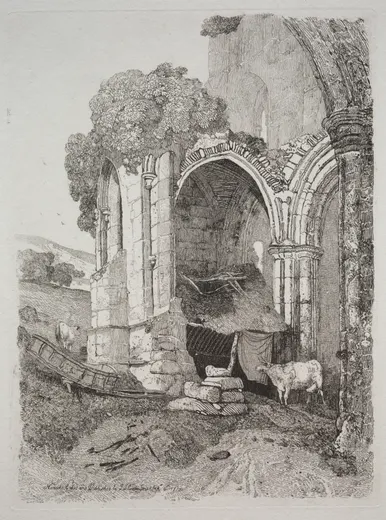
    Rievaulx Abbey, Yorkshire

    Capstone · Cotman

    Master copy I: Line

    Cotman's Rievaulx Abbey, in full

  47. 47
    A foliage mass against sky and a distant hill, labelled where its edge is hard, soft, and lostHARDcrisp against the bright skySOFTblurred where the form turnsLOSTsame value as the ground: the edge disappearsA drawing with only hard edges is a cut-out. Lose at least one edge on every form.

    Capstone · Corot

    Master copy II: Mass

    Corot's Bent Tree by the Water, in charcoal, in full

  48. 48
    Corot's three divisions of light: a landscape divided into foreground with the darkest darks and strongest contrast, a midground of halftones, and a background of pale, close valuesSKY · 1FAR · 2 to 3MID · 4 to 6NEAR · 6 to 9FAR: narrow, pale, softMID: medium rangeNEAR: full range, sharpestEach zone has its own quality of light. The far zone never borrows a dark from the near zone.

    Capstone · Corot

    Fusion: the abbey in morning air

    A Gothic ruin drawn with the draughtsman's accuracy, standing inside Corot's three divisions

  49. 49
    The souvenir method: look for three minutes, turn the back to the subject, draw from memory for ten, compare for one, repeatLOOK3 minSquint. Name the 3masses. Find thelightest and thedarkest.TURNBack to the subject.No peeking.DRAW10 minOnly what youremember. Massesfirst.COMPARE1 minTurn round. Say aloudwhat went wrong.Repeat three times. The third drawing is always the best, and it is yours.Corot titled his late landscapes Souvenir because they were drawn from memory.Memory keeps the masses and the mood and drops the clutter. That is what you want.The best filter for detail is forgetting it.

    Capstone · Corot

    The souvenir, and the review of the box

    Your fusion subject from memory, then every drawing on the floor