Composition
Line + MassThe depth stack
Five overlapping planes from foreground to sky, each clearly in front of the next, each lighter and softer. Overlap is the strongest depth cue there is.
The surest way to make space in a landscape is to stack overlapping planes: a foreground shape that overlaps a near-field shape that overlaps a middle-distance shape that overlaps the far hills that overlap the sky. Overlap alone tells the eye which is in front. Then grade the values (aerial perspective) and the sizes (perspective) and the space is undeniable.
Five planes is a landscape; two is a backdrop. When you choose a viewpoint, look for one that gives you overlaps: a bush in front of the wall, the wall in front of the trees, the trees in front of the hill. Move your feet until you have them.
Make each overlap clear. A tree that just touches the edge of a building is ambiguous; a tree that clearly covers part of it is in front of it.
Visuals
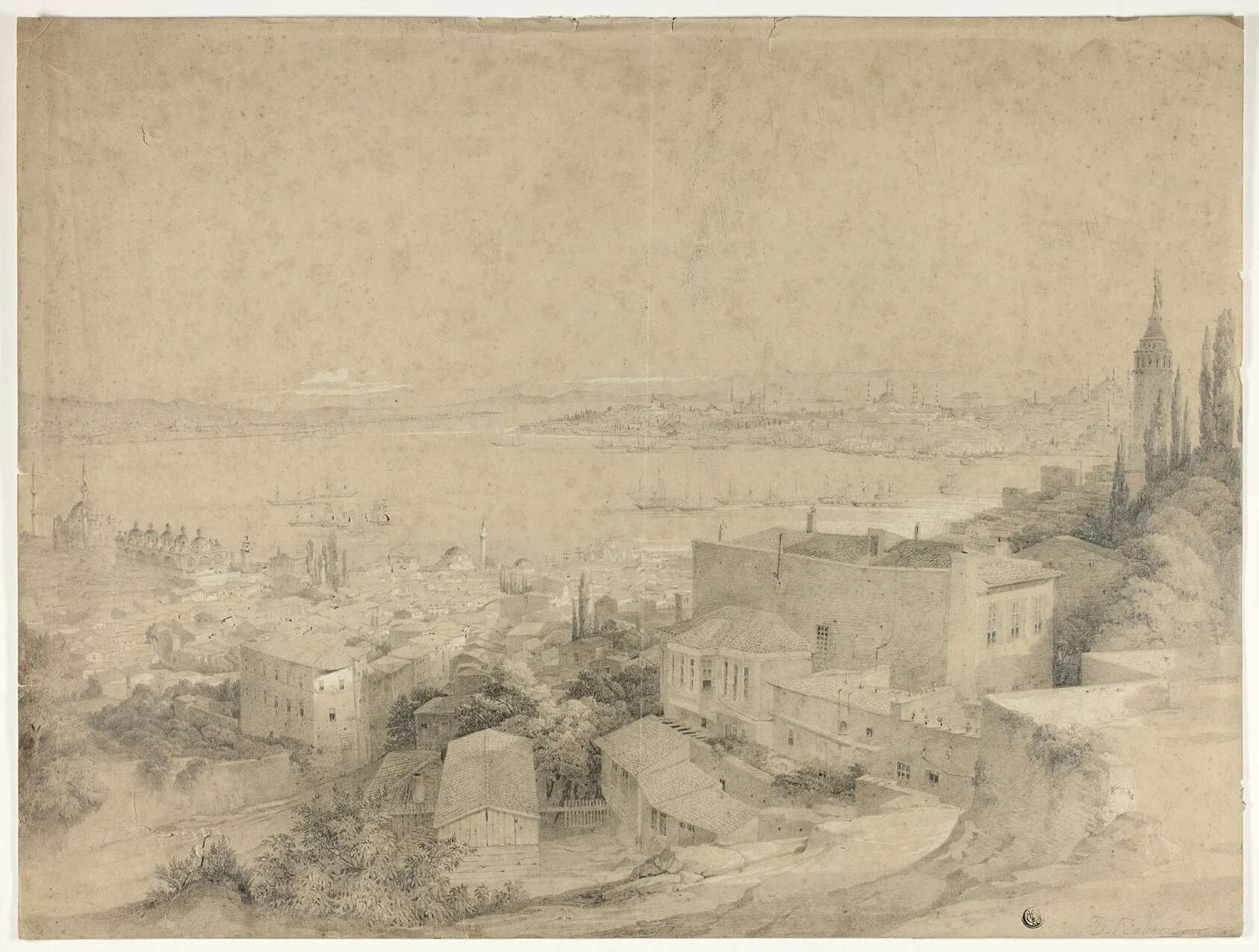
Roberts, Constantinople, n.d.. Graphite, heightened with lead white, on tan wove paper.
David Roberts, Constantinople. Foreground trees and walls, then houses, then the city, then the water, then the far shore: a stack of overlapping planes going back in value.
The Art Institute of Chicago · The Leonora Hall Gurley Memorial Collection
Pitfalls
What
Planes that touch edge to edge without overlapping.
Why
The eye cannot tell which is in front, and the picture flattens.
Fix
Shift something so that it clearly covers part of the plane behind it.