Mass
MassAerial perspective
Air is a veil. With every mile, things get lighter, lower in contrast and softer-edged. Distance is drawn with a lighter pencil, not smaller detail.
Between you and a far hill there are miles of air, and air is not transparent. It scatters light into the shadows (so darks get lighter), it drains contrast (so the range of values narrows), and it blurs edges. The further away a thing is, the more it tends toward the value of the sky. This is aerial perspective, and it is the mass drawer's main tool for depth.
Draw a row of five overlapping hills. The nearest gets the full range and crisp edges. Each hill behind gets a lighter dark, a narrower range and a softer edge, until the last is barely a value darker than the sky. Nothing else is needed to make the eye travel five miles.
Beginners try to make distance by drawing far things smaller and with less detail, which helps a little. But a far hill drawn small and dark comes forward; a far hill drawn large and pale stays back. Value does the work.
From your kit
The whole kit →- 1Grafwood 2H, HB, 2B, 4B one grade per depth plane: far 2H, middle HB and 2B, near 4B. The grade does the air.
- 2Kneaded eraser to push the far plane back if it darkens.
Visuals
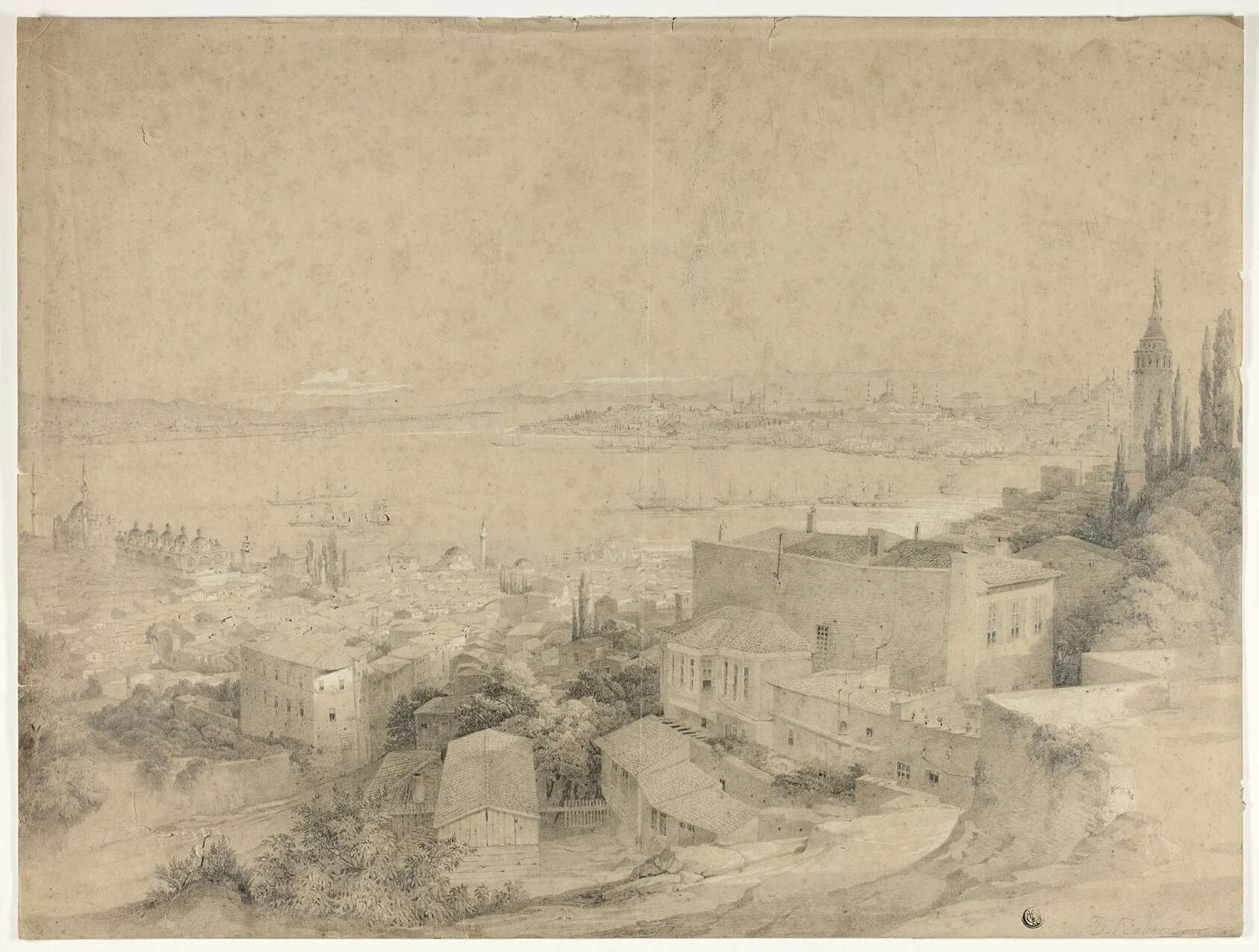
Roberts, Constantinople, n.d.. Graphite, heightened with lead white, on tan wove paper.
David Roberts, Constantinople (graphite with white on tan paper). A whole city going back in steps of value until the far shore is a breath on the paper.
The Art Institute of Chicago · The Leonora Hall Gurley Memorial Collection
Pitfalls
What
Sharp edges on the far hills.
Why
Edges are a distance cue; sharp means near.
Fix
Soften the far edges with a lighter touch or a single pass of the side of the pencil.