Building a tree from masses
Silhouette first, then three to five big clumps, then a light side and a shadow side on each clump, then leaf texture at the edges only. Never draw a leaf.
A tree is not ten thousand leaves. It is a silhouette made of a few big clumps of foliage, each clump a rough sphere with its own light side, shadow side and cast shadow onto the clump below it. Draw it in that order. First the overall silhouette, lightly, as one lobed shape with the trunk's position marked. Then divide it into three to five clumps, overlapping, bigger toward the centre of the canopy and smaller at the edges. Then give each clump a lit top and a shadowed underside, letting the lower clumps go darker because the ones above shade them. Only then, and only along the outer edges, suggest leaves with a broken, scribbled contour.
Corot's trees are the model. Look at The Large Tree: a single dark mass, lit along the top, with the lights lifted out and the branches zig-zagging up inside it. There is not one leaf drawn. Prout's tree study in the Cleveland sketchbook shows the same method in pencil: clumps, scribbled edges, a trunk.
Keep the interior of each clump as flat tone. Texture inside a mass flattens it and kills the light. The eye reads texture at the edge and assumes it continues.
From your kit
The whole kit →- 1Pitt Matt 6B and 10B, on their sides clumps first as flat masses.
- 2Mono Zero the sky holes near the edge of the canopy.
- 3Grafwood 4B, long point trunk and branch logic drawn into the mass.
Visuals
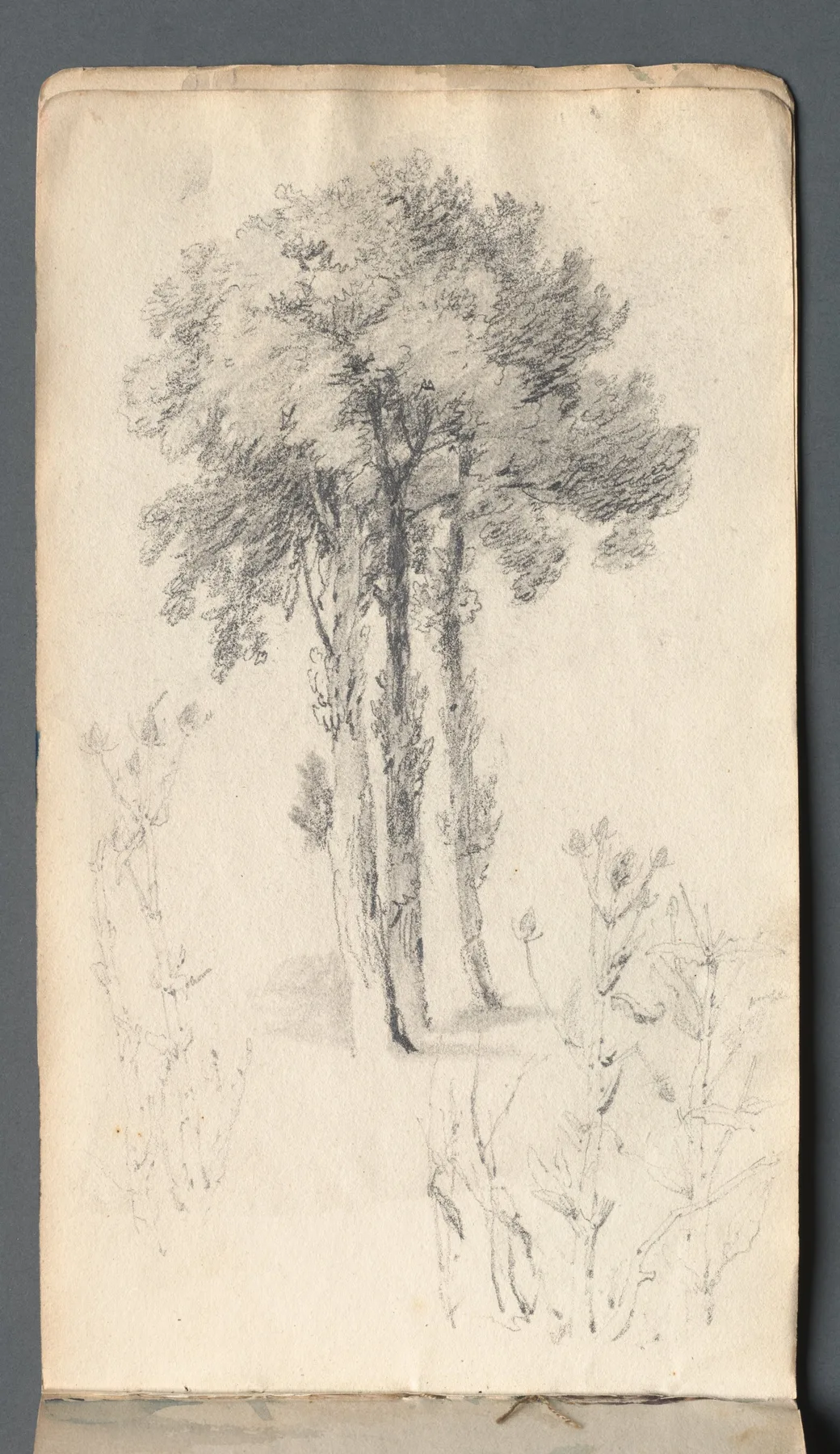
Prout, Sketchbook: Tree Study, 1814. graphite.
Prout, Sketchbook: Tree Study (1814, graphite). Clumps, a scribbled edge, a firm trunk, the interior left as tone.
The Cleveland Museum of Art · Gift of Mr. and Mrs. Herbert N. Bier, London
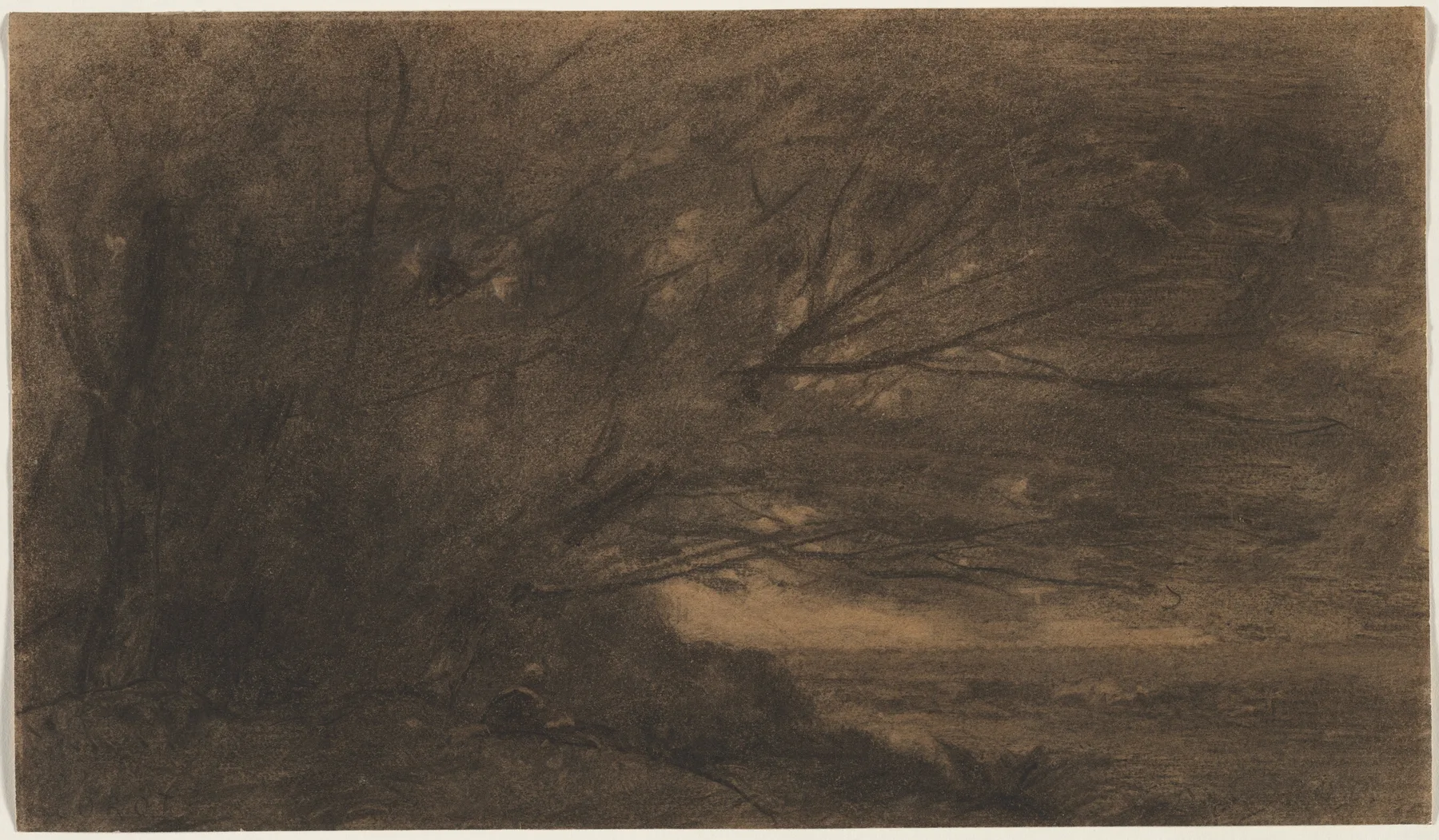
Corot, Landscape (The Large Tree), c. 1865–70. charcoal with stumping, erasing, and wet brushwork on light brown wove paper.
Corot, Landscape (The Large Tree). The whole canopy is one mass; the lights are lifted, not left.
The Cleveland Museum of Art · Bequest of Muriel Butkin
Pitfalls
What
Scribbled texture across the whole canopy.
Why
The tree becomes a flat patch of noise with no light on it.
Fix
Erase back to clumps. Texture only on the outer edges of the lit clumps.
What
A round lollipop silhouette.
Why
Real canopies are lobed, asymmetrical and have gaps.
Fix
Draw the silhouette by its negative shapes against the sky.