Composition
Line + MassFocal hierarchy
The eye goes where contrast, sharpness and detail coincide. Let that happen in exactly one place. Spend your darkest dark and your whitest white together, once, on purpose.
Every drawing needs one place the eye goes first and a reason to wander from there and come back. You make that place by letting three things coincide: the strongest value contrast (your 9 beside your 1), the sharpest edges, and the only passage of real detail. Everywhere else, the contrast narrows, the edges soften and the detail is suggested. The eye cannot help itself; it goes to the focal point.
Beginners put equal contrast, sharpness and detail everywhere, and the eye slides around the page with nowhere to rest. Or they put the focal point dead centre, which is static. Put it off centre, usually on a third, and let the big masses lead toward it.
The architectural draughtsmen locate the focal point at a doorway, a tower top against sky, or a figure in a patch of sun. Corot puts it where a trunk crosses the brightest distance. Decide yours at the thumbnail stage.
From your kit
The whole kit →- 1Grafwood 2B or 4B, blunt thumbnails are value notes two inches wide; a blunt soft pencil stops you drawing detail.
- 2Alpha sketchbook six thumbnails to a page, dated.
Visuals
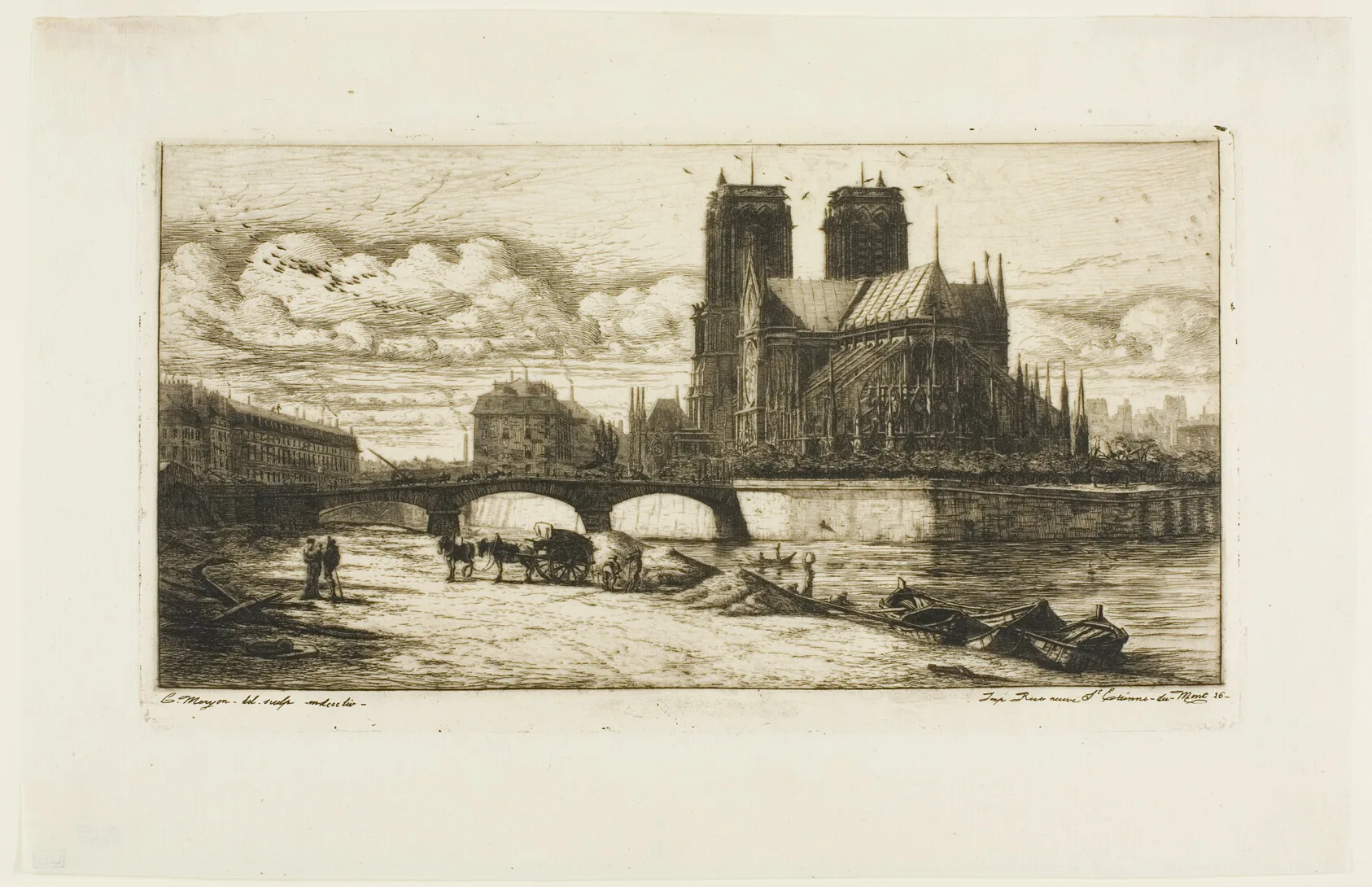
Meryon, The Apse of Notre-Dame, Paris, 1854. Etching and drypoint ivory laid paper.
Meryon, The Apse of Notre-Dame. The cathedral's silhouette against the sky carries the sharpest edges and the deepest contrast; the quays and river soften away from it.
The Art Institute of Chicago · Clarence Buckingham Collection
Pitfalls
What
Two focal points of equal strength.
Why
The eye bounces between them and never settles.
Fix
Subordinate one: soften its edges and narrow its values.