Architecture
LineRoof planes and slates
A roof is a tilted plane: light if it faces the sky. Its rows converge with the building. Draw slates in the nearest two rows only; the rest is tone.
A pitched roof is a plane tilted toward the sky, so in daylight it is usually lighter than the wall below it, however dark the slate. Its ridge and eaves recede to the same vanishing point as the wall they belong to. The rows of slates or tiles are lines on that plane, so they converge too, and the slates themselves shrink with distance.
Draw the roof's outline and value first. Then, if the roof is near the focal point, articulate the slates in the two nearest rows at the eave and let the rows above dissolve into tone with a few broken horizontal lines. More than two rows of drawn slates is a texture; more than four is a mistake.
Roofs seen from above (from a hill, or an upper window) show their tops and are large light shapes; roofs seen from the street show only the eave and are thin. The eye level decides which.
Visuals
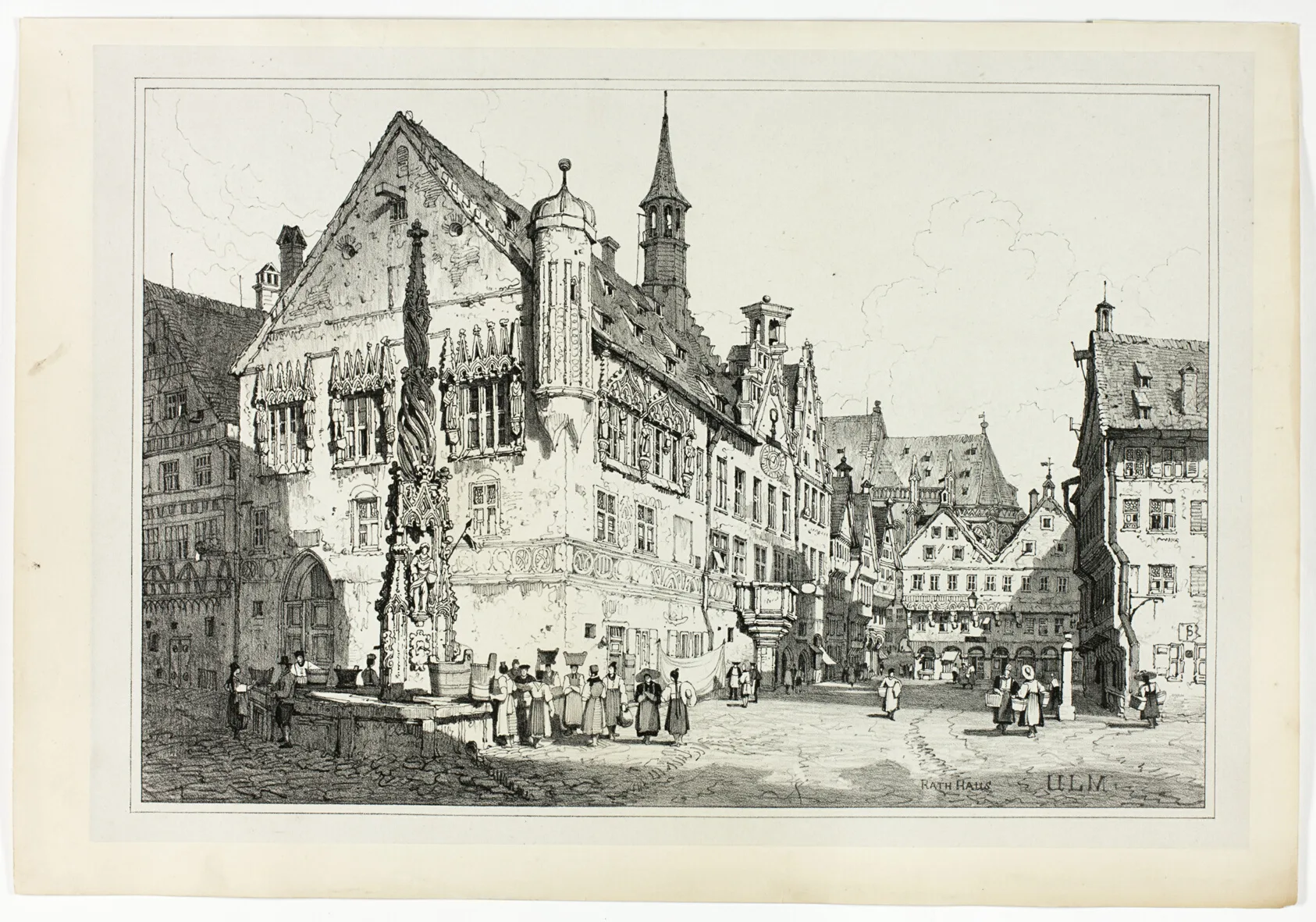
Prout, Rath Haus, Ulm, from Facsimiles of Sketches made in Flanders and Germany, 1833. Lithograph in black on grayish-ivory chine, laid down on ivory wove paper.
Prout, Rath Haus, Ulm. The steep roofs are light planes with their tile rows suggested near the eaves and dissolved toward the ridge.
The Art Institute of Chicago · The Leonora Hall Gurley Memorial Collection
Pitfalls
What
Every slate drawn.
Why
The roof becomes a texture that fights the light and the focal point.
Fix
Erase to the two nearest rows.