Line
LineTwo-point perspective
A building seen at its corner: each face recedes to its own vanishing point, both on the eye level and usually both off the page. The near corner is the tallest and darkest edge.
Turn so that you see the corner of a building rather than a face, and each visible face now recedes to its own vanishing point, left and right, both on the eye-level line. The near vertical corner is the tallest edge on the page; the far edges of each face are shorter. The two vanishing points are usually far apart and often both off the paper, which is normal and correct. If both fit comfortably on your sheet, your building will look like a toy seen through a fish-eye lens.
Set it up: eye-level line, the near corner as a vertical of the right height, then sight the angle of the top edge of each face with the pencil and draw them. Where the vanishing points are off the page, the convergence method (next technique) handles everything between.
Most buildings in a landscape are seen this way. Cotman's castles, Prout's town halls, Roberts's churches: find the near corner and the two slopes of the top edges, and the rest is division.
Visuals
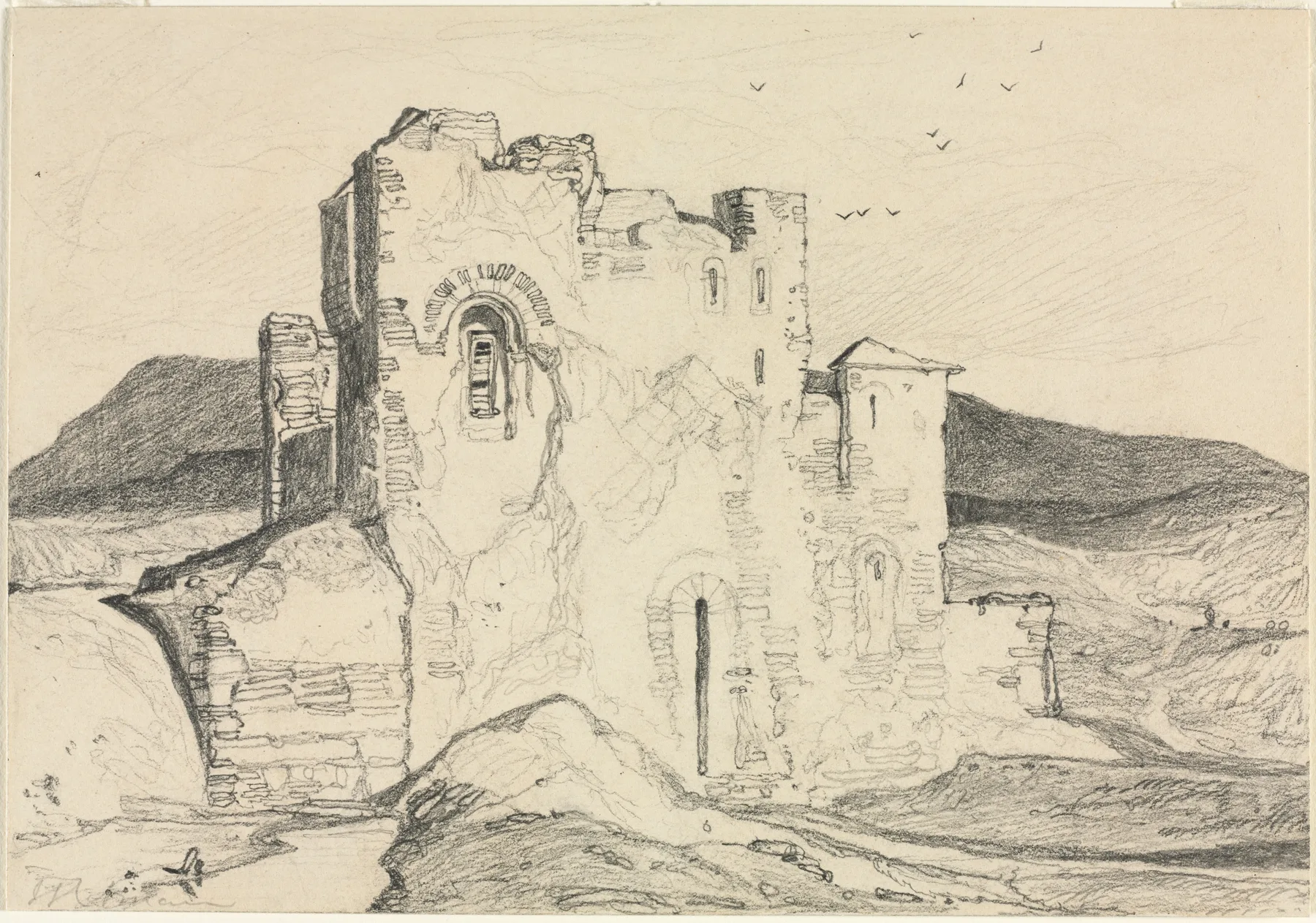
Cotman, A Castle in Normandy, c. 1800–1842. graphite.
Cotman, A Castle in Normandy (graphite). The keep is seen at its corner; its two faces recede to opposite sides, and the near edge is the firmest line in the drawing.
The Cleveland Museum of Art · Dudley P. Allen Fund
Pitfalls
What
Both vanishing points placed on the page to make construction easy.
Why
The building distorts badly; the near corner angle becomes acute and unnatural.
Fix
Let them fall off the page and use the convergence method.