Mass
MassTexture lives at the edge
The interior of a mass stays flat tone. All the texture goes on its outer edge, broken and varied. The eye assumes the rest.
The eye reads texture at the boundary of a form and assumes it continues inside. So a foliage clump needs leaf-like marks only along its silhouette; a stone wall needs stones only along its top edge and around its openings; a thatched roof needs straw only at the eave. Inside the shape, flat tone that carries the light.
This is an economy that every master in this program uses and every beginner violates. Texture inside a mass does three bad things: it flattens the form by destroying the light-to-shadow gradient, it competes with the focal point, and it takes an hour. Texture at the edge does the opposite of all three.
The edge marks themselves should be broken, varied in size and direction, and pointing outward from the mass. A regular, even edge texture reads as a pattern, not a surface.
Visuals
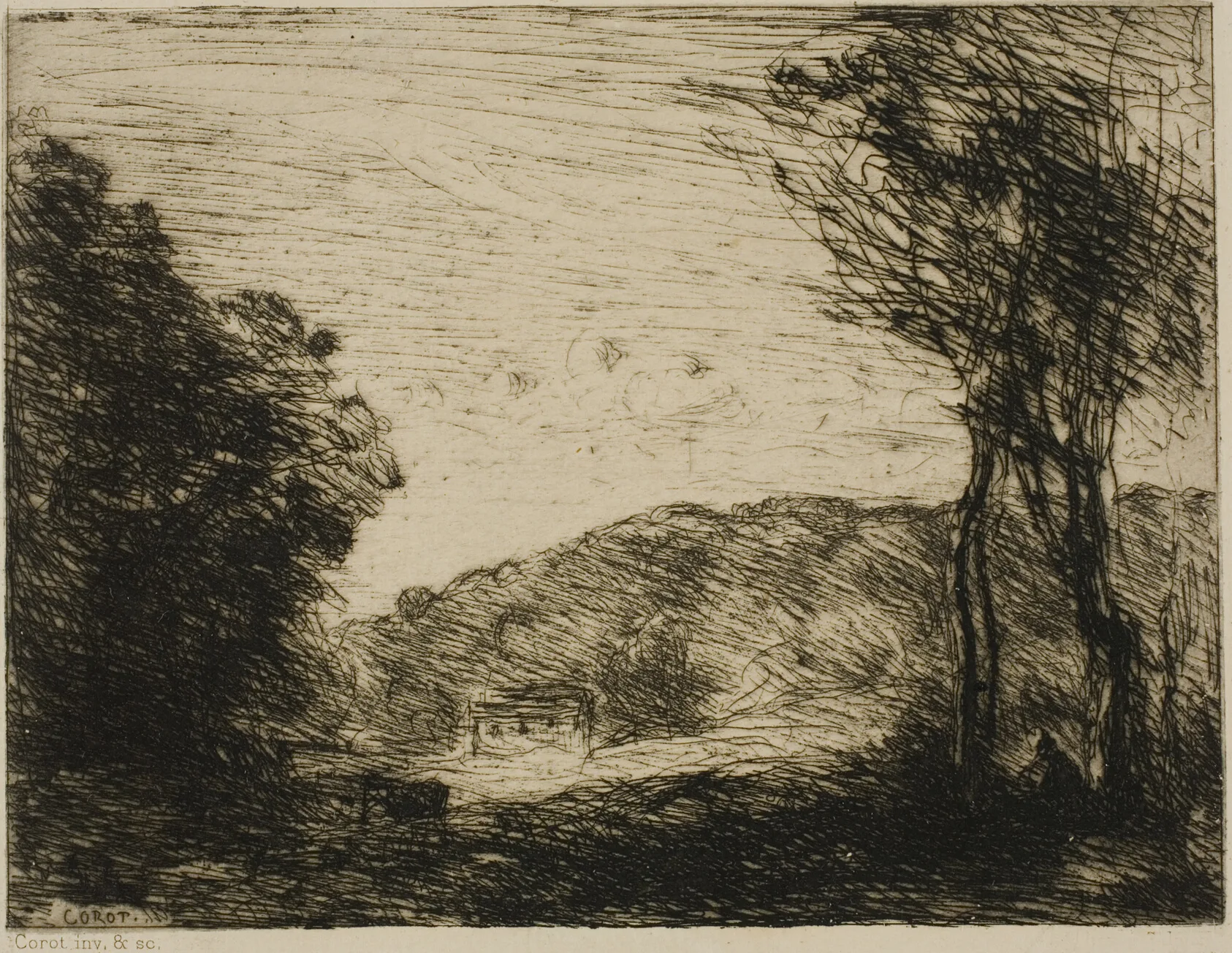
Corot, Wooded Countryside, 1866. Etching on ivory laid paper.
Corot, Wooded Countryside (etching). The foliage is dense scribble at the silhouette and against the sky, and settles into near-flat tone inside.
The Art Institute of Chicago · The Charles Deering Collection
Pitfalls
What
Rendering bark across a whole trunk.
Why
The cylinder loses its light side and turns into a flat strip.
Fix
Bark texture only along the shadow edge and at the base. Let the lit side be smooth tone.