Marks
Line + MassA smooth gradient
Each layer starts a little further along than the last. Change direction between layers. Bands vanish.
A gradient is a stack of flat tones that start at different places. Layer one covers the whole band lightly. Layer two starts a quarter of the way in. Layer three starts halfway. Layer four covers only the last quarter. Because each layer is light and overlapping, the steps disappear and you have a continuous ramp. Change the stroke direction with each layer and any residual banding goes too.
Skies are gradients (darker at the top, lighter at the horizon). Cast shadows are gradients (darkest at the object, softening with distance). The side of a cylinder is a gradient both ways. Piranesi's Pyramid of Cestius is one enormous gradient with texture laid on top of it.
A stump can polish a gradient at the very end, and it can also kill it. If you use one, use it on the dark half only and leave the light half with its grain.
Visuals
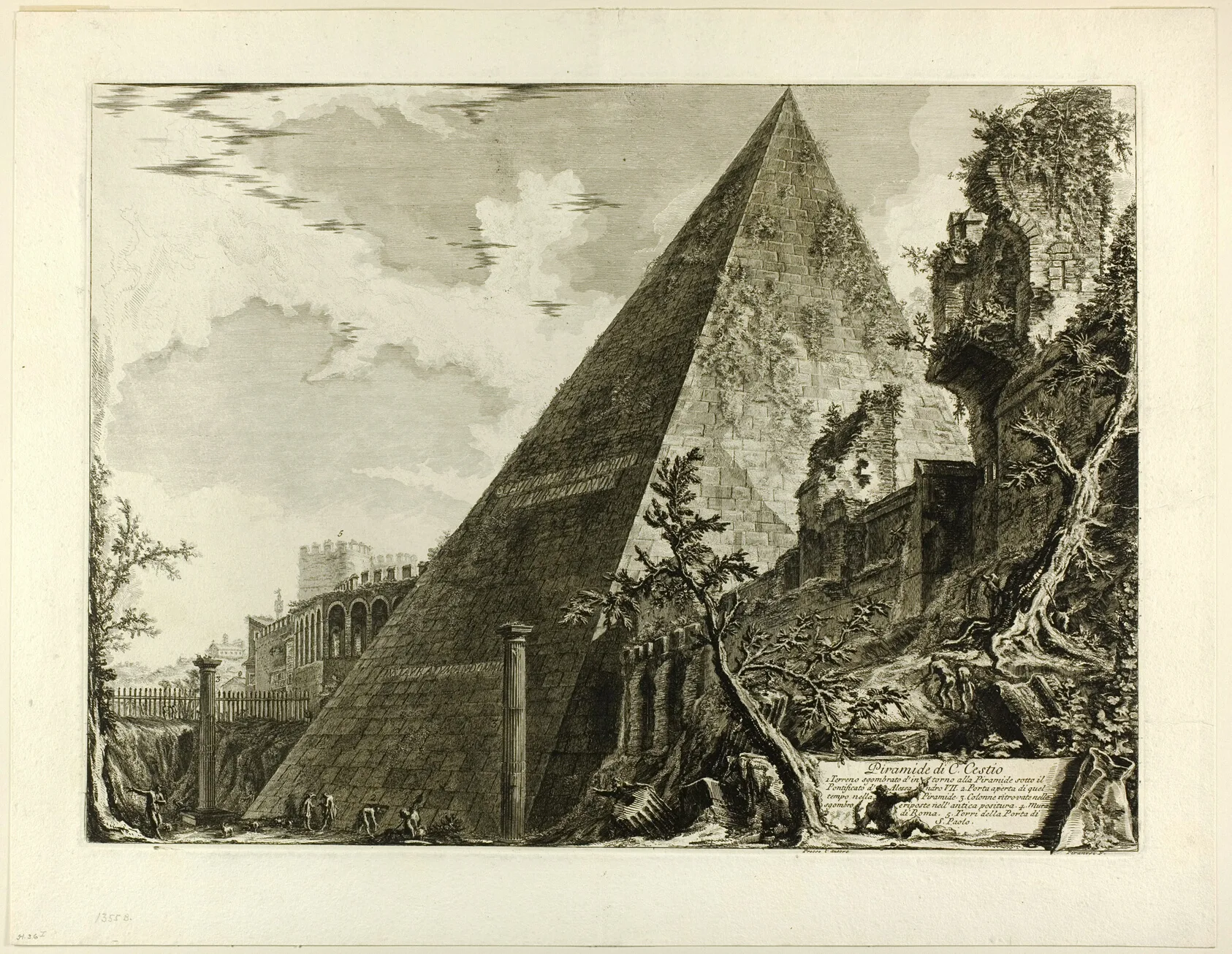
Piranesi, The Pyramid of Gaius Cestius, from Views of Rome, 1750/59, published 1800–07. Etching on heavy ivory laid paper.
Piranesi, The Pyramid of Gaius Cestius. One vast plane graded from light to dark without a band, then stone texture only where the eye lands.
The Art Institute of Chicago · The Charles Deering Collection
Pitfalls
What
Trying to make the gradient in one pass by varying pressure.
Why
Pressure control is not fine enough yet and the result has steps.
Fix
Build it from four flat layers. Pressure stays constant; the number of layers changes.