Comparative measurement
Comparative measurement
A mug, a chair, a window: how many of these is that?
Measure proportions by counting a unit along the subject, and draw three objects whose proportions are right.
- Difficulty
- Time
- about 0.5 h
- You draw with
- 2H and HB
Why this one
- Unit 2 of the program: Seeing.
- Three objects with correct proportions, drawn inside their measured boxes.
From your kit
The whole kit →- 1Grafwood 2H, HB 2H, HB for layout and line. Long points from the Blackwing on everything up to B.
- 2Kneaded eraser and the Mono Zero press-and-lift corrections only; the Mono Zero for a single sharp light.
- 3Alpha sketchbook 9 x 6 draw at the book's size and keep the proportions; date the page.
In general, this study asks for
- Drawing pad
- 2H and HB
- A mug, a chair, a window
Watch first
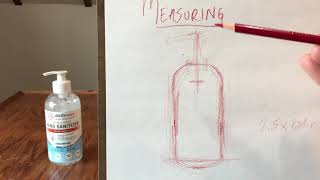
All videos →Comparative measurement with a straight arm, demonstrated on a still life.
YouTube
The plan
4 stages · ~41 min- 1
The mug
12 minStraight arm. Thumb on the pencil marks the mug's width. Count: how many widths tall is it? One and a half? Draw a width on the page at any size, then make the height one and a half of it. Draw the mug inside that box. The proportion is now right whatever else is wrong.
FigureOne unit, counted up the height. Checklist0 / 1 - 2
The chair
12 minUnit: the seat's width. Count the height of the back, the height of the seat from the floor, the width of the whole thing. Draw the box those numbers make, then the chair inside it. Sight the angles of the legs as you learned yesterday.
Checklist0 / 1 - 3
The window
12 minUnit: one pane. Count panes across and up. Count the wall from the window edge to the room's corner in panes. Draw it. A window is a small building; this is exactly how you will measure a church.
Checklist0 / 1 - 4
Self-check
5 minTick each item honestly. If one is a no, the session is not finished; go back to that step.
Checklist0 / 3
What it should look like
- Three objects with correct proportions, drawn inside their measured boxes.
Where it goes wrong
- Measuring a detail before the whole. The detail comes out right-sized in a wrong-sized whole. Whole first: height to width. Then the main divisions. Then parts.
Log this session
Start the clock when you pick up the pencil. Stop it when you put it down. Log it. Every session counts toward the box.
Status
How did it go?