Branch logic and sky holes
Branch logic and sky holes
A winter tree from the ground up, then a summer tree that breathes
Draw branches that taper, zig-zag and vanish into foliage, and lift sky holes that make a canopy read as a volume.
- Difficulty
- Time
- about 1 h
- You draw with
- HB, 2B, 6B
Why this one
- Unit 3 of the program: Mass: the Corot Half.
- A winter tree that grew, not one that was assembled.
- A summer tree you could walk under, with three or four holes of sky.
From your kit
The whole kit →- 1Grafwood HB, 2B, 6B HB for layout and line; 2B, 6B for the darks, on their sides for mass. Long points from the Blackwing on everything up to B.
- 2Pitt Matt 8B to 12B for the big tone passages: matt, so the dark mass reads as tone, not shine.
- 3Kneaded eraser (warm it) and the clean Mono Zero lift the lights out of the mass; the Mono Zero for sky holes and lit edges.
- 4Alpha sketchbook 9 x 6 draw at the book's size and keep the proportions; date the page.
In general, this study asks for
- Drawing pad
- HB, 2B, 6B
- Kneaded eraser shaped to a point
- A bare tree and a leafy tree, or photos
Watch first
All videos →Clump construction and sky holes.
YouTube

The plan
4 stages · ~56 min- 1
The winter tree, from the ground
17 minStart at the base of the trunk with the 6B, widest. Work up. At each fork, each limb thinner than what it came from, and in a new direction. Nothing goes straight for long. Keep the total thickness roughly constant across a fork. By the fifth fork you are drawing single lines. End each line in a small scribbled cluster of twigs, never in a bare point.
FigureTaper, change direction, vanish into mass. Checklist0 / 1 - 2
Corot's bent tree
17 minFollow the trunk of Bent Tree by the Water with your eye from the ground up. It leans, forks, changes direction, thins, and every limb disappears into foliage. Not one ends in air.
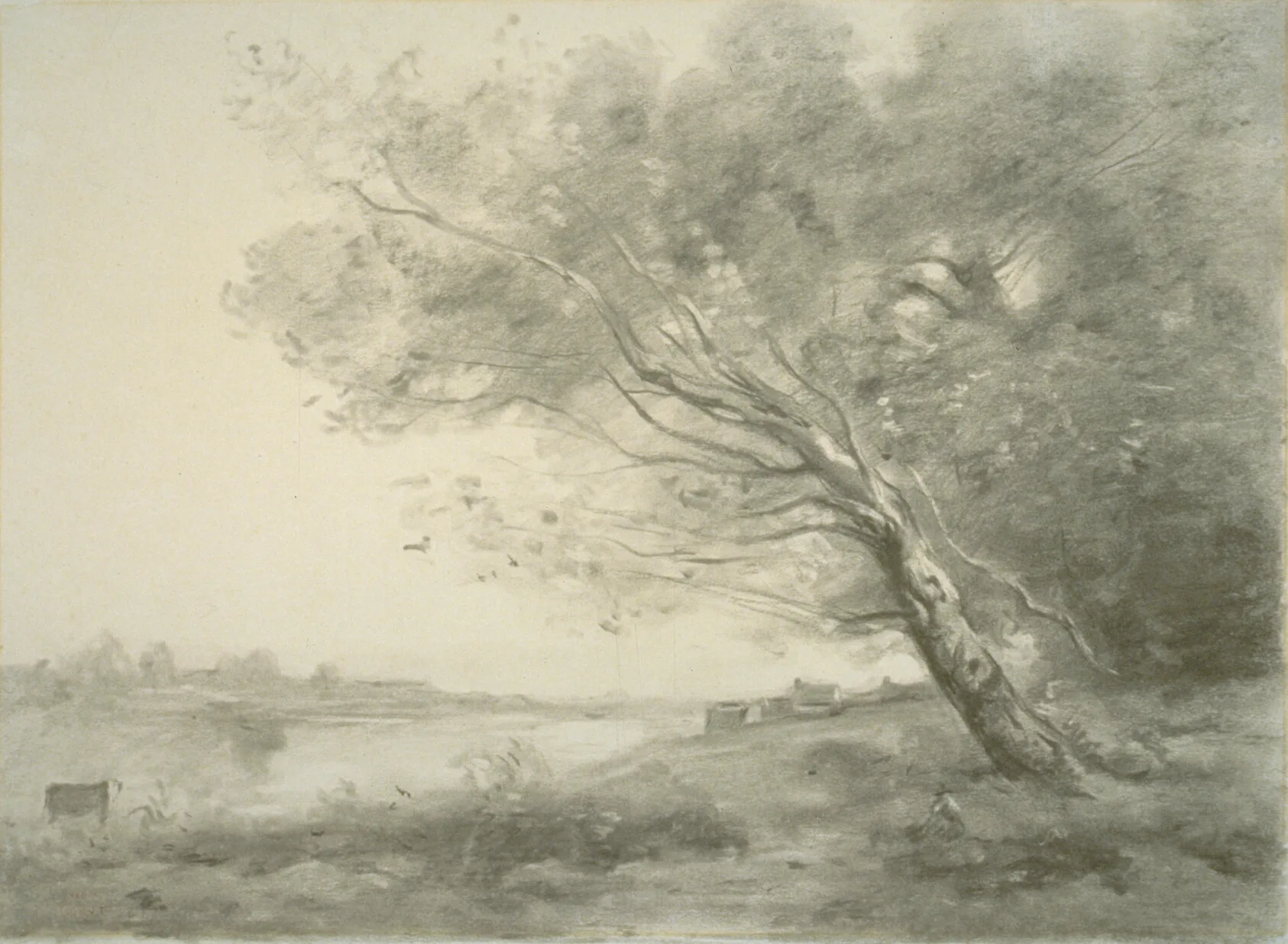
Corot, Bent Tree by the Water, 1860/70. Charcoal, with stumping and erasing, on cream wove paper, laid down on cream board.
Corot, Bent Tree by the Water. Follow the trunk up and count the direction changes.
The Art Institute of Chicago · Harold Joachim Birthday Fund, purchased with funds provided by the Alsdorf Foundation, Mr. and Mrs. William O. Hunt and Frank B. Hubachek
Checklist0 / 1 - 3
The summer tree with holes
17 minDraw the leafy tree as masses (last session's method), a touch darker than you want. Then shape the kneaded eraser to a point and lift three or four sky holes, irregular, different sizes, near the edges of the canopy where clumps fail to meet. Draw a thin branch across the largest hole with the HB. Darken the foliage immediately around each hole a touch.
FigureFew, irregular, at the edges, with a branch across one. Checklist0 / 1 - 4
Self-check
5 minTick each item honestly. If one is a no, the session is not finished; go back to that step.
Checklist0 / 4
What it should look like
- A winter tree that grew, not one that was assembled.
- A summer tree you could walk under, with three or four holes of sky.
Where it goes wrong
- Branches ending in bare points in the sky. Twigs end in buds and buds read as mass. End every line in a small scribbled cluster, or dive it into a clump.
- A dozen even round holes. Pattern instead of observation. Fill all but three. Make those three irregular and move them to the edge.
Log this session
Start the clock when you pick up the pencil. Stop it when you put it down. Log it. Every session counts toward the box.
Status
How did it go?