Masonry coursing
Run the horizontal courses as broken lines. Add vertical joints only near openings, corners and the base. Let tone carry the middle. Hundreds implied, forty drawn.
A stone wall drawn with every stone outlined looks like a net thrown over a flat surface, and it takes an hour. A stone wall drawn properly takes ten minutes: the horizontal courses run across as broken lines (lighter and more broken where the wall is lit, darker and more continuous in shadow), and the vertical joints appear only where the eye needs them, which is at the corners (quoins), around openings, along the base, and in a few random places near the viewer. Everywhere else, tone.
Count the stones in Cotman's Haute Allemagne tower. Perhaps forty are actually drawn; hundreds are implied. The same in Prout, in Roberts, in Forrest. The implied stone is more convincing than the drawn one because it does not fight the light.
Rubble walls (irregular stones) are treated the same way: a few stones drawn near edges and openings, the rest suggested by broken horizontal strokes and tone. Brick likewise, with the courses closer.
Visuals
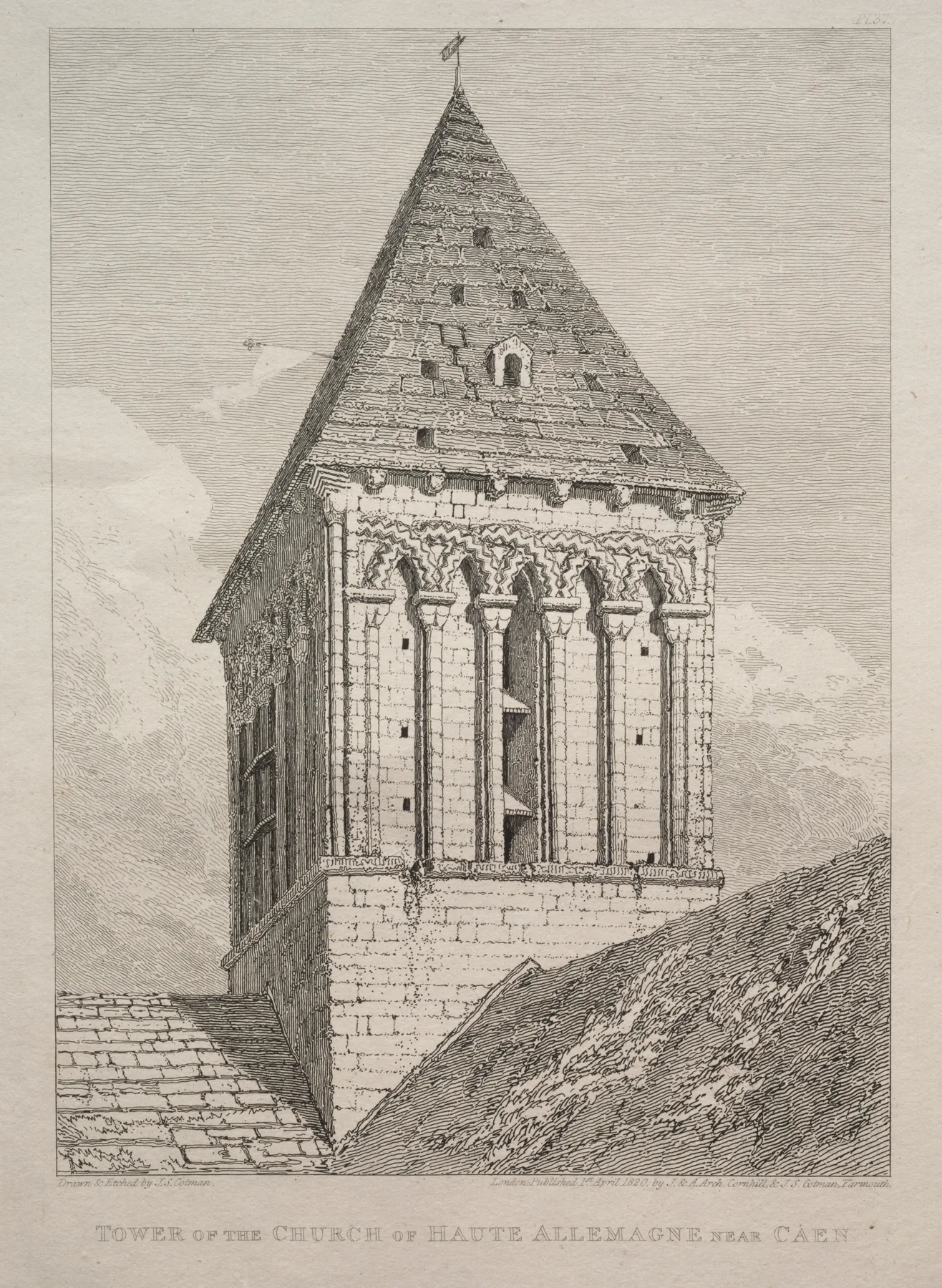
Cotman, Tower of the Church of Haute Allemagne near Caen, 1822. etching.
Cotman, Tower of the Church of Haute Allemagne. Count the stones that are actually drawn. Then notice where they are: edges, openings, the base.
The Cleveland Museum of Art · Gift of William C. Keough
Pitfalls
What
Even, complete coursing across the whole wall.
Why
The wall flattens and the drawing turns into a diagram.
Fix
Erase the middle. Keep the edges. Add tone.