Figures for scale
Two or three small figures, heads on the eye level, and the building has a size. Draw them small and the architecture becomes monumental. They are rulers, not people.
Without a figure, a doorway can be any size. With one, it is a cathedral door or a cottage door, instantly. Prout dropped two or three figures into every street scene for exactly this reason; Piranesi made his tiny so that Rome would look colossal. They are rulers, and you do not need to be able to draw people to use them.
The rule that makes them easy: if the figures stand on the same ground as you, every adult head is on your eye-level line, near or far. Only the feet move: nearer figures have their feet lower on the page, further ones higher. A figure is a head-dot on the eye level and a vertical stroke down to the feet, with a hint of shoulders. That is enough.
Place them where they help: beside the thing whose scale you want to show, or walking into the picture to lead the eye. Never in the exact centre, never looking out at the viewer.
From your kit
The whole kit →- 1Grafwood 2B, blunt figures are two strokes and a head on the eye level; a blunt point stops you drawing faces.
Visuals
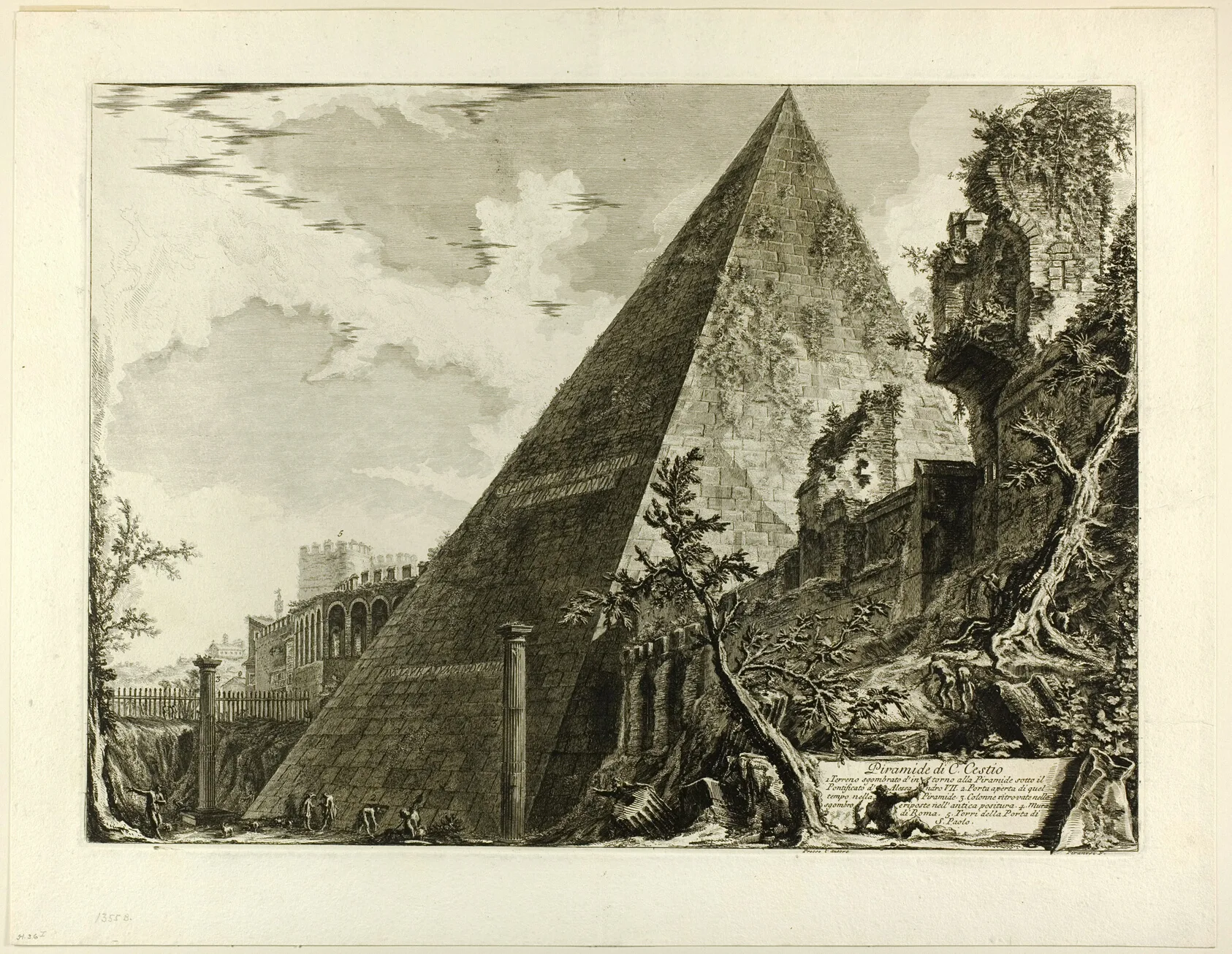
Piranesi, The Pyramid of Gaius Cestius, from Views of Rome, 1750/59, published 1800–07. Etching on heavy ivory laid paper.
Piranesi, The Pyramid of Gaius Cestius. Find the figures. Then notice how large the pyramid has become because of them.
The Art Institute of Chicago · The Charles Deering Collection
Pitfalls
What
Figures drawn with faces and clothes.
Why
They become subjects and pull the eye from the architecture.
Fix
A dot, a stroke, a shoulder. Stop.