The framing device
Dark foreground trees on the sides and dark ground below enclose a small, pale, distant view. The eye is funnelled to the distance and stays there.
Corot's favourite design, used in Environs of Rome and dozens of souvenirs: a dark frame of foreground foliage down both sides and across the bottom, with a light distance showing through the gap. The frame is close in value (all 7 to 9), soft-edged and undetailed; the view inside it is pale, far and quiet. The eye enters at the bottom, is held by the frame, and is pushed to the distance.
The frame does not need to be trees. A gateway, an arch, an alley between buildings: Cotman looks through the arches of Rievaulx; Meryon looks under a bridge. Any dark surround with a light centre works the same way.
Keep the frame simple. Its job is to be dark and get out of the way. The moment you render the frame's foliage or stonework it starts to compete with the view.
Visuals
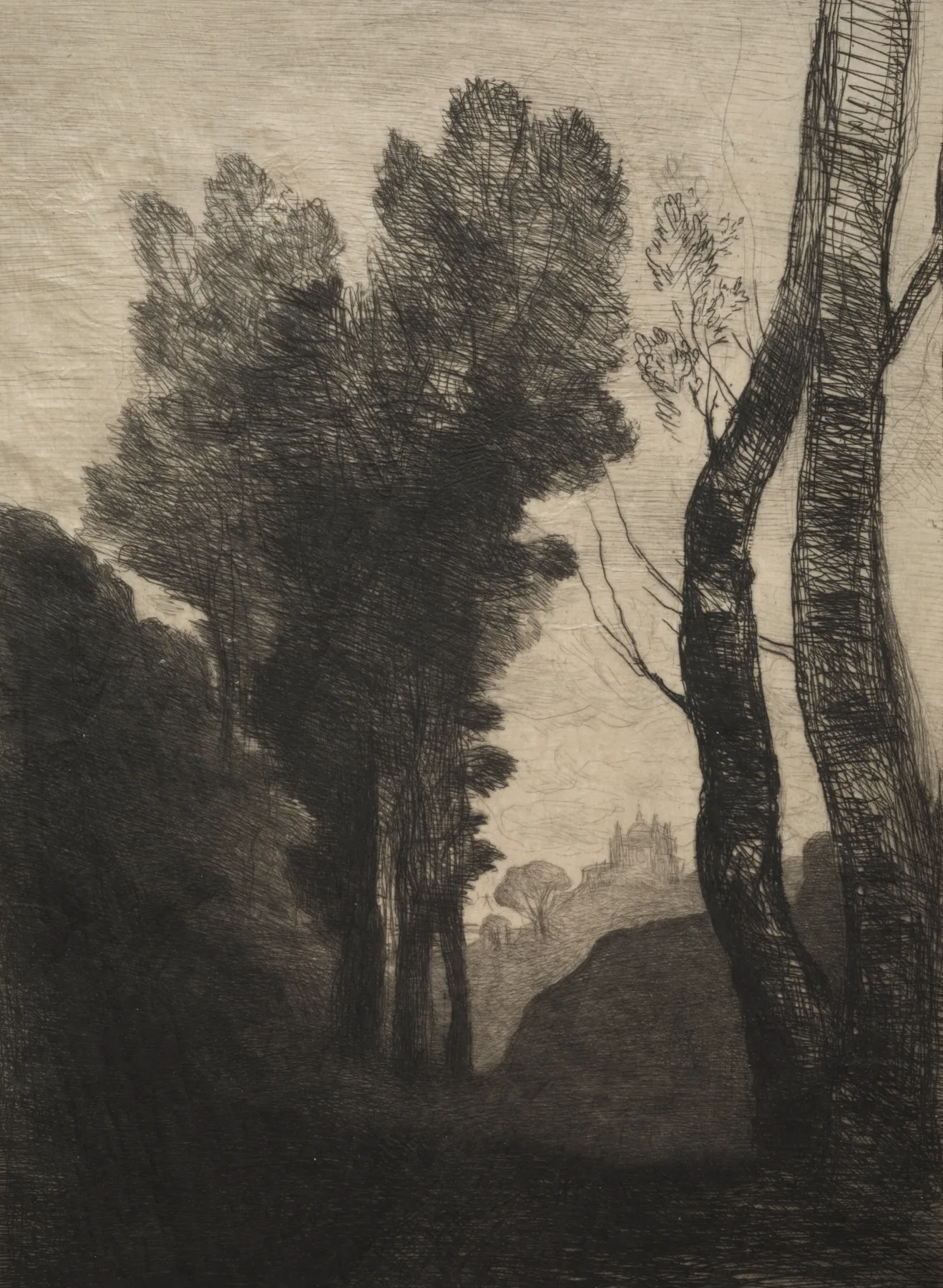
Corot, Environs of Rome, 1866. etching.
Corot, Environs of Rome (etching, 1866). Tall dark trees left and right, a dark foreground, and a pale distant town seen through the gap.
The Cleveland Museum of Art · Gift of Frederick Keppel and Co., Inc., The Frederick Keppel Memorial
Pitfalls
What
The frame rendered in detail.
Why
It competes with the view and the funnel stops working.
Fix
Frame as a flat dark mass with a few edge marks. Nothing inside it.