Architecture
LineThe window as a void
A window is a hole in a thick wall. Show the reveal for depth. The glass is dark with one thin highlight. The sill is light and casts a small shadow.
A beginner draws a window as a rectangle with a cross in it. A draughtsman draws a hole in a thick wall. The thickness shows as the reveal: the inner faces of the opening, one lit and one in shadow, visible because the glass is set back from the face of the wall. The glass itself is dark, because it shows the dark room behind it, with perhaps one pane catching the sky and going light. The sill projects and is lit on top (paper) with a cast shadow beneath. The lintel or arch head is lit on its face and dark underneath.
That reveal is what makes a wall feel like stone and not cardboard. Draw it even when it is only a millimetre wide on your page.
Rows of windows obey the dividing-bays rule. Their sills and heads sit on convergence lines. And they are all, on one building at one time of day, lit from the same side.
Visuals
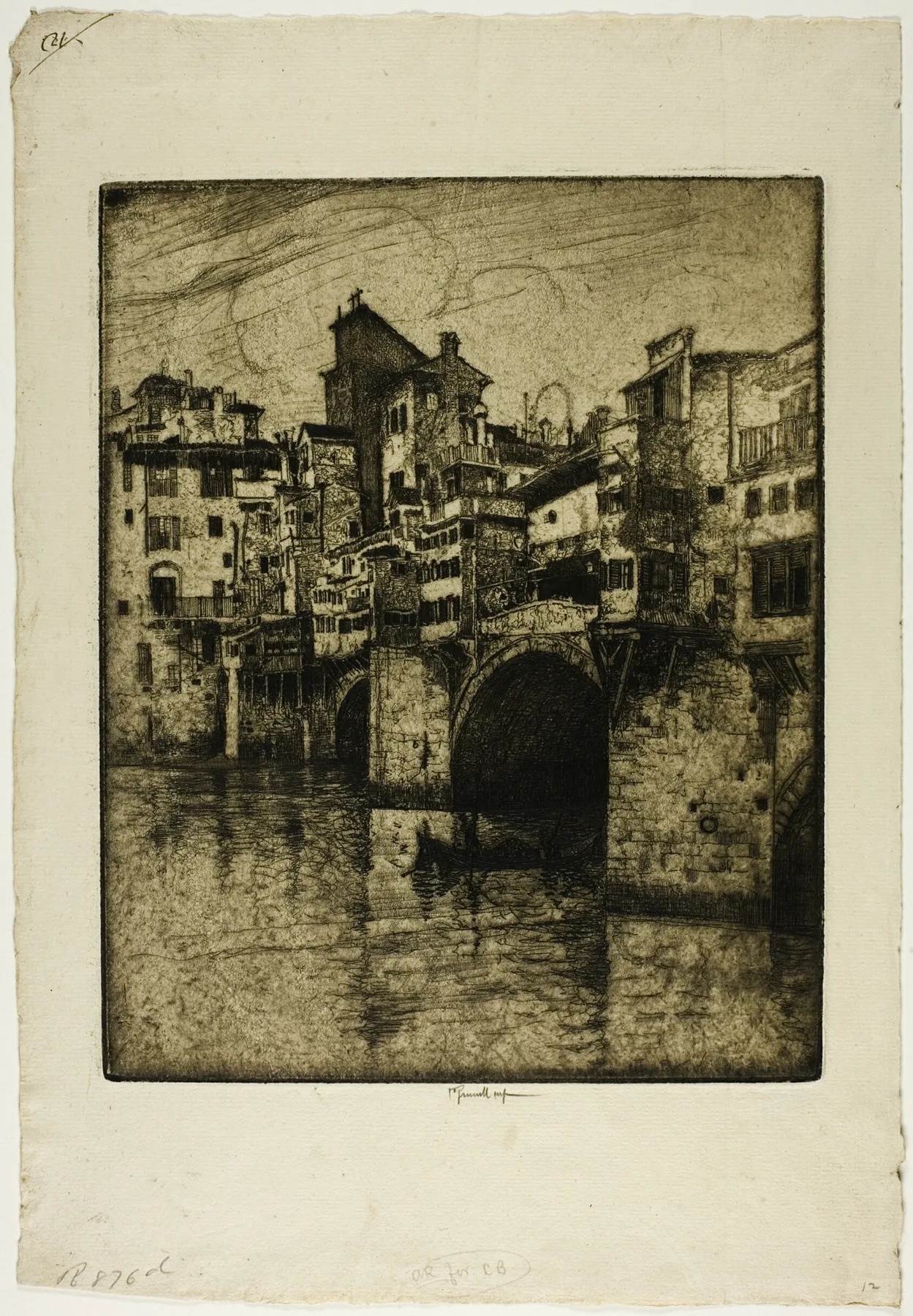
Pennell, Ponte Vecchio, Florence, 1883. Etching on cream laid paper.
Pennell, Ponte Vecchio, Florence. Every window is a dark void with a lit sill, and the stacked rows read as holes in thick old walls.
The Art Institute of Chicago · The Joseph Brooks Fair Collection
Pitfalls
What
Windows left as white rectangles.
Why
They read as paper stuck on the wall, not openings into a dark interior.
Fix
Glass is dark. Lay a value 7 across the whole opening first, then lift one highlight.