Architecture
LineA moulding in light
A projecting course is four horizontal bands of value: bright top fillet, halftone curve, dark underside, cast shadow on the wall. The darkest line on any building is the underside of a projection.
A string course, a cornice, a window sill, a plinth: any horizontal projection on a building catches the light in the same way. Its top surface faces the sky and is the lightest thing nearby, often bare paper. Its curved or chamfered face is halftone. Its underside turns completely from the light and is as dark as the drawing goes. And below it, on the wall, it casts a shadow that is dark but not as dark as the underside, softening as it falls.
Four bands, in that order, and the stone turns. You do not need to know the name of the moulding or its profile. You need the four bands, in the right values, with the right widths.
Save your softest pencil for undersides. The darkest accents on a Meryon or a Cotman are nearly always the shadow under a cornice, inside an arch head, or under a sill.
From your kit
The whole kit →- 1Grafwood H, long point arches, tracery and mouldings are compass geometry drawn freehand; a hard long point keeps it light until it is right.
- 2Grafwood HB and 2B the committed line and the dark of a window void.
- 3Mono Zero a lit edge on a moulding, or a mullion drawn back out of a dark window.
Visuals
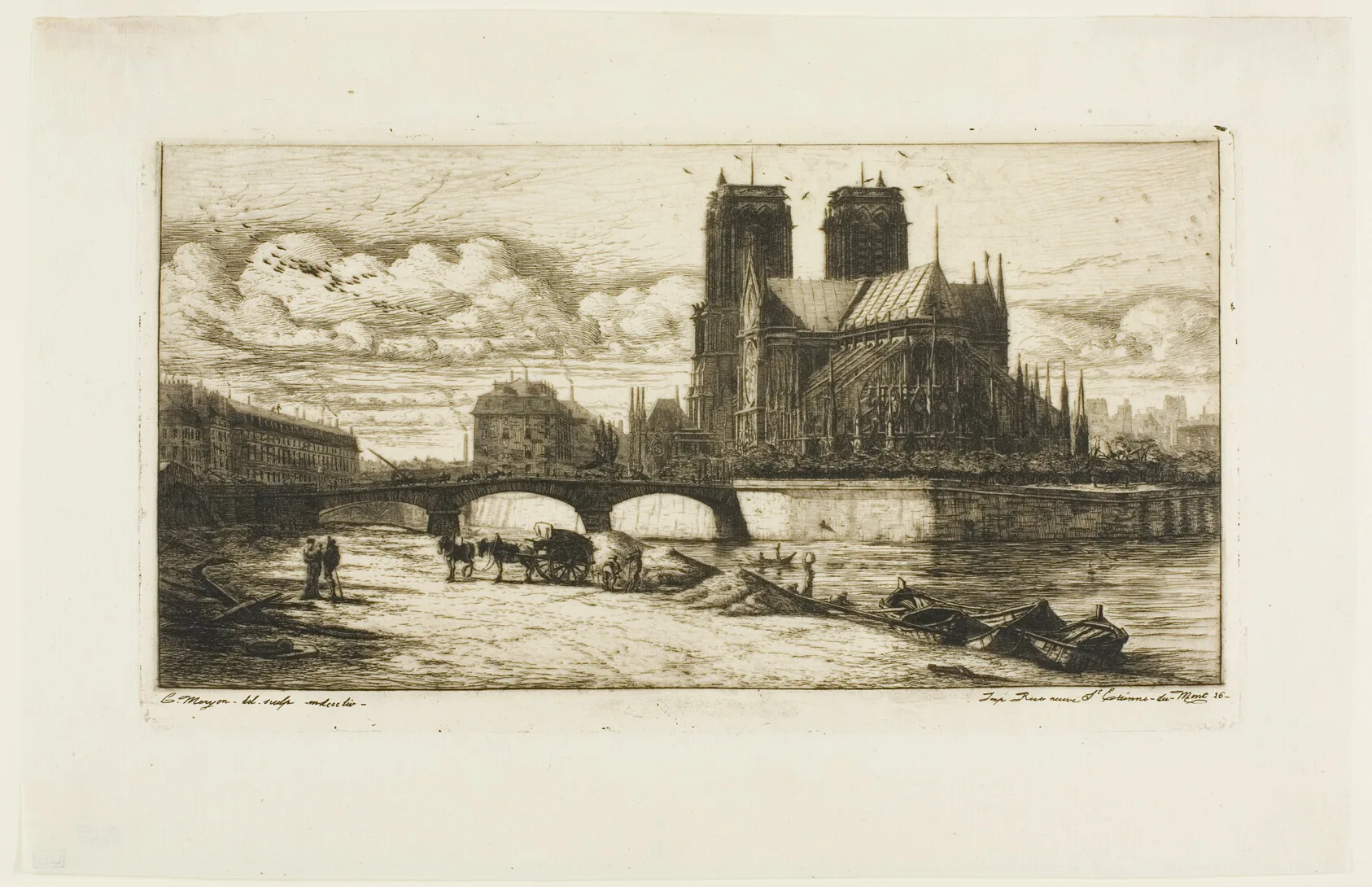
Meryon, The Apse of Notre-Dame, Paris, 1854. Etching and drypoint ivory laid paper.
Meryon, The Apse of Notre-Dame. The cornices and string courses read as dark lines under light edges, each a cast shadow beneath a lit fillet.
The Art Institute of Chicago · Clarence Buckingham Collection
Pitfalls
What
A moulding drawn as a single dark line.
Why
It reads as a crack, not a projection.
Fix
Light line above, dark line below, a halftone between. Three marks minimum.