Line
LineDividing bays in perspective
Equal in the world means shrinking on the page. Draw the first bay by eye, find its centre with an X, and use the diagonal to find each next bay. Never measure receding bays with a ruler.
A row of equal windows, arches or buttresses gets narrower and closer together as it recedes, and the rate is not something you can guess. Construct it. Draw the first bay by eye (sight it). Draw its diagonals to find its centre, and run a line from that centre to the vanishing point (or along the convergence) to make a centre line for the whole wall. Now a line from the top of the first bay's near edge, through the centre of its far edge, hits the base line exactly where the next bay ends. Repeat for each bay. Equal in the world, shrinking on the page, and correct.
In a cathedral nave this gives you the piers. On a Georgian terrace, the windows. On a bridge, the arches. On a Gothic arcade, the columns. Once you can do it you will see every ruler-measured, evenly spaced colonnade in a beginner's drawing as what it is.
If the vanishing point is off the page, the centre line runs along the convergence from the technique above, and the method is identical.
From your kit
The whole kit →- 1Grafwood 2H and H, long points construction lines you can leave in: eye level, vanishing traces, bay divisions.
- 2Grafwood F or HB the drawn line over the construction, broken and weighted.
- 3Grafwood 2B the few counted accents that make the line read as stone.
Visuals
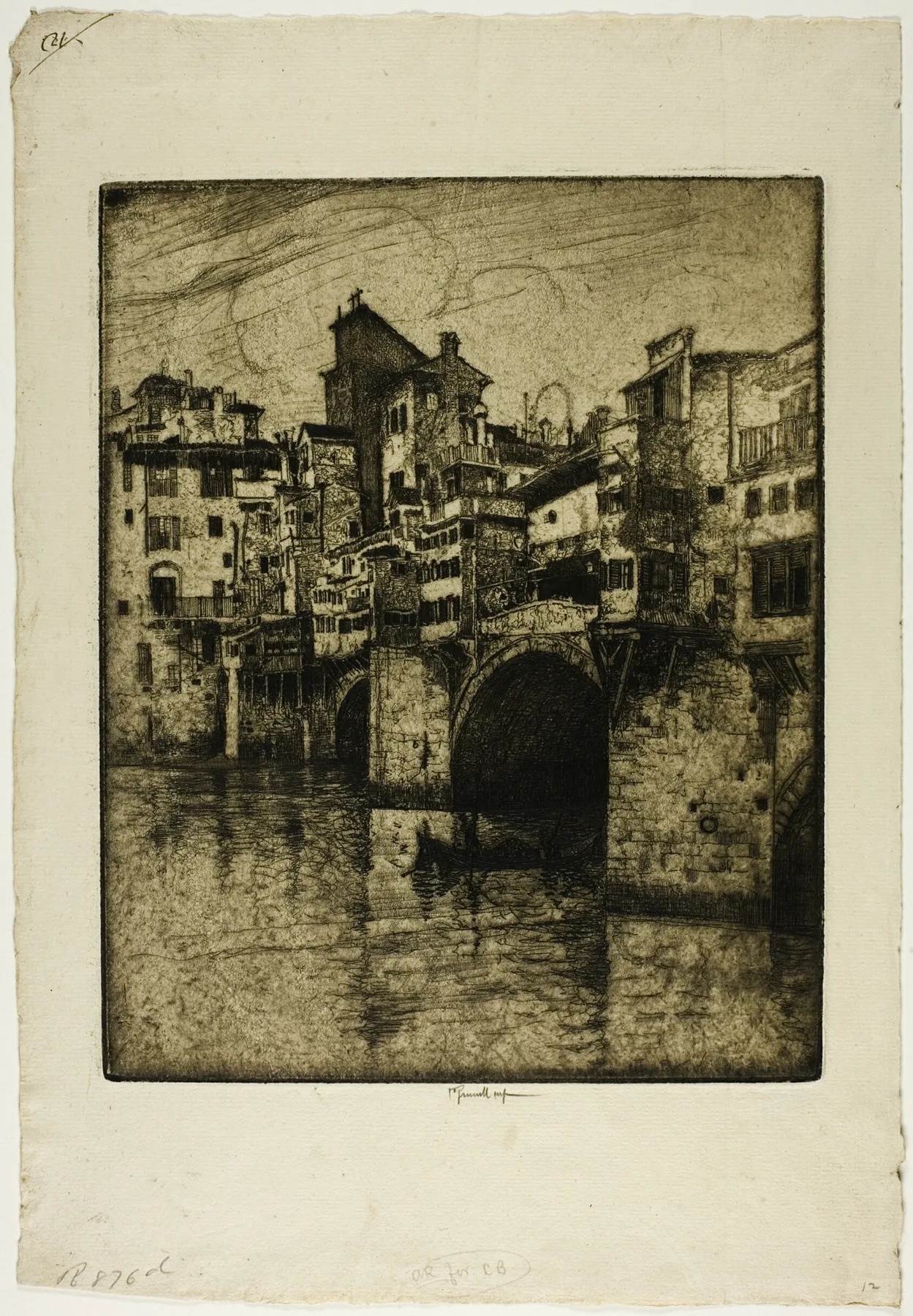
Pennell, Ponte Vecchio, Florence, 1883. Etching on cream laid paper.
Pennell, Ponte Vecchio, Florence. The stacked windows and arches shrink along the bridge at a rate that was constructed, not guessed.
The Art Institute of Chicago · The Joseph Brooks Fair Collection
Pitfalls
What
Bays measured equal with a ruler.
Why
The wall refuses to recede and flips flat.
Fix
Erase and construct with the diagonal. Equal spacing is the error.