Tracery from circles
A Gothic window is geometry you can rebuild, not lace you must copy. Main arch, central mullion, two sub-arches of half the span, a circle in the spandrel that becomes a quatrefoil.
Tracery looks impossibly complex until you see that it is made of the same pointed arch repeated at smaller scales, plus circles. The simplest two-light window: a main pointed arch; a vertical mullion splitting it; two smaller pointed arches, each with half the span, filling the lower part; and in the spandrel above them a circle, which is then cusped into a trefoil or quatrefoil. Three- and four-light windows nest the same logic deeper.
In the field, draw the main arch and the mullions first (they are the structure), then place the circle of the spandrel, then the sub-arches. Draw the cusps last and only suggest them; at any distance they are dark notches, not shapes.
Cotman's Cley Church shows what a controlled pencil can do with tracery: every window head is a compass construction drawn freehand, and none of it is fussy.
From your kit
The whole kit →- 1Grafwood H, long point arches, tracery and mouldings are compass geometry drawn freehand; a hard long point keeps it light until it is right.
- 2Grafwood HB and 2B the committed line and the dark of a window void.
- 3Mono Zero a lit edge on a moulding, or a mullion drawn back out of a dark window.
Visuals
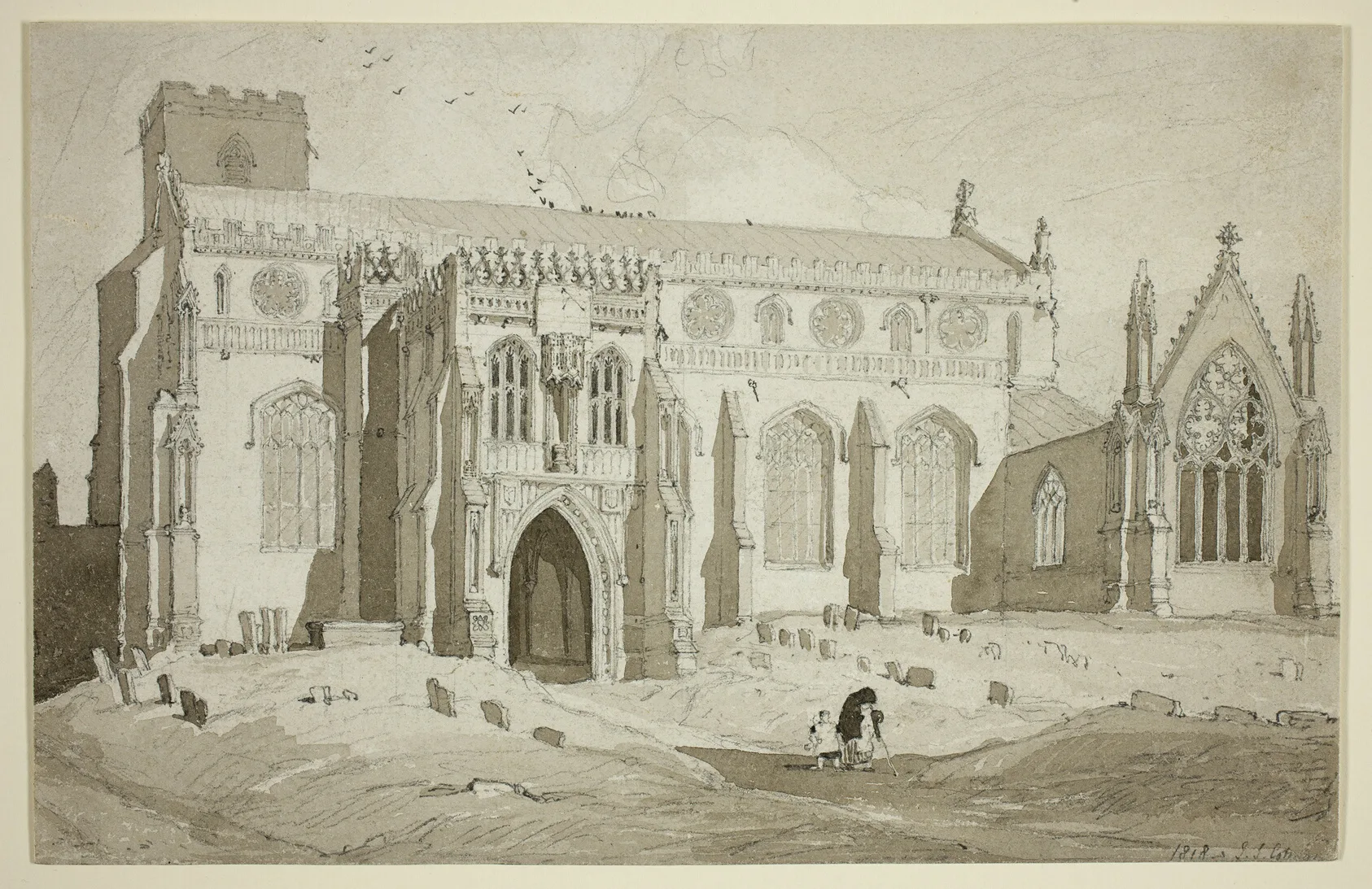
Cotman, Cley Church, Norfolk, 1818. Graphite and gray wash on ivory wove paper.
Cotman, Cley Church, Norfolk. The east window and the side windows are nested pointed arches with circles in the spandrels. Count the lights in each.
The Art Institute of Chicago · Gift of Dorothy Braude Edinburg to the Harry B. and Bessie K. Braude Memorial Collection
Pitfalls
What
Tracery drawn as decoration on the surface of the wall.
Why
It should read as stone bars with dark glass or dark space between them.
Fix
Draw the dark shapes between the bars (negative shapes) and let the bars be what is left.