The Lonely Tower
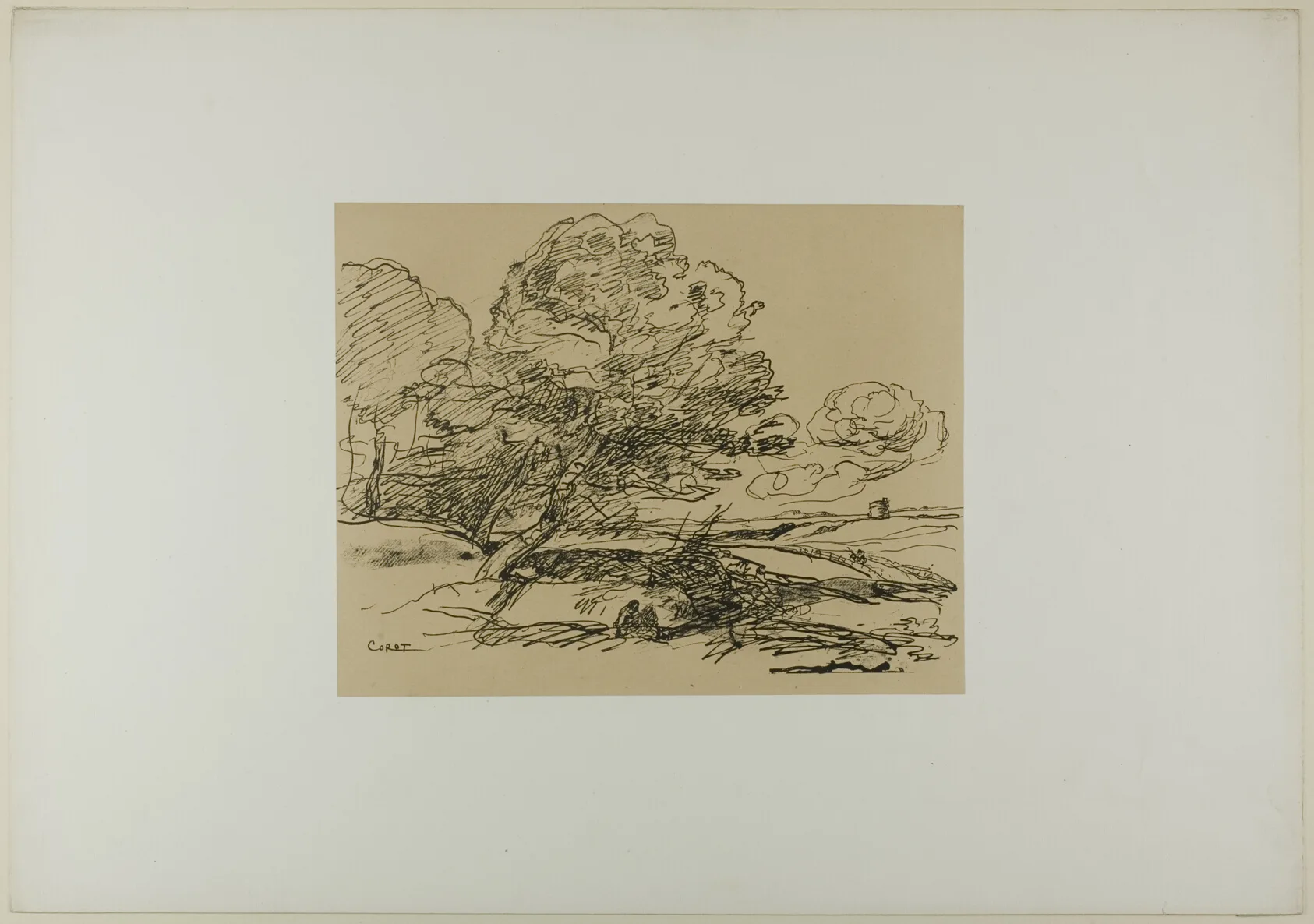
Corot, The Lonely Tower, 1871. Transfer lithograph in black on tan China paper laid down on white wove paper.
Pins mark where to look before you draw.
The Art Institute of Chicago · William McCallin McKee Memorial Endowment
The Lonely Tower
A tower as one mass among trees, in crayon
1871, from the set of twelve autographic lithographs: a round tower on a rise, trees crowding its base, a wide sky scribbled in. The crayon on the transfer paper behaves like charcoal on toothed paper, so this is a late fusain you can copy with a soft pencil on its side. The tower is a mass, not a building.
- Difficulty
- Time
- about 2 h
- You draw with
- 4B and 6B graphite on their sides, or a woodless stick, charcoal pencil
Why this one
- Architecture handled entirely as mass: a cylinder in light, no masonry.
- The tooth of the stone shows in every stroke, which teaches the paper-tooth lesson by example.
From your kit
The whole kit →- 1Grafwood 4B, 6B 4B, 6B for the darks, on their sides for mass. Long points from the Blackwing on everything up to B.
- 2Willow charcoal, or until it arrives Pitt Matt 12B and 14B on their sides the matt grades are the closest graphite gets to willow. Slip sheet under the hand.
- 3Pitt Matt 14B, knife-sharpened stands in for the charcoal pencil: trunk, branch zig-zag, the one accent.
- 4Kneaded eraser (warm it) and the clean Mono Zero lift the lights out of the mass; the Mono Zero for sky holes and lit edges.
- 5Alpha sketchbook 9 x 6 draw at the book's size and keep the proportions; date the page.
In general, this study asks for
- Drawing pad, medium tooth
- 2B, 4B, 6B with long points
- Kneaded eraser
- Precision eraser
- Slip sheet
- woodless 6B stick
Watch first
All videos →Corot's 1871 autographies are crayon lithographs. This is the process in four minutes.
YouTube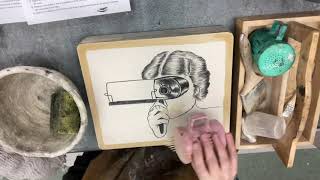 Litho #2: drawing on the stone and first etchKaleena Stasiak · The drawing stage only: litho crayon on stone behaves like charcoal on toothed paper. That is why the Corot lithographs look like his fusains.
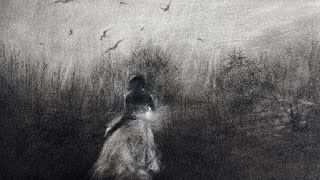 Atmospheric charcoal landscape drawing tutorialMad Charcoal · Broad charcoal masses and lifted lights; the closest thing on YouTube to a late Corot being made.
 Stone lithography at Edinburgh PrintmakersEdinburgh Printmakers · Grease and water on a stone, demonstrated in Edinburgh, Forrest's city.
The plan
3 stages · ~100 min- 1
Cylinder in light
20 minEnvelope the tower as a cylinder. Decide the light (from the left). Lay its three zones with the side of the 4B: lit, halftone, shadow. No stones.
FigureEvery building is cubes and cylinders. Checklist0 / 1 - 2
Trees and ground
50 minSide of the stick: the tree masses crowding the base, darkest where they touch the tower. Ground in long side-strokes. Keep the paper's grain showing.
Checklist0 / 2 - 3
Sky and compare
30 minSky as open scribble with the 2B. Compare with the print. Note where you drew a stone.
Checklist0 / 2
What it should look like
- A tower you believe is stone without a single stone, standing in crayon trees.
Where it goes wrong
- Masonry lines on the tower. You know it is stone. Erase them. The value turn is the stone.
Log this session
Start the clock when you pick up the pencil. Stop it when you put it down. Log it. Every session counts toward the box.
Status
How did it go?
Before this, ideally
Related studies
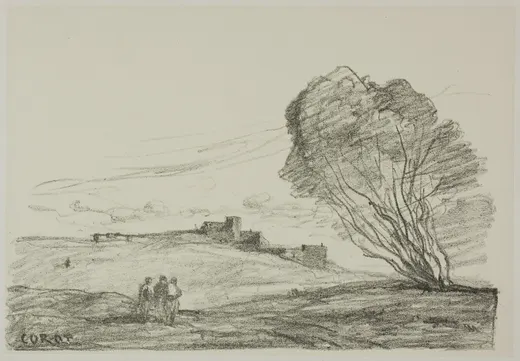 Master study
Corot · The lithographs
The Isolated Fort
Wind, a tree, a fort on the horizon
2h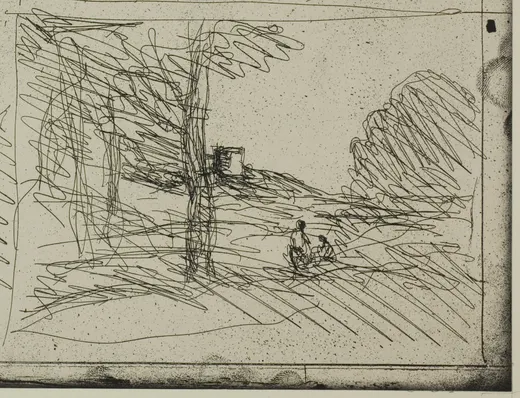 Master study
Corot · Cliché-verre: drawing on glass
The Tower of Henry VIII
A building in a scribble
1h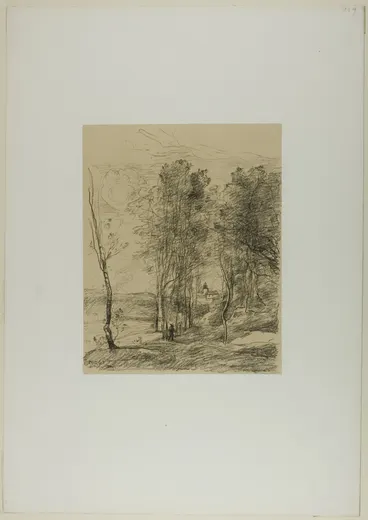 Master study
Corot · Towers, forts and bell towers
The Bell Tower of St. Nicolas-lez-Arras
A church spire as a thin vertical among trees
1.5h