The three divisions of light
The three divisions of light
Copy the structure of Bent Tree by the Water, then build your own
Organise a landscape into Corot's three divisions, each with its own value range, and keep them separate.
- Difficulty
- Time
- about 1 h
- You draw with
- 2B, 4B, 6B
Why this one
- Unit 3 of the program: Mass: the Corot Half.
- A landscape that recedes in three clear steps of value, with its darkest dark in front and its softest edge at the back.
From your kit
The whole kit →- 1Grafwood 2B, 4B, 6B 2B, 4B, 6B for the darks, on their sides for mass. Long points from the Blackwing on everything up to B.
- 2Pitt Matt 8B to 12B for the big tone passages: matt, so the dark mass reads as tone, not shine.
- 3Kneaded eraser (warm it) and the clean Mono Zero lift the lights out of the mass; the Mono Zero for sky holes and lit edges.
- 4Alpha sketchbook 9 x 6 draw at the book's size and keep the proportions; date the page.
In general, this study asks for
- Drawing pad
- 2B, 4B, 6B
- Kneaded eraser
Watch first
All videos →Broad charcoal masses and lifted lights; the closest thing on YouTube to a late Corot being made.
YouTube

The plan
5 stages · ~65 min- 1
Read the divisions
15 minStudy Bent Tree by the Water with the annotations. Three horizontal zones: the foreground with the tree, the cow and the darkest darks; a halftone plain; a pale distant strip under the lightest sky. Say the value range of each zone aloud: near 2 to 9, mid 3 to 5, far 1 to 3.
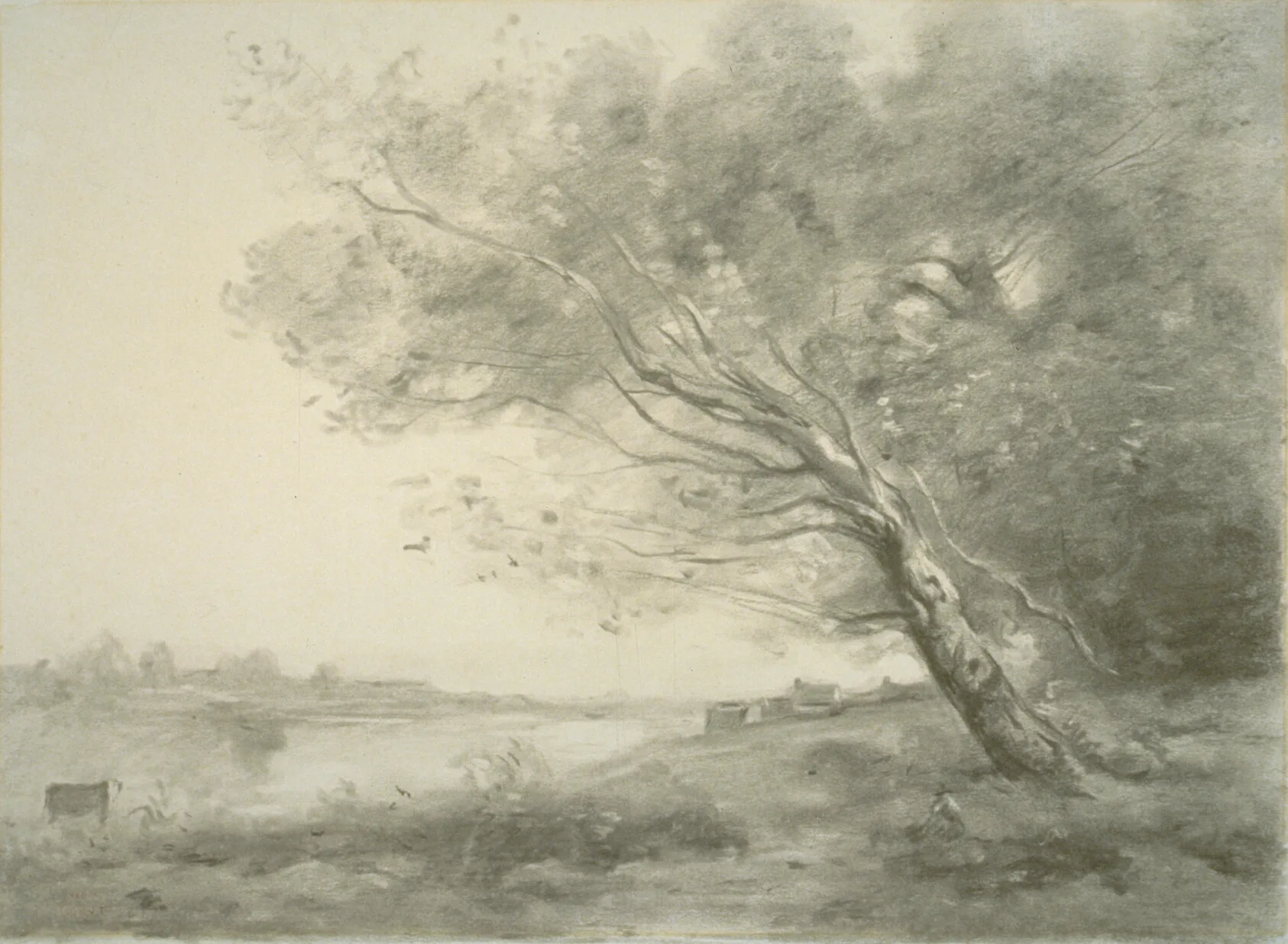
Corot, Bent Tree by the Water, 1860/70. Charcoal, with stumping and erasing, on cream wove paper, laid down on cream board.
Corot, Bent Tree by the Water, charcoal. Three divisions of light.
The Art Institute of Chicago · Harold Joachim Birthday Fund, purchased with funds provided by the Alsdorf Foundation, Mr. and Mrs. William O. Hunt and Frank B. Hubachek
Checklist0 / 1 - 2
Structure copy
15 minOn a half sheet, copy only the structure of the Corot: three horizontal bands of tone in the three value ranges, the tree as a single dark mass, the cow as a dark spot. No detail at all. Twenty minutes. It should look like the squint view, not the drawing.
FigureThree ranges that never overlap. Checklist0 / 1 - 3
Your own
15 minTake the thumbnail you circled last session. On a full sheet, enlarge it, assigning the three divisions: decide where near, mid and far fall, draw three faint lines, and give each its value range. Lay the big masses first. Keep every dark out of the far zone and every pale softness out of the near zone.
Checklist0 / 1 - 4
Audit the zones
15 minSquint at your drawing. Is there a dark in the distance pulling it forward? Lighten it. Is the foreground as dark as the tree in the Corot? If not, go darker; beginners never do. Lose at least one edge in the far zone.
Checklist0 / 1 - 5
Self-check
5 minTick each item honestly. If one is a no, the session is not finished; go back to that step.
Checklist0 / 4
What it should look like
- A landscape that recedes in three clear steps of value, with its darkest dark in front and its softest edge at the back.
Where it goes wrong
- A dark accent in the distance because the photo had one. Truth to the photo over truth to the design. Lighten it into the far zone's range. The design wins.
- Foreground not dark enough. Fear of the 6B. Find the darkest spot and take it to 9. Then everything else looks right.
Log this session
Start the clock when you pick up the pencil. Stop it when you put it down. Log it. Every session counts toward the box.
Status
How did it go?