A tree from masses
A tree from masses
Copy Prout's tree study, then draw a real tree the same way
Build a summer tree in four stages: silhouette, clumps, light and shadow on each clump, edge texture last.
- Master
- Samuel Prout
- Difficulty
- Time
- about 1 h
- You draw with
- 2B, 4B, 6B
Why this one
- Unit 3 of the program: Mass: the Corot Half.
- Two trees that read as masses with light on them, with texture only at their edges and not a single leaf drawn.
From your kit
The whole kit →- 1Grafwood 2B, 4B, 6B 2B, 4B, 6B for the darks, on their sides for mass. Long points from the Blackwing on everything up to B.
- 2Pitt Matt 8B to 12B for the big tone passages: matt, so the dark mass reads as tone, not shine.
- 3Kneaded eraser (warm it) and the clean Mono Zero lift the lights out of the mass; the Mono Zero for sky holes and lit edges.
- 4Alpha sketchbook 9 x 6 draw at the book's size and keep the proportions; date the page.
In general, this study asks for
- Drawing pad
- 2B, 4B, 6B
- Kneaded eraser
- A real tree in leaf, or a photo
Watch first
All videos →Shadow shapes as flat masses first. Shown on a portrait, but the principle is identical for a tree or a tower.
YouTube

The plan
4 stages · ~65 min- 1
Read Prout's tree
20 minStudy the Prout tree study. It is a sketchbook page, so it shows the method naked: a lobed silhouette, three or four clumps, scribbled texture only at the edges, the inside left as tone, a firm trunk. Point to each clump.
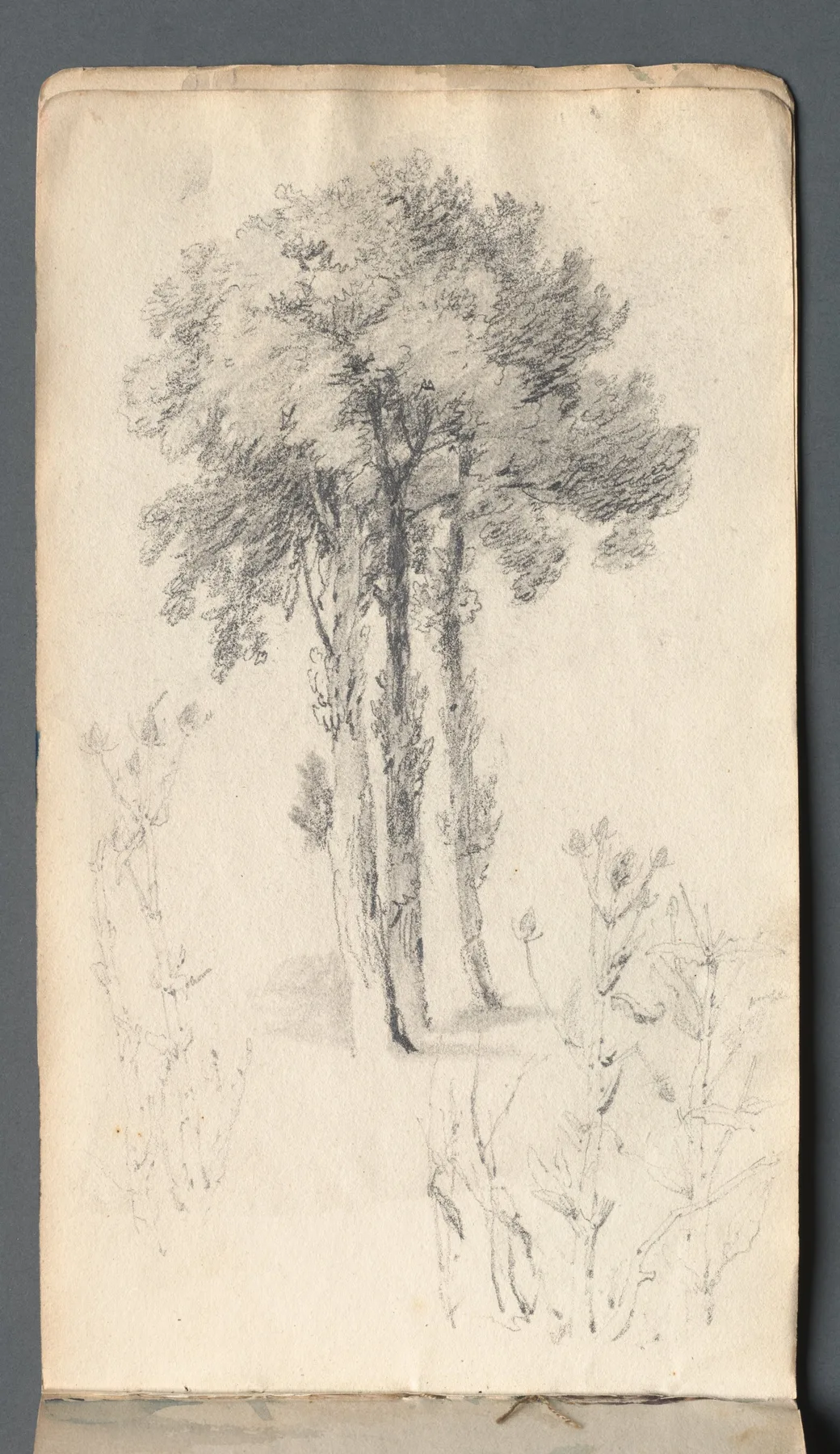
Prout, Sketchbook: Tree Study, 1814. graphite.
Prout, Sketchbook: Tree Study, 1814, graphite.
The Cleveland Museum of Art · Gift of Mr. and Mrs. Herbert N. Bier, London
Checklist0 / 1 - 2
Copy it in four stages
20 minStage one: the whole silhouette, lightly, one lobed shape plus the trunk's position. Stage two: divide into three to five clumps. Stage three: a lit top and a shadowed underside on each clump; lower clumps darker. Stage four: broken scribble along the outer edges of the lit clumps only. Thirty minutes.
FigureSilhouette, clumps, light and shadow, edge texture. Checklist0 / 1 - 3
A real tree
20 minSame four stages from life or your photo. Squint for the silhouette and the clumps; open your eyes only for stage four. Lift two or three lights from the clump tops with the kneaded eraser instead of leaving them white.
Checklist0 / 1 - 4
Self-check
5 minTick each item honestly. If one is a no, the session is not finished; go back to that step.
Checklist0 / 4
What it should look like
- Two trees that read as masses with light on them, with texture only at their edges and not a single leaf drawn.
Where it goes wrong
- Scribble across the whole canopy. Texture felt like progress. Erase back to flat clumps. Texture only on the outer edge of the lit clumps.
- A round, symmetrical silhouette. The symbol for tree. Draw the silhouette by the sky shapes around it.
Log this session
Start the clock when you pick up the pencil. Stop it when you put it down. Log it. Every session counts toward the box.
Status
How did it go?