View of Ponte Lugano on the Anio
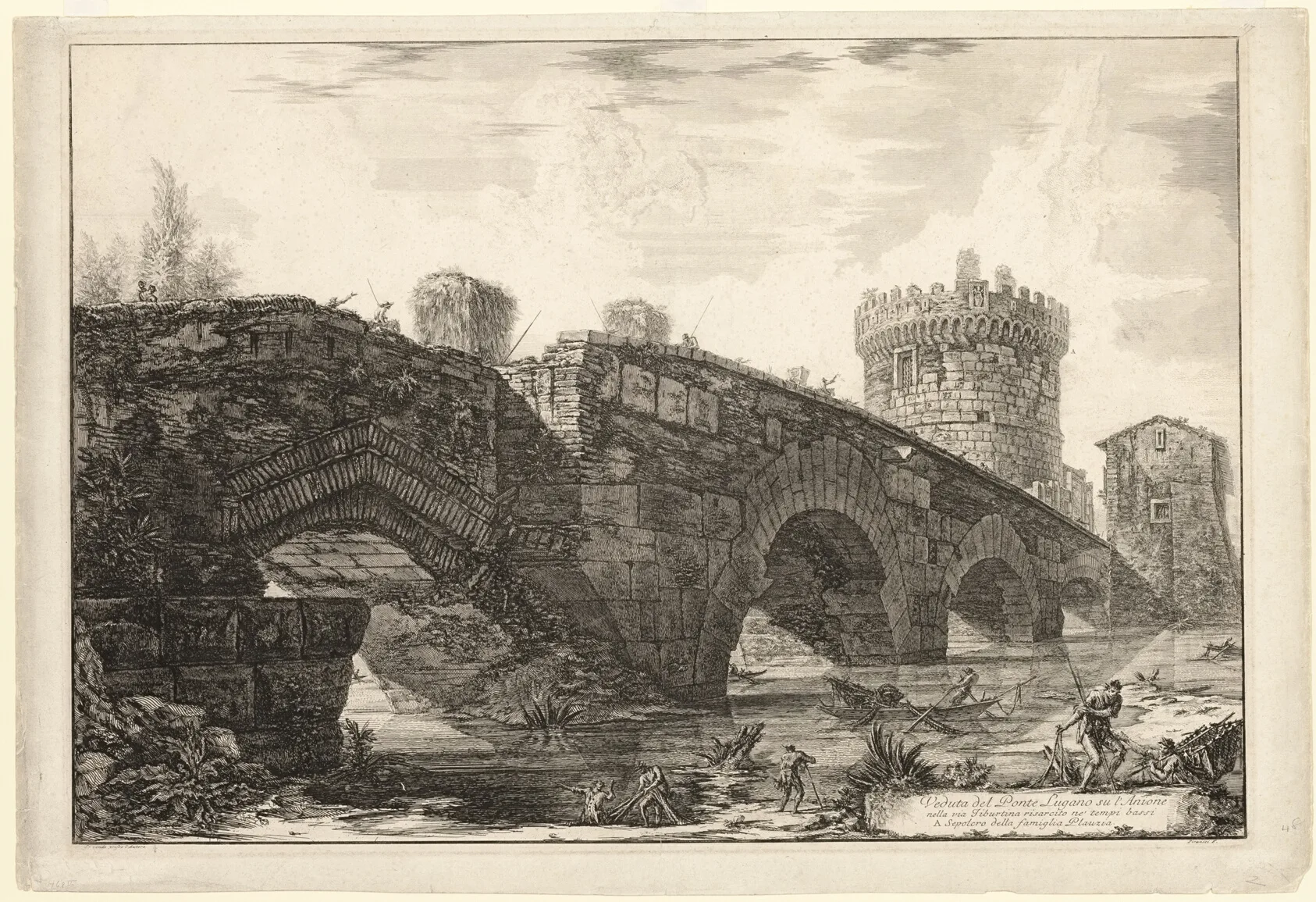
Piranesi, View of Ponte Lugano on the Anio, from Views of Rome, 1763, published 1800–07. Etching on heavy ivory laid paper.
Pins mark where to look before you draw.
The Art Institute of Chicago · Elizabeth Hammond Stickney Collection
View of Ponte Lugano on the Anio
A Roman bridge and a tomb, drawn big
1763, from the Views of Rome: the ancient bridge over the Anio with the round tomb of the Plautii beside it, a dramatic sky, figures for scale. Round arches in perspective, a cylinder in light, and Piranesi's broken, directional sky.
- Difficulty
- Time
- about 3 h
- You draw with
- H, HB, 2B graphite
Why this one
- Round arches and a cylinder together.
- A sky drawn with broken directional lines, never flat hatch.
From your kit
The whole kit →- 1Grafwood H, HB, 2B H, HB for layout and line; 2B for the darks. Long points from the Blackwing on everything up to B.
- 2Kneaded eraser and the Mono Zero press-and-lift corrections only; the Mono Zero for a single sharp light.
- 3Alpha sketchbook 9 x 6 draw at the book's size and keep the proportions; date the page.
In general, this study asks for
- Drawing pad or smooth cartridge
- 2H and H with long points
- HB for accents
- Kneaded eraser
- Sandpaper block
Watch first
All videos →The whole Vedute series paged through. Note how small the figures are and how large Rome becomes.
YouTube
The plan
3 stages · ~180 min- 1
Structure
60 minEye level, bridge arches from centres, tomb as a cylinder.
Checklist0 / 2 - 2
Tone and sky
90 minCounted hatch on the stone; sky in broken sweeping lines.
Checklist0 / 1 - 3
Figures and audit
30 minTiny figures. Squint. Box.
Checklist0 / 1
What it should look like
- A Roman bridge and tomb with a sky that moves.
Where it goes wrong
- Flat hatched sky. Habit. Sweep. Break. Follow the clouds.
Log this session
Start the clock when you pick up the pencil. Stop it when you put it down. Log it. Every session counts toward the box.
Status
How did it go?
Before this, ideally