Architecture
LineThe round arch
A semicircle with its centre on the springing line, radius half the span. Voussoirs radiate from the centre; the keystone sits at the top. Draw three joints that point to the centre and the eye believes the rest.
The Romanesque (Norman) arch, and the bridge arch, is a semicircle. Its centre is the midpoint of the springing line and its radius is half the span. The stones of the arch, the voussoirs, are wedges whose joints all point at that centre; the one at the top is the keystone. Below the springing line the arch rests on an impost, a projecting block on top of the pier.
You do not need to draw every voussoir. Draw the inner and outer curves accurately, then three or four joints that genuinely radiate from the centre, and suggest the rest with breaks in the outer curve. The eye completes it.
Cotman's Haute Allemagne tower has round-headed belfry openings; Meryon's bridges are rows of these in perspective; Roberts's Dole bridge too. The construction is the same every time.
From your kit
The whole kit →- 1Grafwood H, long point arches, tracery and mouldings are compass geometry drawn freehand; a hard long point keeps it light until it is right.
- 2Grafwood HB and 2B the committed line and the dark of a window void.
- 3Mono Zero a lit edge on a moulding, or a mullion drawn back out of a dark window.
Visuals
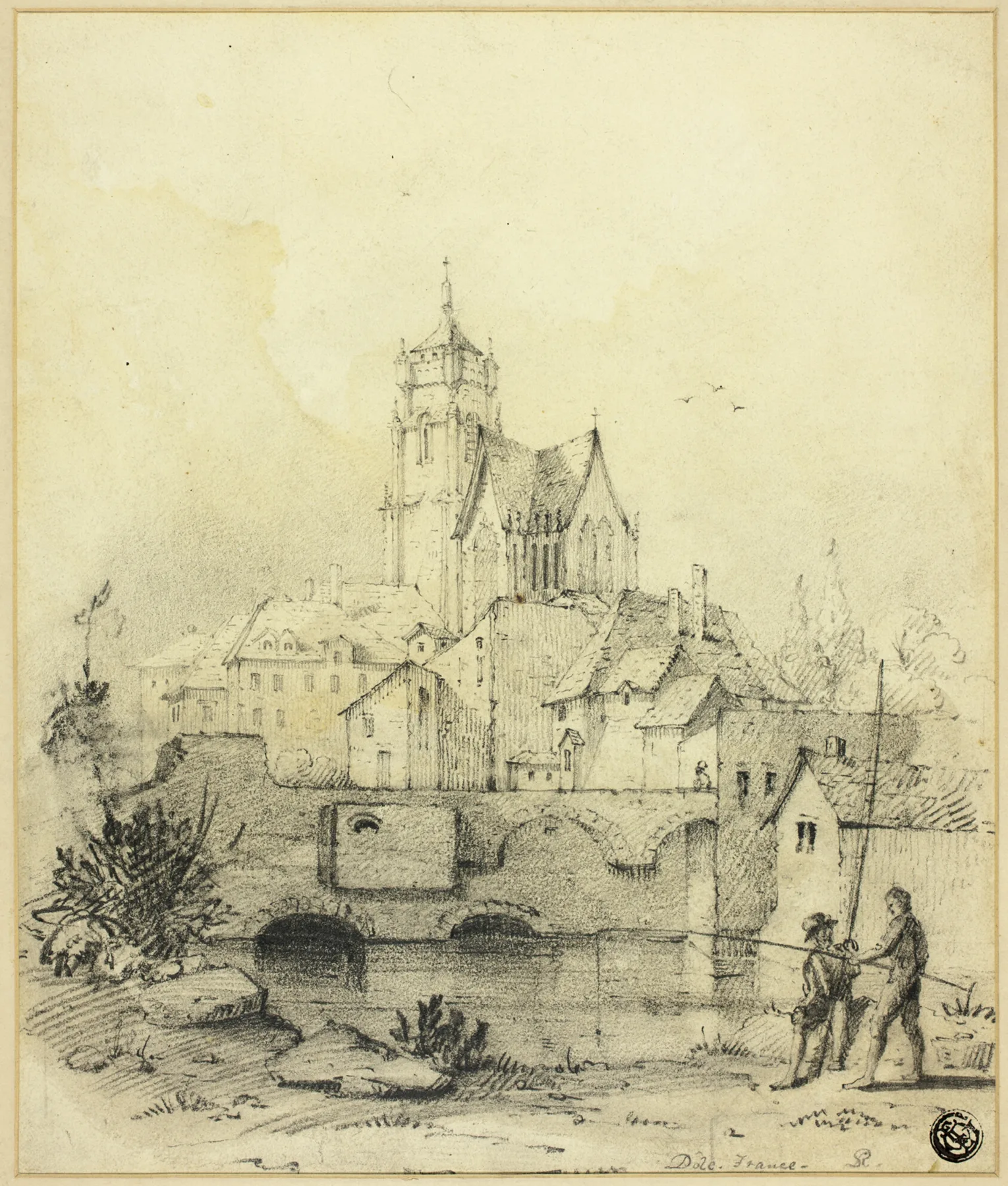
Roberts, Dole, France, n.d.. Graphite and black crayon, on cream wove paper, laid down on tan board.
David Roberts, Dole, France. The bridge arches below the town are semicircles seen slightly obliquely; their joints are only suggested.
The Art Institute of Chicago · The Leonora Hall Gurley Memorial Collection
Pitfalls
What
Voussoir joints drawn vertical.
Why
The arch looks like a stack of bricks, not a ring of wedges.
Fix
Every joint aims at the centre. Draw a faint dot at the centre and check.