Line
LineAn arch in perspective
Head-on, a semicircle in a square. Oblique, half an ellipse in a foreshortened square, apex shifted toward the near side. Draw the square first, then fit the curve.
A round arch seen head-on is a semicircle sitting on a square whose side is the span, with its centre on the springing line. Seen obliquely it becomes part of an ellipse, and the ellipse lives inside the same square foreshortened by perspective. The apex is no longer in the middle: it moves toward the near side, because the near half of the square is wider than the far half.
So never draw the curve freehand from imagination. Draw the perspective square first (its verticals plumb, its top and bottom converging), find its centre with diagonals, drop the centre line, and then fit the curve to touch the top at the centre line and spring from the two bottom corners. The curve is then right by construction.
The same logic applies to pointed arches: construct the enclosing shape in perspective, then strike the two arcs inside it. Cotman's Rievaulx and Meryon's bridges are ellipses that know which square they live in.
From your kit
The whole kit →- 1Grafwood 2H and H, long points construction lines you can leave in: eye level, vanishing traces, bay divisions.
- 2Grafwood F or HB the drawn line over the construction, broken and weighted.
- 3Grafwood 2B the few counted accents that make the line read as stone.
Visuals
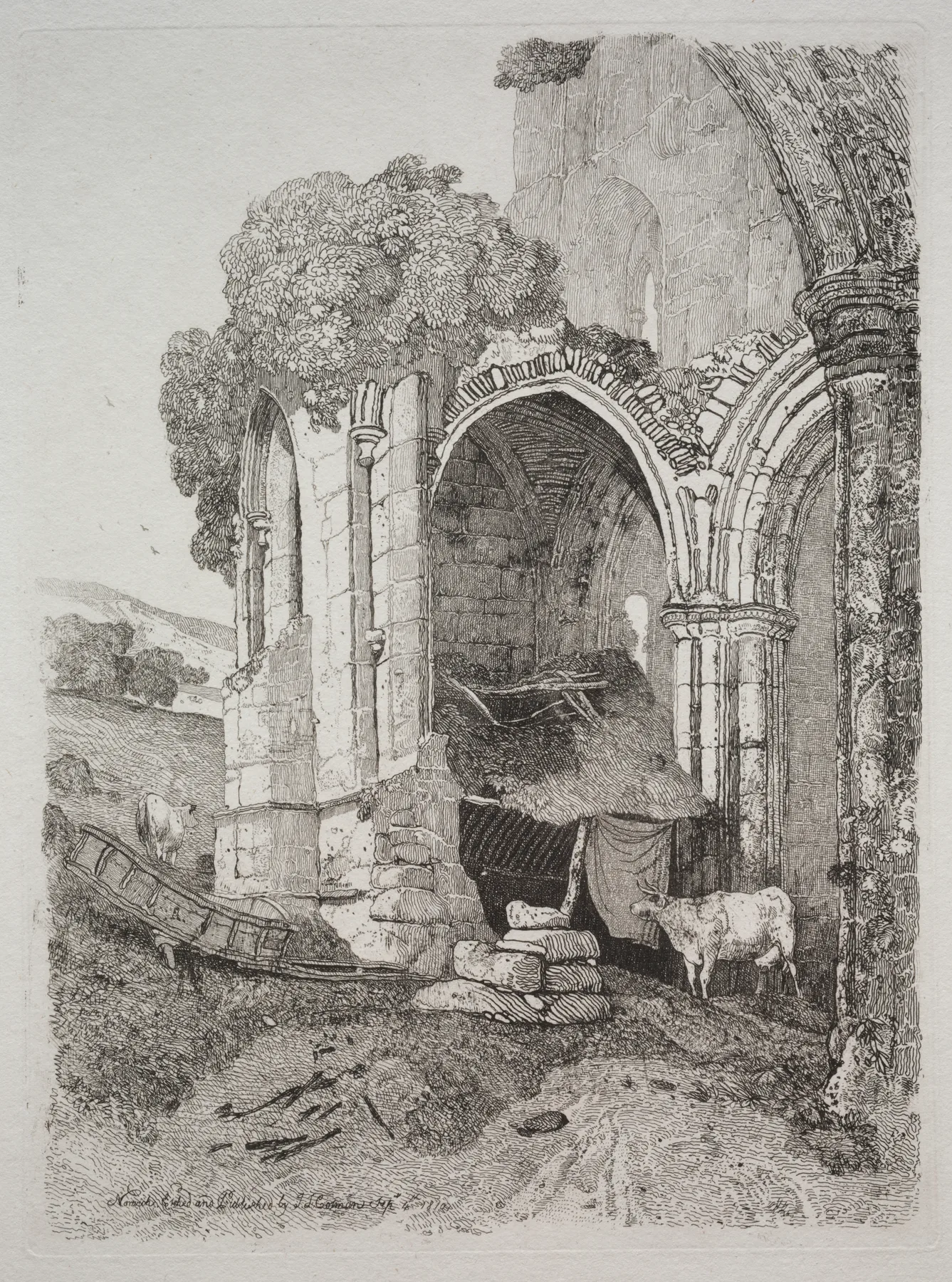
Cotman, Rievaulx Abbey, Yorkshire, 1810. etching.
Cotman, Rievaulx Abbey, Yorkshire (etching, 1810). The pointed arches are seen obliquely: each is a construction inside a foreshortened opening, apex shifted toward us.
The Cleveland Museum of Art · John L. Severance Fund
Pitfalls
What
A symmetrical arch drawn on an oblique wall.
Why
The arch appears to be facing you while its wall faces away; the building twists.
Fix
Draw the perspective square first. Let the apex move.