Tone from line
The etcher's value scale: each layer of hatching crosses the last at a new angle. Paper, one layer, two, three, four. Every shadow is a counted number of layers.
An etcher cannot press harder. Every line is the same black, so every value is a count: bare paper for the lights, one layer of parallel hatch for a light halftone, a second crossing it at about sixty degrees for halftone, a third at a shallow angle for shadow, a fourth for near-black. Keep the spacing even within each layer and the line weight constant, and the layers add up to a clean scale.
Working this way with a pencil is the best training for the Line half of the course because it forces decisions. Before you hatch a wall you must decide its value, and therefore how many layers it gets, and therefore where it sits relative to every other plane. Meryon's Notre-Dame is this discipline carried through an entire city.
A practical sequence for a building: lay one layer over everything in shadow. Lay a second over everything in deep shadow. Lay a third only in the openings and under projections. Then stop and squint.
From your kit
The whole kit →- 1Grafwood H and HB, needle points etcher's tone: parallel lines whose spacing is the value. Hard grades keep the lines lines.
- 2Grafwood 2B the cross-hatch in the darkest third only.
Visuals
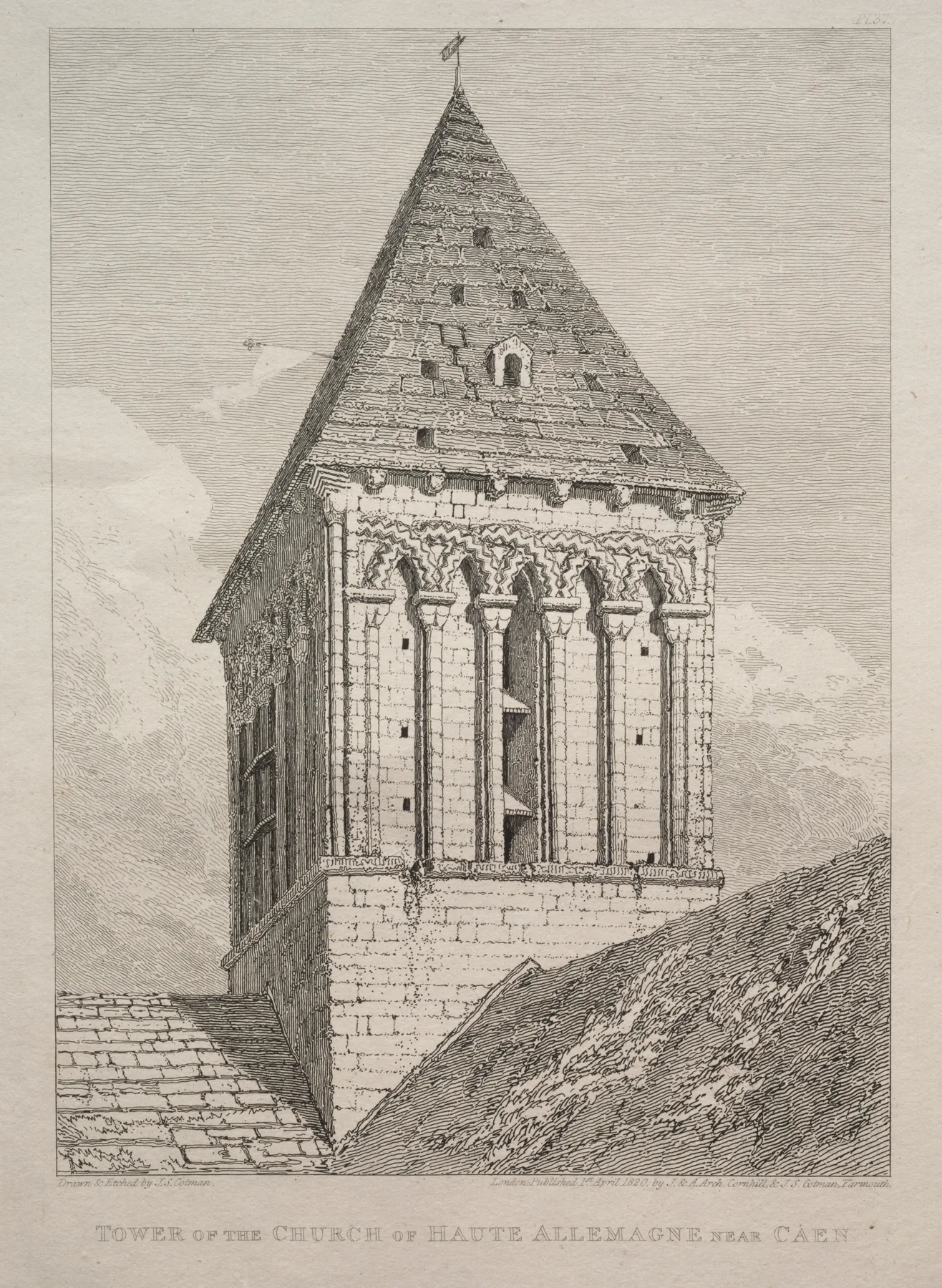
Cotman, Tower of the Church of Haute Allemagne near Caen, 1822. etching.
Cotman, Tower of the Church of Haute Allemagne (etching). Count the layers on the shadow face of the tower, under the eaves, and inside the belfry openings.
The Cleveland Museum of Art · Gift of William C. Keough
Pitfalls
What
Layers crossed at ninety degrees.
Why
A grid reads as a screen, not a tone.
Fix
First layer at 45, second at about 105, third near horizontal.