Constructing a pointed arch
Equilateral: two arcs, each centred on the opposite springing point, radius equal to the span, meeting at the apex. Lancet if the radius is longer, drop arch if shorter.
The Gothic pointed arch that fills Melrose, Dryburgh and Rievaulx is a compass construction. Mark the two springing points where the arch leaves the vertical jambs. Set the radius equal to the distance between them (the span). Swing an arc from each springing point, centred on the other one. They meet at the apex, which sits at a height of about 0.87 times the span above the springing line. That is the equilateral arch, the commonest of all.
Lengthen the radius beyond the span and the arch gets taller and narrower: a lancet, the Early English type. Shorten it and the arch gets lower and blunter: a drop arch. In the field you do not have a compass, so you sight the apex height against the span with the pencil and ghost the two arcs by hand, knowing where their centres are.
Once you can strike this arch, every abbey in Britain is drawable. The arcade is a row of them (dividing bays), the window is one with tracery inside (next), and the vault is the same arch in perspective.
From your kit
The whole kit →- 1Grafwood H, long point arches, tracery and mouldings are compass geometry drawn freehand; a hard long point keeps it light until it is right.
- 2Grafwood HB and 2B the committed line and the dark of a window void.
- 3Mono Zero a lit edge on a moulding, or a mullion drawn back out of a dark window.
Visuals
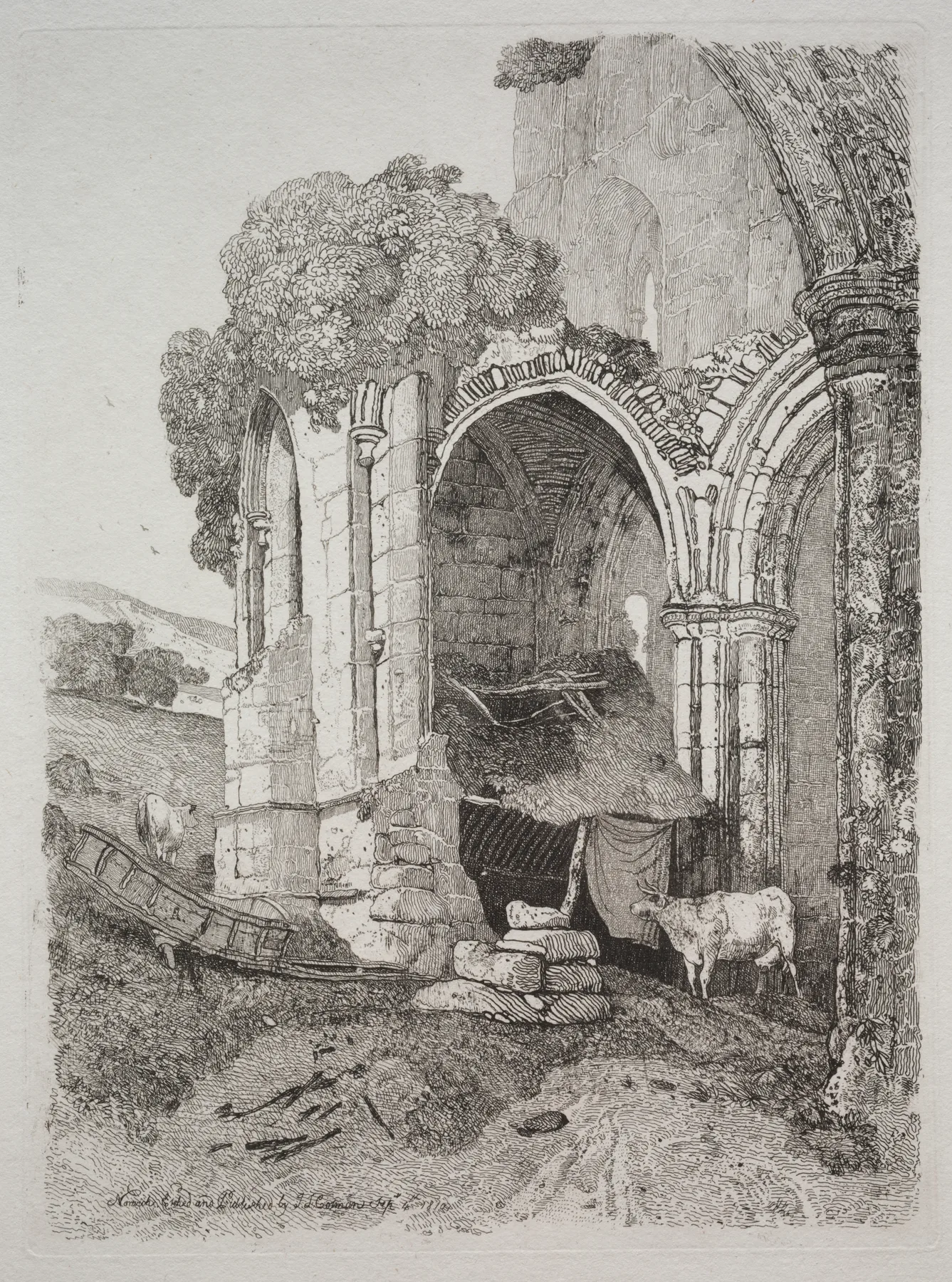
Cotman, Rievaulx Abbey, Yorkshire, 1810. etching.
Cotman, Rievaulx Abbey. The great arches are equilateral or near it. Find each pair of springing points and check the apex height against the span.
The Cleveland Museum of Art · John L. Severance Fund
Pitfalls
What
An arch drawn as a pointed oval, bulging at the sides.
Why
The arcs were started from the wrong centres.
Fix
Centre each arc on the opposite springing point. The sides are straight-ish near the bottom.