Portrait of Abbé Jouveau
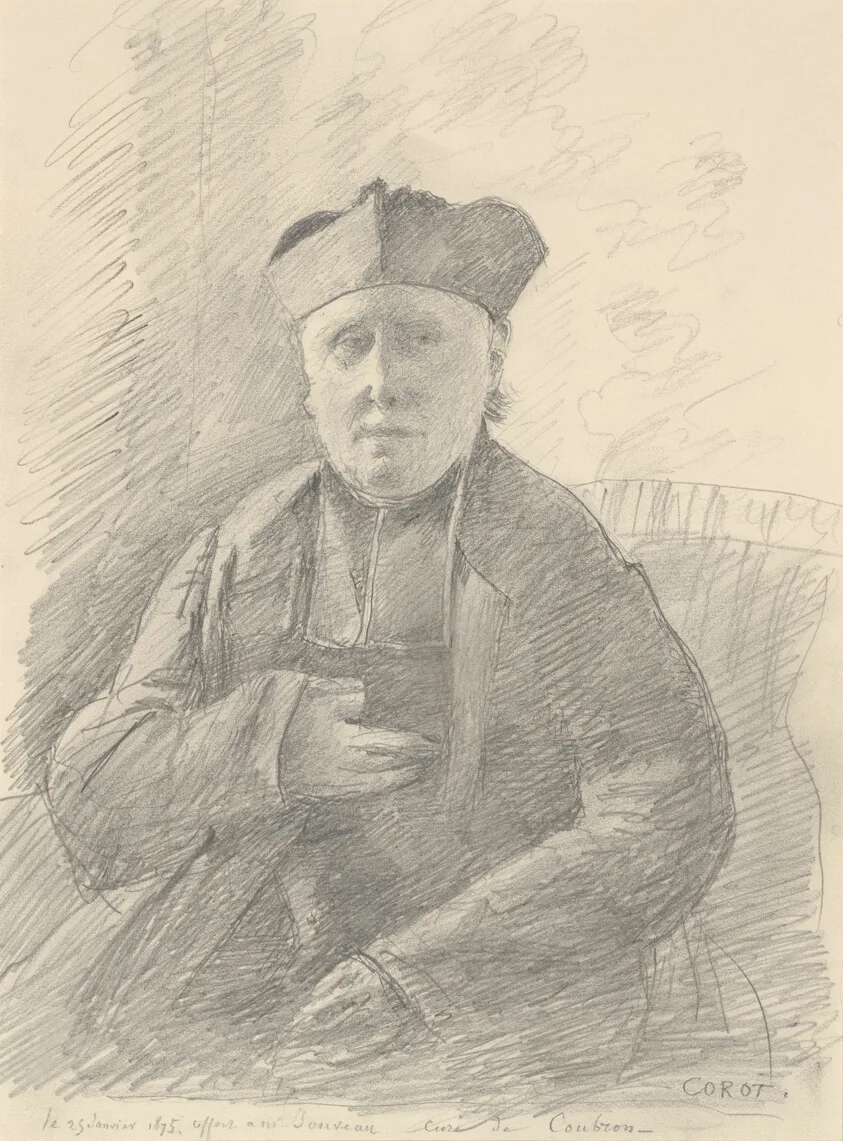
Corot, Portrait of Abbé Jouveau, 1875. Graphite, with traces of charcoal, on ivory wove paper.
Pins mark where to look before you draw.
The Art Institute of Chicago · Helen Regenstein Collection
Portrait of Abbé Jouveau
A face in the last year, in graphite
1875, graphite with traces of charcoal: a priest in his biretta, seated, hands folded, drawn in the year Corot died. The face is built like one of his hill towns: a few exact placements, then soft tone, then almost nothing. A portrait study for a landscape course, because the method does not change.
- Difficulty
- Time
- about 2 h
- You draw with
- HB and 2B graphite
Why this one
- Shows that Corot drew a head the way he drew a tree: mass, then a few exact lines.
- A late, unhurried sheet with every decision visible.
From your kit
The whole kit →- 1Grafwood HB, 2B HB for layout and line; 2B for the darks. Long points from the Blackwing on everything up to B.
- 2Kneaded eraser and the Mono Zero press-and-lift corrections only; the Mono Zero for a single sharp light.
- 3Alpha sketchbook 9 x 6 draw at the book's size and keep the proportions; date the page.
In general, this study asks for
- Drawing pad
- HB and 2B with long points
- Kneaded eraser
Watch first
All videos →Shadow shapes as flat masses first. Shown on a portrait, but the principle is identical for a tree or a tower.
YouTube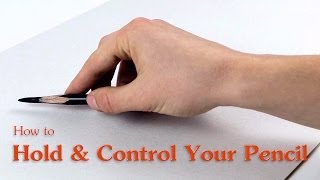
The plan
3 stages · ~110 min- 1
Envelope the figure
20 minHat, head, shoulders, hands as a simple envelope. Measure head height against the whole figure.
Checklist0 / 1 - 2
Masses of light and shadow
50 minSide of the HB: the shadow side of the face and the body as flat masses. Lit side left as paper.
Checklist0 / 2 - 3
A few exact lines
40 minWith the 2B point: eyes, the line of the mouth, the hat's edge, the fold of the hands. Count your lines. Stop early.
Checklist0 / 2
What it should look like
- A head that reads at arm's length, with fewer lines than you believed a face needs.
Where it goes wrong
- Rendering the face. Faces attract pencils. Treat it as a sphere in light with four marks on it.
Log this session
Start the clock when you pick up the pencil. Stop it when you put it down. Log it. Every session counts toward the box.
Status
How did it go?
Before this, ideally