Meet the two hands
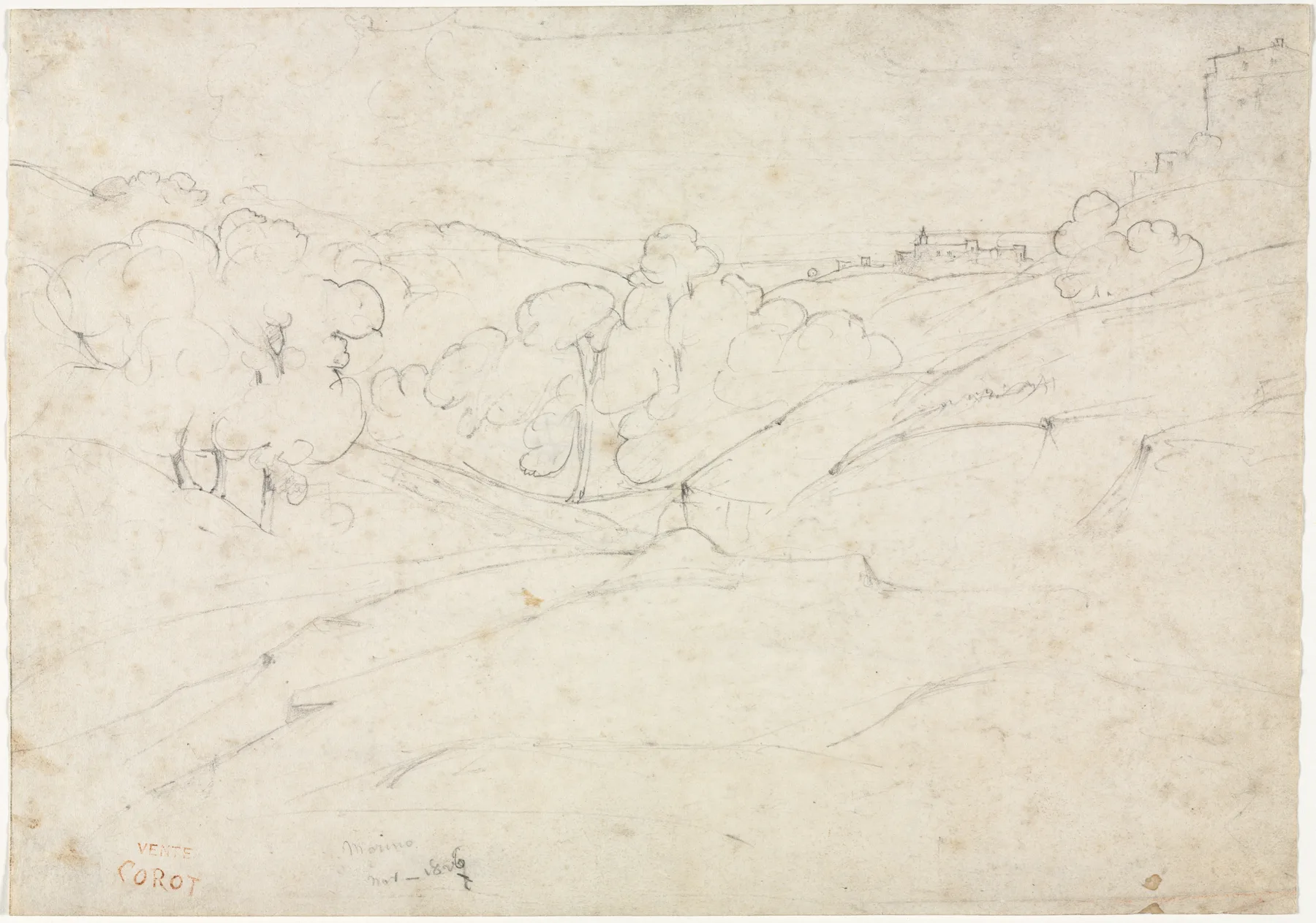
Corot, View of Marino (recto), 1827. graphite.
The Cleveland Museum of Art · Gift of Robert Hays Gries
Meet the two hands
A looking session: six drawings, no pencil
Learn to look at a master drawing for what it does rather than what it shows, and feel the difference between the Mass hand and the Line hand.
- Difficulty
- Time
- about 0.5 h
- You draw with
- graphite
Why this one
- Unit 0 of the program: Before the First Mark.
- A sheet with two columns and six observations.
From your kit
The whole kit →- 1Kneaded eraser and the Mono Zero press-and-lift corrections only; the Mono Zero for a single sharp light.
- 2Alpha sketchbook 9 x 6 draw at the book's size and keep the proportions; date the page.
In general, this study asks for
- No materials. This is a looking session.
Watch first
All videos →Squinting, value scales and why beginners under-read darks.
YouTube Practice simplifying values with notan studiesProko · Two- and three-value notan, the exact exercise the Mass studies start with.
 How to simplify your light and shadow shapesDrawing Tutorials Online · Shadow shapes as flat masses first. Shown on a portrait, but the principle is identical for a tree or a tower.
The plan
7 stages · ~35 min- 1
The young Corot: line
5 minLook at View of Marino for two full minutes. Notice how little is on the page. A hill town in the upper right, placed with a few exact strokes. Foreground trees as outlined clumps, barely shaded. Acres of untouched paper. Now notice that despite all that emptiness you know exactly where everything is and how far away. This is the Line hand: edges placed with precision, tone almost absent.
Corot, View of Marino (recto), 1827. graphite.
Corot, View of Marino, 1827, graphite.
The Cleveland Museum of Art · Gift of Robert Hays Gries
Checklist0 / 1 - 2
The old Corot: mass
5 minNow The Large Tree, forty years later, in charcoal. Squint. One huge dark mass, a light sky breaking through on the right, almost nothing you could call a line. Toggle the squint view and see that it barely changes: the drawing was already a squint. This is the Mass hand. Where the Marino drawing describes edges, this one describes light.
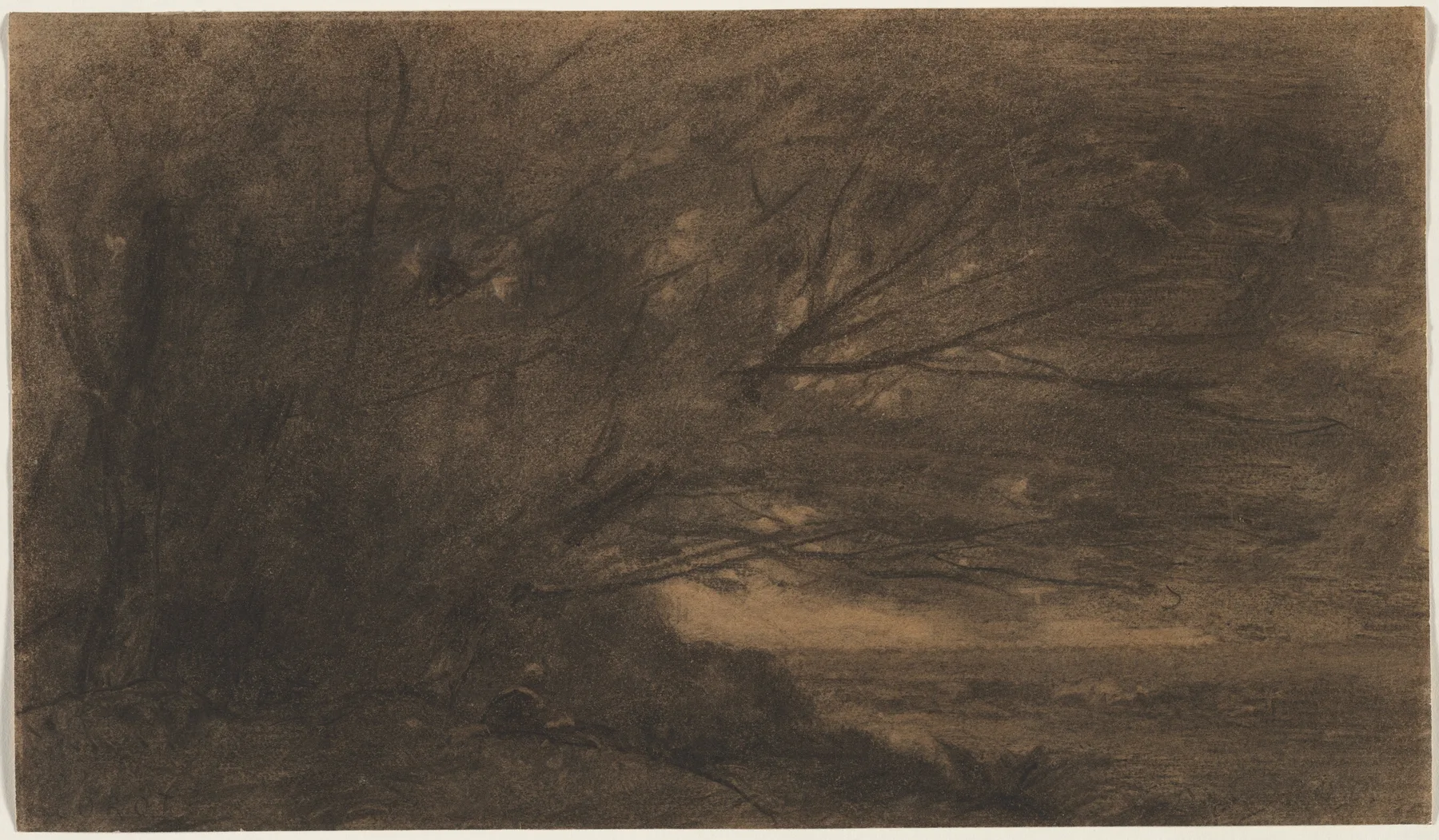
Corot, Landscape (The Large Tree), c. 1865–70. charcoal with stumping, erasing, and wet brushwork on light brown wove paper.
Corot, Landscape (The Large Tree), c. 1865 to 1870, charcoal.
The Cleveland Museum of Art · Bequest of Muriel Butkin
Checklist0 / 1 - 3
Cotman: architecture in line
5 minCley Church. Every window, buttress and parapet placed exactly, with a grey wash for the shadow side and nothing else. Squint and it is three flat shapes: light sky, mid church, dark openings. Look at the windows: the tracery is a construction, not decoration. This is what the Architecture unit will teach you to do.
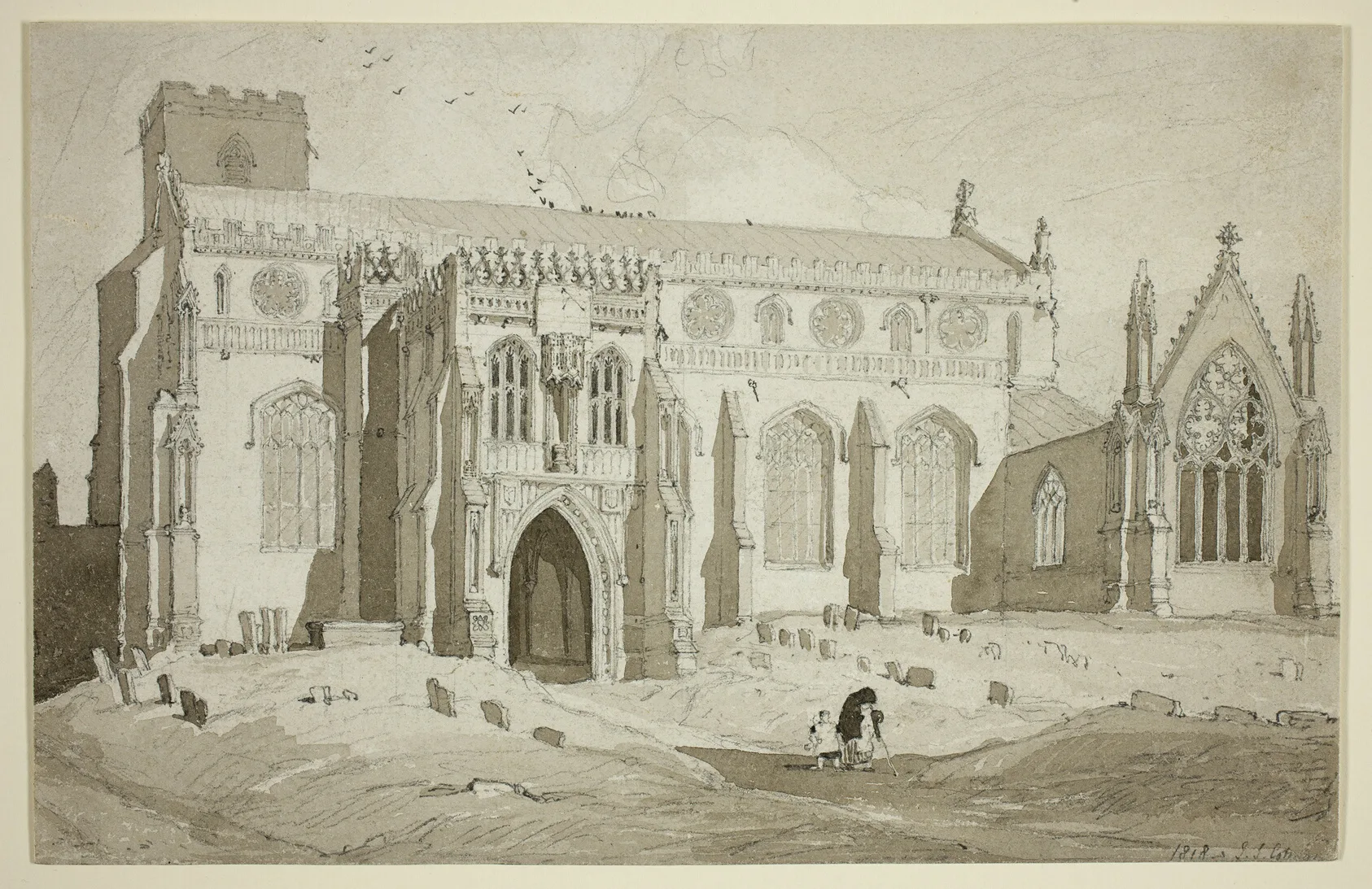
Cotman, Cley Church, Norfolk, 1818. Graphite and gray wash on ivory wove paper.
Cotman, Cley Church, Norfolk, 1818, graphite and grey wash.
The Art Institute of Chicago · Gift of Dorothy Braude Edinburg to the Harry B. and Bessie K. Braude Memorial Collection
Checklist0 / 1 - 4
Prout: the broken line and the figure
5 minThe Rathaus at Ulm. Find a long edge and notice it is not one line but a chain of short broken ones. Find the figures in the square: their heads all sit at the same height, which is the eye level. Find the shapes of sky between the gables. Prout was looking at those shapes as hard as at the building.
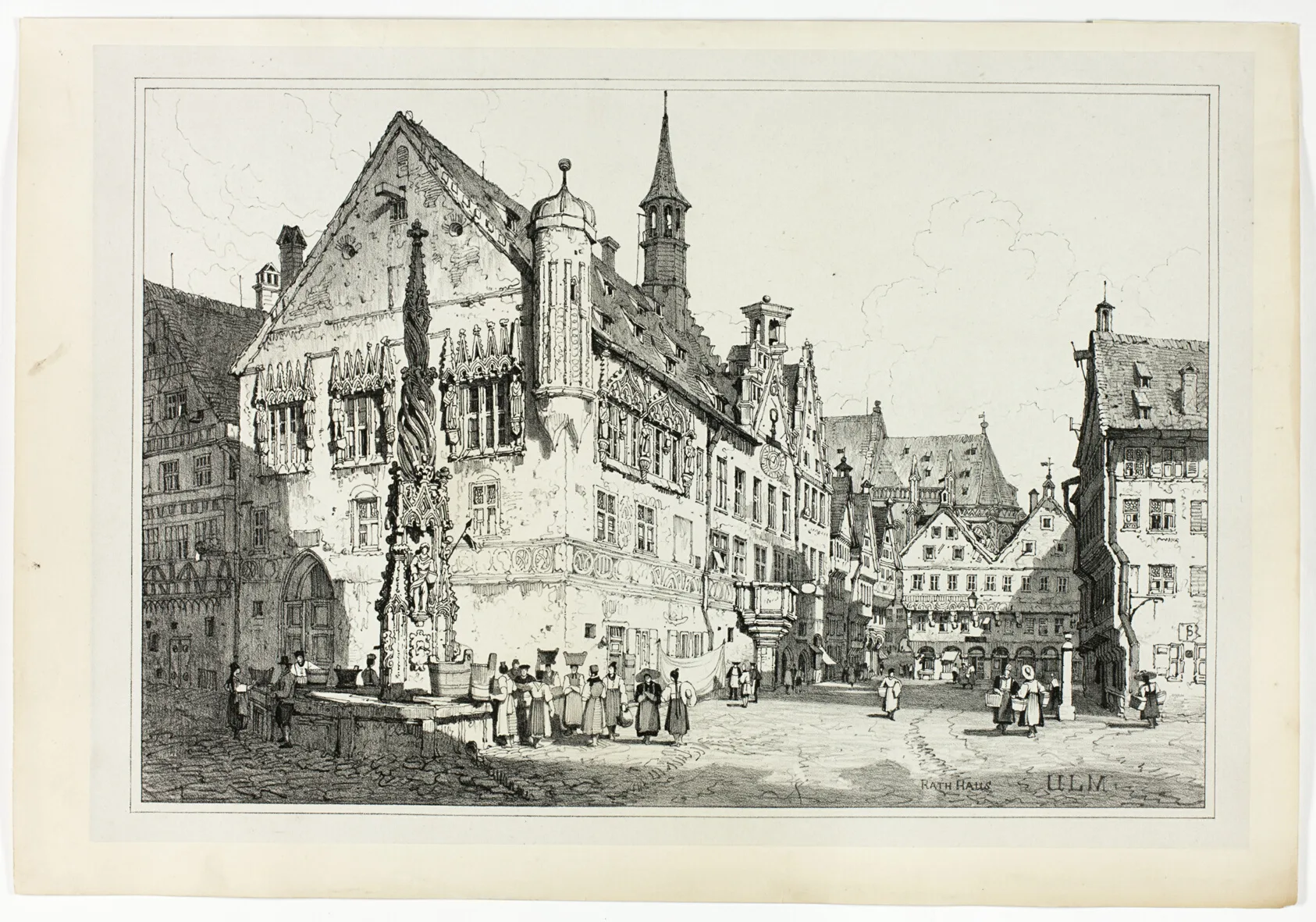
Prout, Rath Haus, Ulm, from Facsimiles of Sketches made in Flanders and Germany, 1833. Lithograph in black on grayish-ivory chine, laid down on ivory wove paper.
Prout, Rath Haus, Ulm, 1833, lithograph after his sketch.
The Art Institute of Chicago · The Leonora Hall Gurley Memorial Collection
Checklist0 / 1 - 5
Meryon: tone from line
5 minThe Apse of Notre-Dame. Toggle the squint view: the lines vanish and leave clean values. Toggle back: every one of those values is a count of hatch layers. This is the discipline of the Line unit, and it is the same discipline Forrest brought to Melrose and Dryburgh.
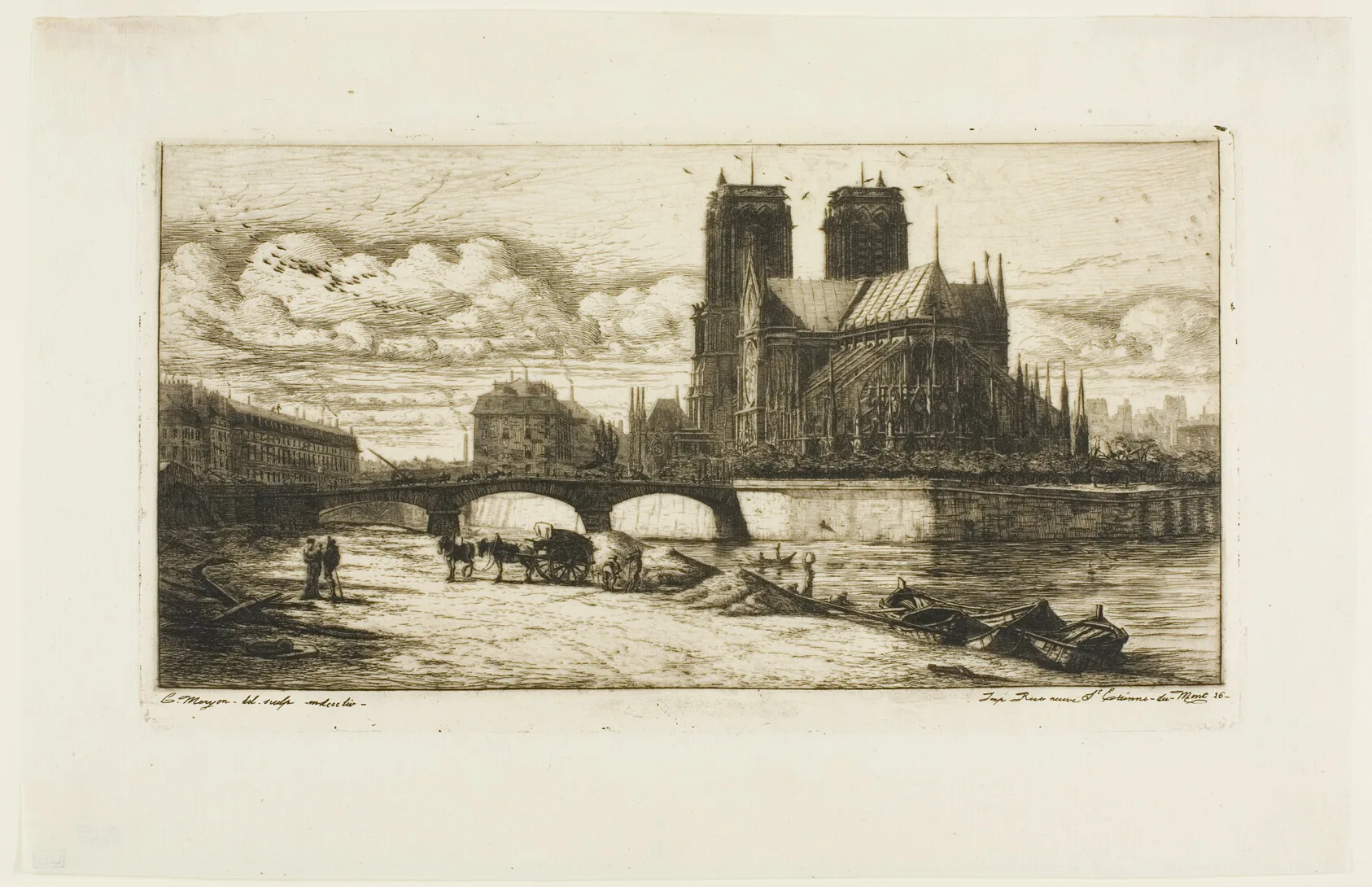
Meryon, The Apse of Notre-Dame, Paris, 1854. Etching and drypoint ivory laid paper.
Meryon, The Apse of Notre-Dame, Paris, 1854, etching and drypoint.
The Art Institute of Chicago · Clarence Buckingham Collection
Checklist0 / 1 - 6
Say what you saw
5 minOn a sheet of paper, write two columns: MASS and LINE. Under each, write three things you noticed, in your own words. There are no wrong answers. Date it and put it in the box. In six months you will read it and laugh, which is the point.
Checklist0 / 1 - 7
Self-check
5 minTick each item honestly. If one is a no, the session is not finished; go back to that step.
Checklist0 / 3
What it should look like
- A sheet with two columns and six observations.
Where it goes wrong
- Trying to draw the masterworks today. You do not have the control yet and the result will discourage you. Look only. Copying comes in units 3 to 7, when it will work.
Log this session
Start the clock when you pick up the pencil. Stop it when you put it down. Log it. Every session counts toward the box.
Status
How did it go?