The six marks
The six marks
A sampler sheet of every hatch family
Produce clean examples of parallel, cross, contour, scumble, stipple and broken-line hatching, and know what each is for.
- Difficulty
- Time
- about 0.5 h
- You draw with
- HB, 2B
Why this one
- Unit 1 of the program: Instrument Control.
- Six distinct textures, each even within itself, each clearly different from its neighbours.
From your kit
The whole kit →- 1Grafwood HB, 2B HB for layout and line; 2B for the darks. Long points from the Blackwing on everything up to B.
- 2Kneaded eraser and the Mono Zero press-and-lift corrections only; the Mono Zero for a single sharp light.
- 3Alpha sketchbook 9 x 6 draw at the book's size and keep the proportions; date the page.
In general, this study asks for
- Drawing pad
- HB, 2B
Watch first
All videos →On the quality of each individual line inside a hatch, which is what separates Meryon from a beginner.
YouTube Sketch like an architect: techniques and tips from a real project30X40 Design Workshop · Line weight hierarchy and when to stop, from an architect.
 How Rembrandt made his prints: a demonstrationChristie's · Filmed at the Rembrandt House. The clearest view of drawing with a needle through ground, which is why etched line looks the way it does.
The plan
5 stages · ~45 min- 1
Six boxes
10 minDraw six two-inch boxes, two rows of three. Label them parallel, cross, contour, scumble, stipple, broken.
FigureThe target sampler. Checklist0 / 1 - 2
Parallel and cross
10 minBox one: parallel lines at forty-five degrees, even spacing, even weight, covering the box. Box two: the same, then a second layer crossing at about sixty degrees (not ninety; ninety makes a window screen). Keep each layer complete before starting the next.
Checklist0 / 1 - 3
Contour and scumble
10 minBox three: curved lines that all bend the same way, as if wrapping a cylinder. Box four: loose overlapping circles, the pencil never leaving the paper, building up a soft even tone. This is Corot's foliage and ground.
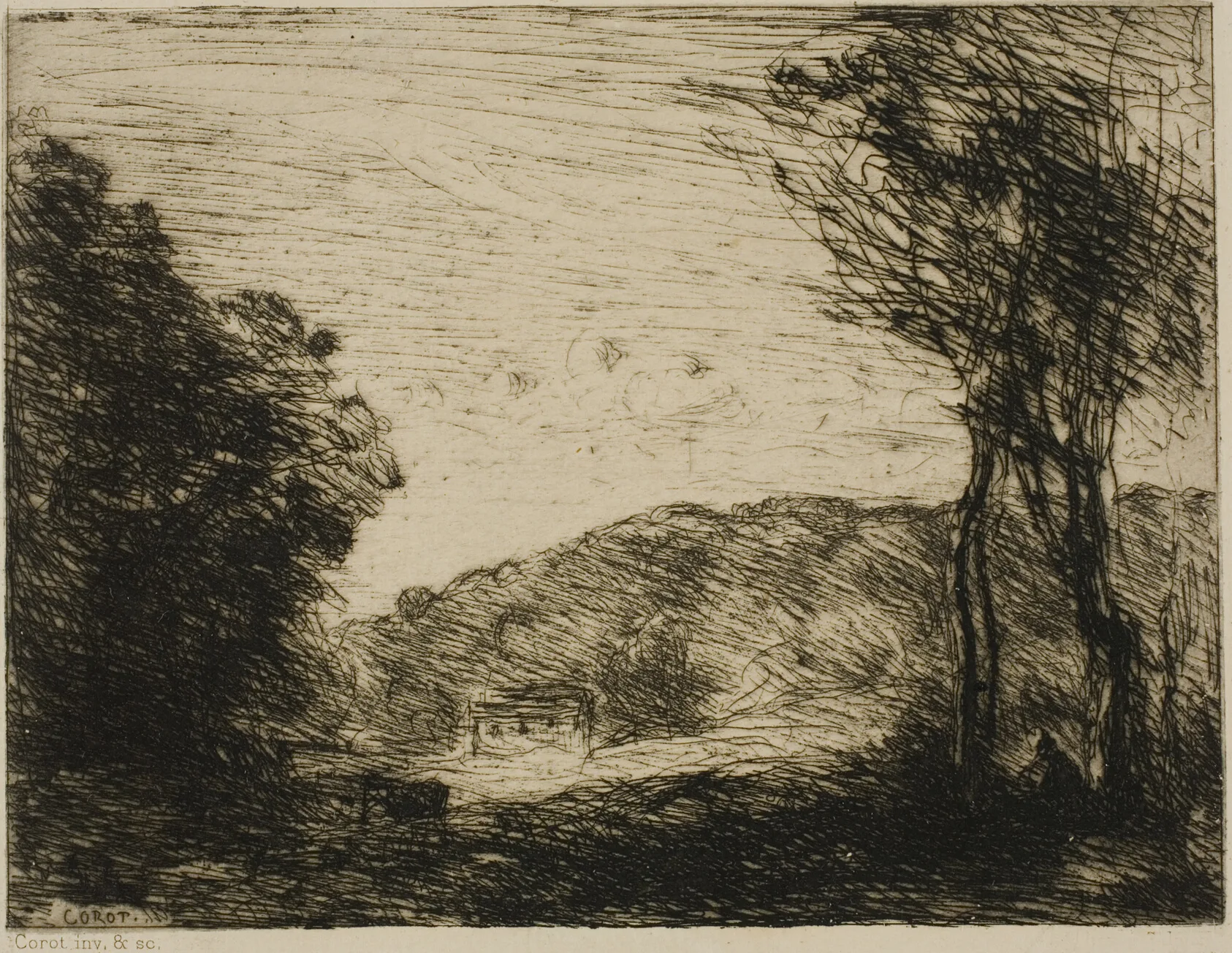
Corot, Wooded Countryside, 1866. Etching on ivory laid paper.
Corot, Wooded Countryside (etching). The foliage is scumble; the ground is loose contour hatch; the sky is parallel.
The Art Institute of Chicago · The Charles Deering Collection
Checklist0 / 1 - 4
Stipple and broken
10 minBox five: dots, closer together toward one corner so the box grades. Slow. Box six: a brick-like wall drawn with Prout's broken line, every edge stopping and restarting, no line more than an inch long. Look at the Prout while you do it.
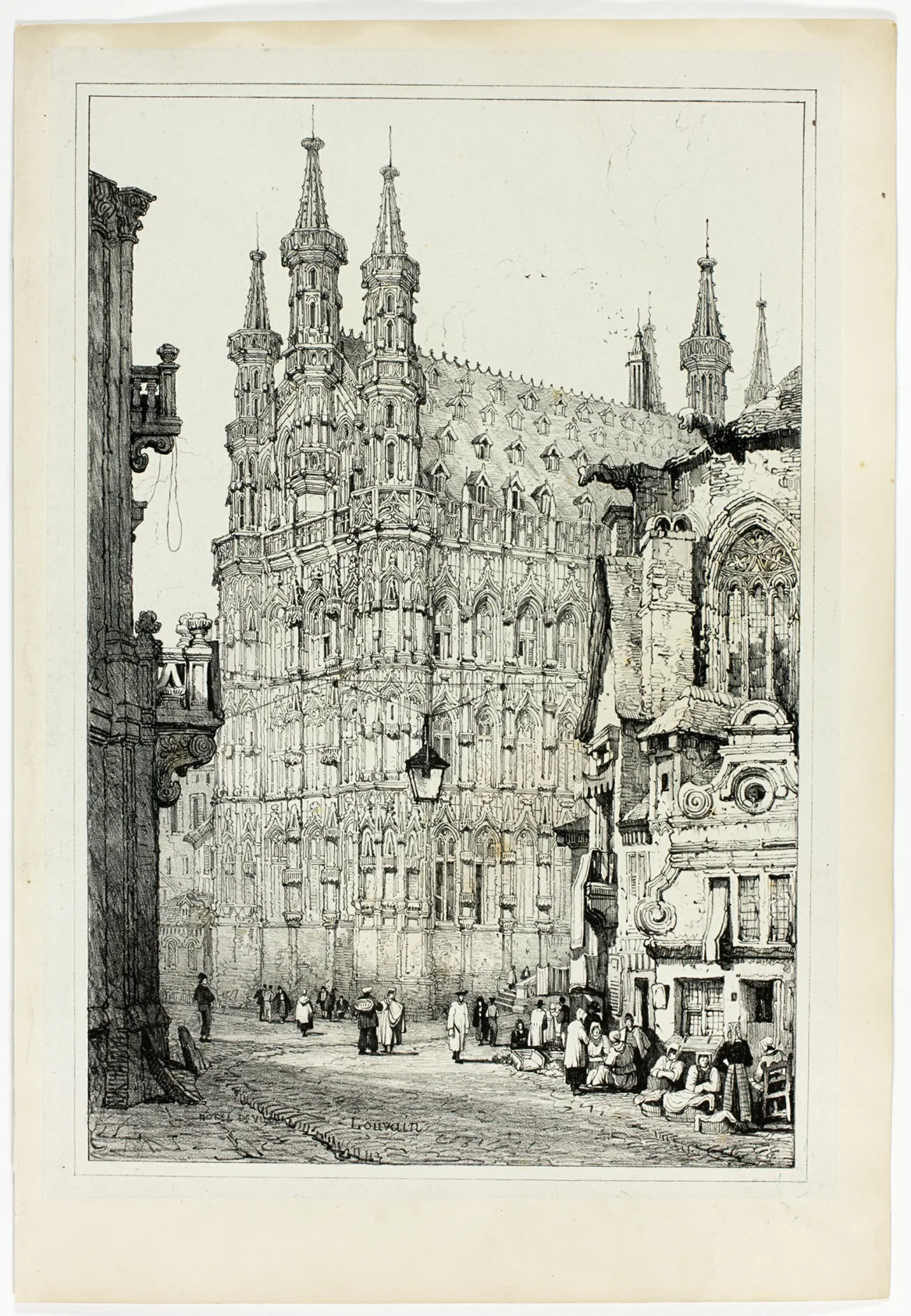
Prout, Hotel de Ville, Louvain, from Facsimiles of Sketches made in Flanders and Germany, 1833. Lithograph in black on grayish-ivory chine, laid down on ivory wove paper.
Prout, Hotel de Ville, Louvain. The broken line on every edge.
The Art Institute of Chicago · The Leonora Hall Gurley Memorial Collection
Checklist0 / 1 - 5
Self-check
5 minTick each item honestly. If one is a no, the session is not finished; go back to that step.
Checklist0 / 3
What it should look like
- Six distinct textures, each even within itself, each clearly different from its neighbours.
Where it goes wrong
- Cross-hatch at ninety degrees. It reads as a grid. Sixty degrees, and a third layer at a shallow angle if needed.
- Scumble that is really scribble. The circles got fast and angular. Slow down. Round circles, overlapping, light.
Log this session
Start the clock when you pick up the pencil. Stop it when you put it down. Log it. Every session counts toward the box.
Status
How did it go?