The broken line
Lift the pencil mid-line. Let it wobble, thicken, vanish and return. A continuous line draws new concrete; a broken line draws old stone.
Prout taught a generation of British draughtsmen that a broken, wiry line draws age. Where a continuous ruled line reads as new and machine-made, a contour that stops, restarts a hair to one side, thickens over a chipped corner and fades across a worn one reads as weathered stone. It is the most imitated trick in British architectural drawing, and Forrest's generation inherited it directly.
The mechanics: draw with a tripod grip, a sharp long point, and a slightly rolling wrist. Lift the pencil every inch or so and set it down again almost in line. Vary the pressure along the stroke. Where a course of masonry runs across a wall, break the line more where the wall is in light (the joints are bleached out) and less in shadow (the joints are dark).
Do not fake it with a deliberate zigzag. The breaks should come from genuinely looking at where the stone edge is crisp and where it is worn.
From your kit
The whole kit →- 1Grafwood F or HB, long point held back from the tip the broken line wants a light, dry grip and a hard-ish grade; a soft one slurs.
- 2Grafwood 2B the thickened returns where the line comes back heavier.
Visuals
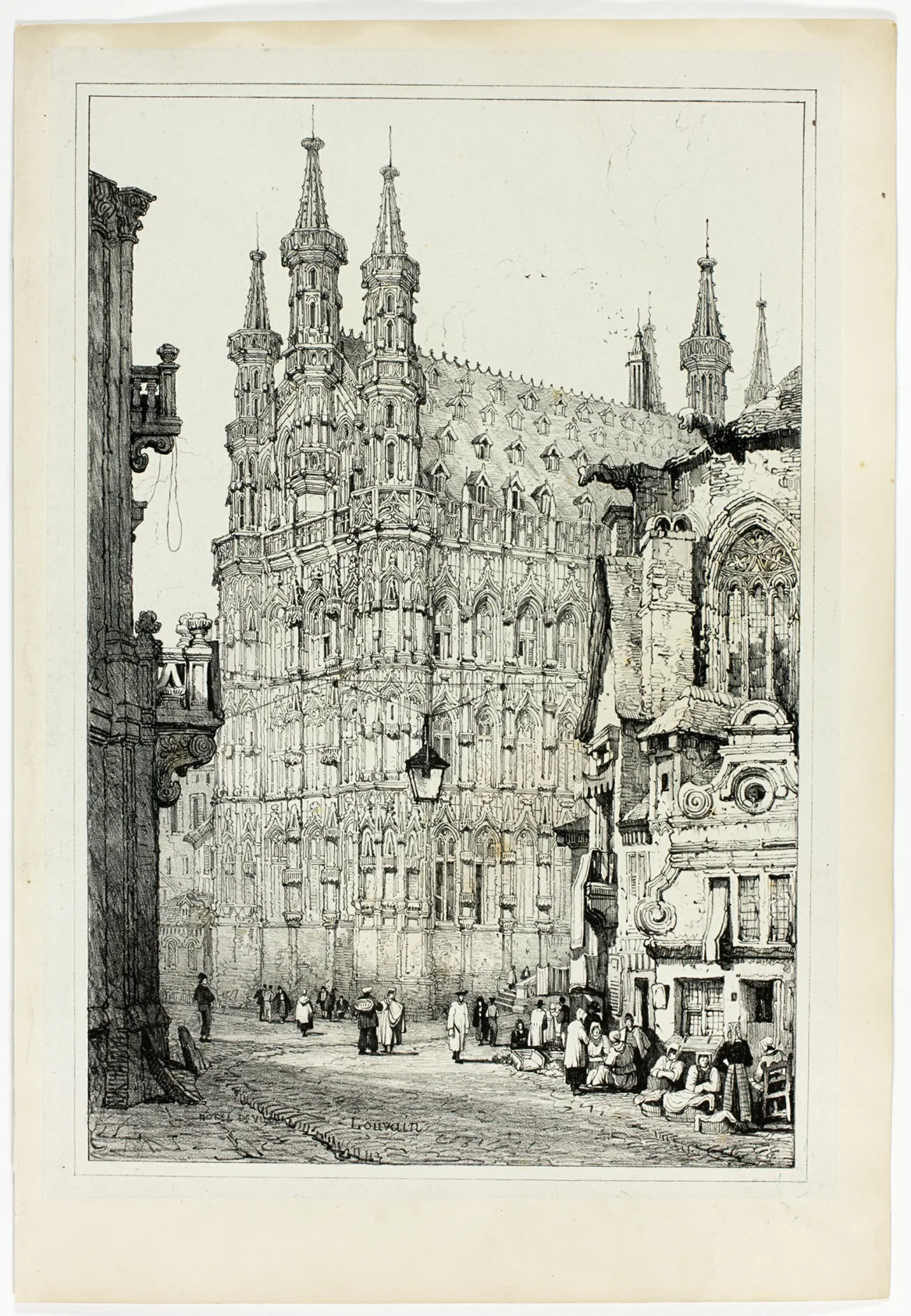
Prout, Hotel de Ville, Louvain, from Facsimiles of Sketches made in Flanders and Germany, 1833. Lithograph in black on grayish-ivory chine, laid down on ivory wove paper.
Prout, Hotel de Ville, Louvain. Every long edge is a chain of short broken strokes; nothing is ruled, and the whole facade reads as centuries old.
The Art Institute of Chicago · The Leonora Hall Gurley Memorial Collection
Pitfalls
What
A regular dashed line.
Why
Even breaks read as a pattern, not as weathering.
Fix
Break where the stone is actually worn or lit out. Look, then break.