Value from spacing
Value from spacing
The etcher's four swatches, and a cube in counted layers
Control value with spacing and layer count alone, the way an etcher must, and shade a cube that way.
- Master
- Charles Meryon
- Difficulty
- Time
- about 0.5 h
- You draw with
- HB with a sharp long point
Why this one
- Unit 1 of the program: Instrument Control.
- Four swatches and five boxes that read as clean value steps when squinted.
- A cube whose planes are clearly different values made only of hatch layers.
From your kit
The whole kit →- 1Grafwood HB HB for layout and line. Long points from the Blackwing on everything up to B.
- 2Kneaded eraser and the Mono Zero press-and-lift corrections only; the Mono Zero for a single sharp light.
- 3Alpha sketchbook 9 x 6 draw at the book's size and keep the proportions; date the page.
In general, this study asks for
- Drawing pad or Bristol
- HB with a sharp long point
Watch first
All videos →Four minutes that make every etching in this catalogue legible: ground, needle, acid, ink, wipe, press.
YouTube Rembrandt's printmaking process: 17th-century etchingNorwich Castle Museum · Shows how a plate is bitten in stages for lighter and darker line, the origin of counted tone.
 Cross-hatching drawing techniques: pen, ink, pencilArt Prof · Cross-hatching taught as a value system, which is how the etchers used it.
The plan
4 stages · ~44 min- 1
Four swatches
13 minFour boxes. Same pencil, same light pressure. Lines spaced wide in the first, closer in each box after, nearly touching in the fourth. Squint: four values, no lines.
FigureSame line, four spacings, four values. Checklist0 / 1 - 2
Five layers
13 minFive boxes. Box one: paper. Box two: one layer of parallel hatch at forty-five. Box three: a second layer crossing at about one hundred and five. Box four: a third layer near horizontal. Box five: a fourth near vertical. Even spacing, constant weight. A clean five-step scale made entirely of line.
FigureThe etcher's scale. Checklist0 / 1 - 3
The counted cube
13 minDraw a cube, light from upper left. Top face: paper. Front face: one layer. Side face: two layers. Cast shadow: three layers. The inside of a small square hole cut in the front face: four layers. Squint. If it reads as a lit cube, you have just done what Cotman did to a church tower.
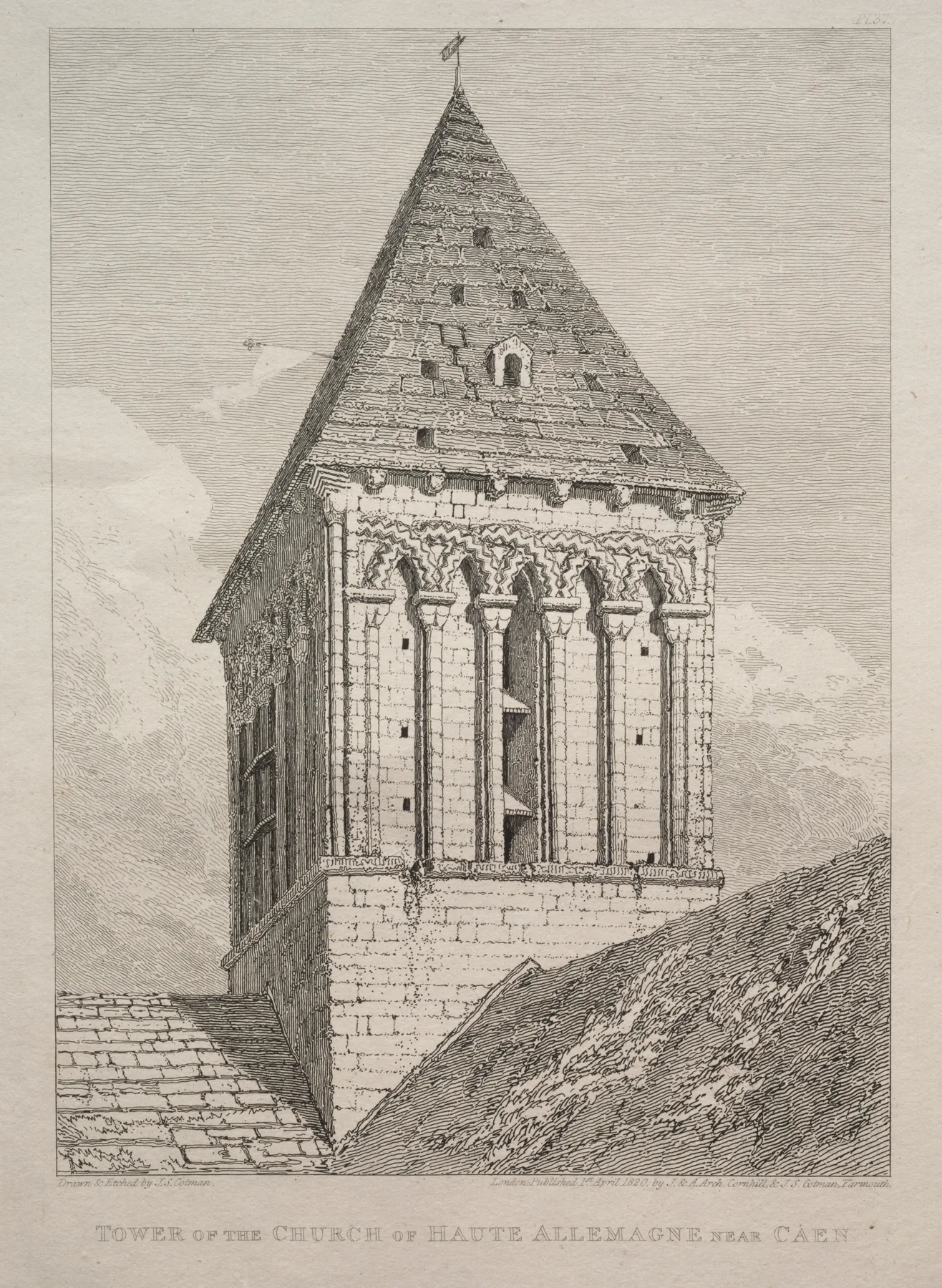
Cotman, Tower of the Church of Haute Allemagne near Caen, 1822. etching.
Cotman, Tower of the Church of Haute Allemagne. Count the layers on the shadow face and inside the belfry arches.
The Cleveland Museum of Art · Gift of William C. Keough
Checklist0 / 1 - 4
Self-check
5 minTick each item honestly. If one is a no, the session is not finished; go back to that step.
Checklist0 / 3
What it should look like
- Four swatches and five boxes that read as clean value steps when squinted.
- A cube whose planes are clearly different values made only of hatch layers.
Where it goes wrong
- The spacing drifts wider as the hand tires. Fatigue. Short runs. Compare each new line's gap to the first one you drew.
Log this session
Start the clock when you pick up the pencil. Stop it when you put it down. Log it. Every session counts toward the box.
Status
How did it go?