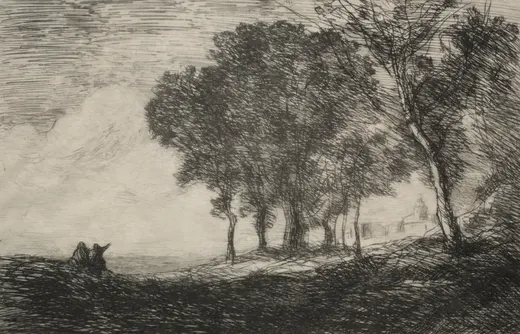
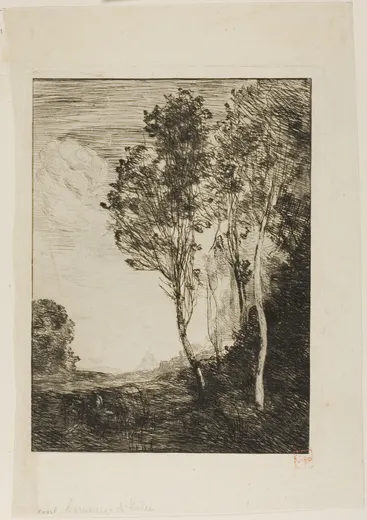
Souvenir of Tuscany
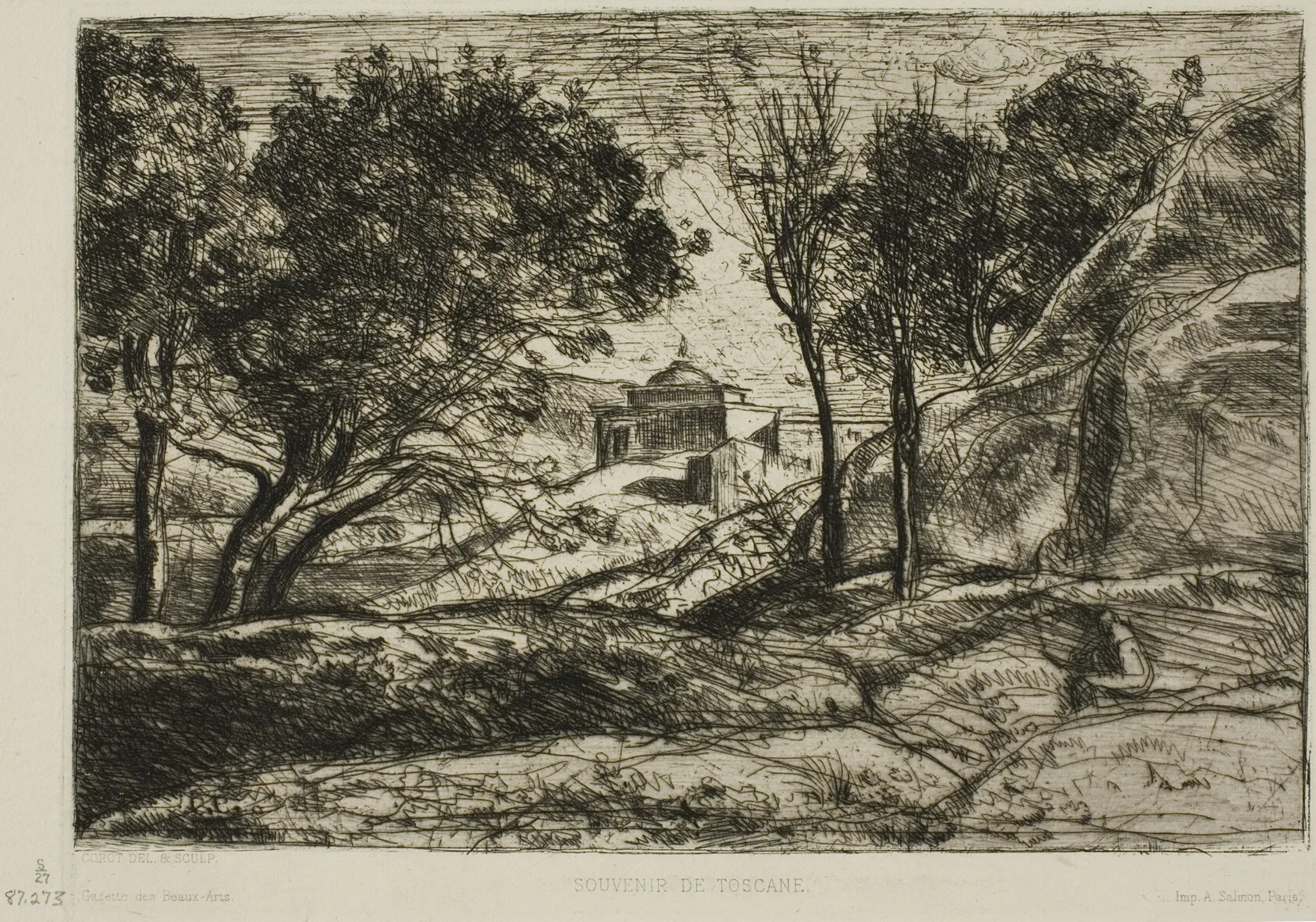
Corot, Souvenir of Tuscany, c. 1845. Etching on ivory laid paper.
Pins mark where to look before you draw.
The Art Institute of Chicago · Elizabeth Hammond Stickney Collection
Souvenir of Tuscany
Corot's first etching
Around 1845, nearly twenty years after Italy, Corot picked up an etching needle for the first time and drew a Tuscan hillside from memory: a leaning tree, a small building with a round-headed opening, a ridge, and ground that is almost entirely parallel hatching. It is a painter's etching, loose and searching, and a perfect first plate to copy because the hatching is open enough to count.
- Difficulty
- Time
- about 2.5 h
- You draw with
- H and HB graphite with sharp points, fine pen optional
Why this one
- The hatching is wide-spaced and legible: you can see exactly how each value was made.
- It shows a mass thinker (trees, ground) working in a line medium, which is the whole bridge of this course.
From your kit
The whole kit →- 1Grafwood H, HB H, HB for layout and line. Long points from the Blackwing on everything up to B.
- 2Grafwood H for the lay-in; a fine pen if you have bought one, else a needle-pointed Grafwood F the pen studies are about the broken line, not the ink.
- 3Kneaded eraser and the Mono Zero press-and-lift corrections only; the Mono Zero for a single sharp light.
- 4Alpha sketchbook 9 x 6 draw at the book's size and keep the proportions; date the page.
In general, this study asks for
- Drawing pad or smooth cartridge
- 2H and H with long points
- HB for accents
- Kneaded eraser
- Sandpaper block
Watch first
All videos →Four minutes that make every etching in this catalogue legible: ground, needle, acid, ink, wipe, press.
YouTube

The plan
4 stages · ~120 min- 1
Count before you draw
10 minChoose three passages (lit ground, shadow ground, the opening) and count the hatch layers in each. Write the numbers on your sheet. You are going to reproduce counts, not appearances.
FigurePaper, one, two, three, four layers. Checklist0 / 1 - 2
Structure in H
25 minEnvelope: the tree, the building, the ridge. Sight the lean of the trunk. Place the arch with its centre on the springing line.
Checklist0 / 2 - 3
Hatch to the counts
75 minHB, sharp. One layer over everything in shadow, following the slope. Second layer where you counted two. Third only in the opening and under the tree. Keep spacing even within a layer; change angle between layers. Foliage last: scribbled contour at the edges only.
Checklist0 / 3 - 4
Squint and compare
10 minHalf-close your eyes until the lines vanish on both. Same values? Note where yours is darker (it usually is).
Checklist0 / 2
What it should look like
- A loose line landscape whose tones are visibly made of counted hatch, with a lit wall left as paper.
Where it goes wrong
- Hatching crossed at right angles. Screen effect. Forty-five, then about one hundred and five, then near horizontal.
Log this session
Start the clock when you pick up the pencil. Stop it when you put it down. Log it. Every session counts toward the box.
Status
How did it go?
Before this, ideally