Marks
Line + MassValue by spacing
Same pencil, same pressure. Close the gap between lines and the tone gets darker. This is how an etcher thinks.
An etched line is always the same blackness, so an etcher controls value with spacing and layering alone. That constraint produced Meryon's Paris and Cotman's abbeys, and it is the best possible training for a pencil draughtsman because it forces you to think in value, not in pressure.
Make four swatches with the same pencil and the same light pressure. Space the lines wide in the first, closer in the second, closer again, and nearly touching in the fourth. Half-close your eyes: four distinct values appear and the lines disappear. That is the whole principle.
When you draw a building this way, you decide the value of each plane first and then choose the spacing that produces it. A lit wall might be bare paper or the widest spacing; the shadow side two layers at medium spacing; the inside of a doorway four layers nearly solid.
From your kit
The whole kit →- 1Grafwood HB and 2B, long points the mark drills live in the middle of the range: dark enough to see, hard enough to control.
- 2Castell 9000 a cheaper pencil is a kinder pencil for a page of repetitive marks; save the Grafwood for the drawings.
- 3Alpha sketchbook the 150 gsm tooth shows spacing honestly.
Visuals
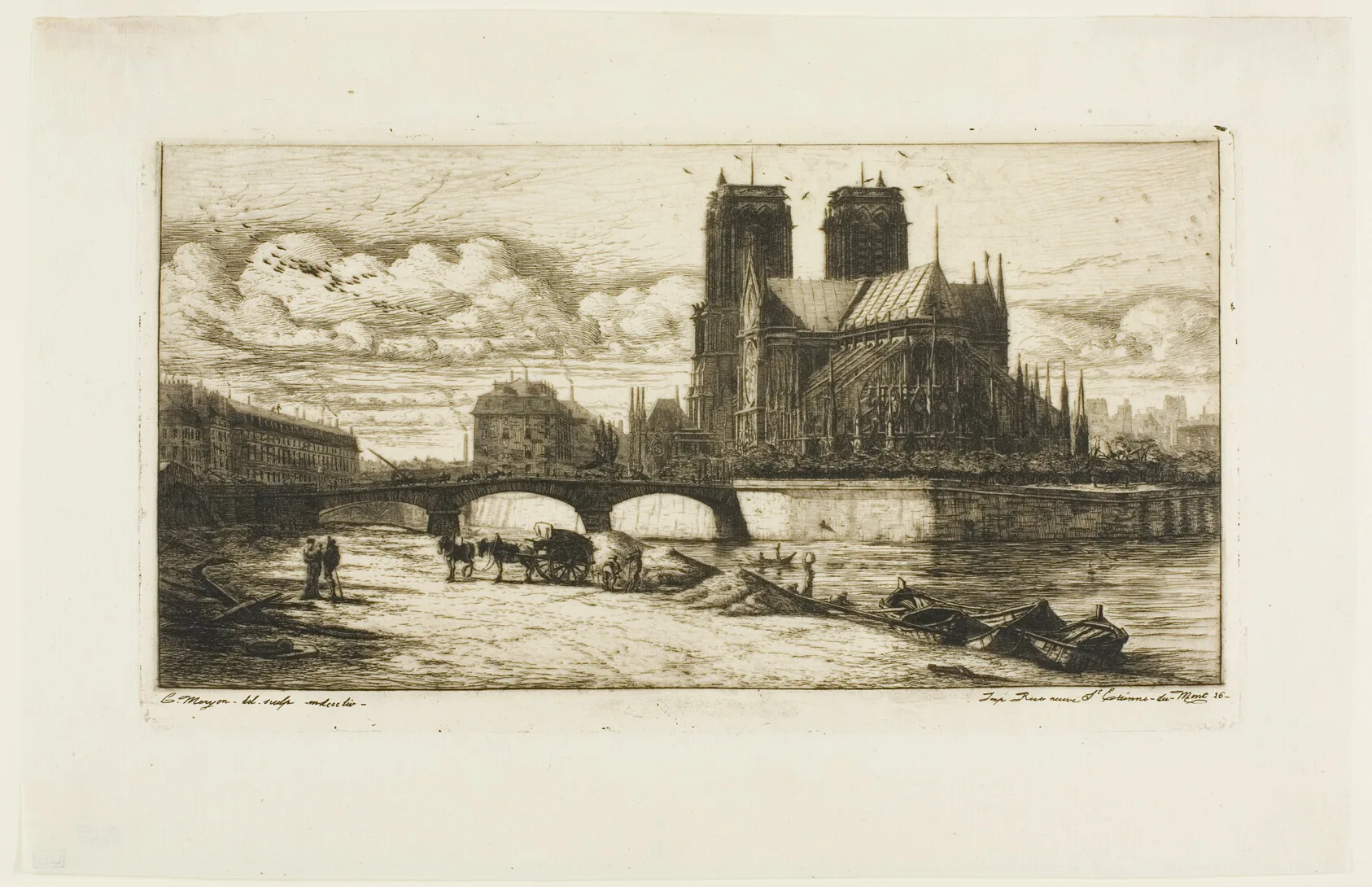
Meryon, The Apse of Notre-Dame, Paris, 1854. Etching and drypoint ivory laid paper.
Meryon, The Apse of Notre-Dame. Squint until the lines vanish: every value in the sky, the stone and the water is a spacing decision.
The Art Institute of Chicago · Clarence Buckingham Collection
Pitfalls
What
Spacing that drifts wider as the hand tires.
Why
The value lightens across the plane and the wall appears to bend.
Fix
Work in short runs, and re-check spacing against the first lines you laid.