Aerial perspective
Aerial perspective
Five hills, then a real distance
Make the eye travel miles using value and edge alone.
- Master
- David Roberts
- Difficulty
- Time
- about 1 h
- You draw with
- 2B, 4B
Why this one
- Unit 3 of the program: Mass: the Corot Half.
- A drawing with obvious depth made from value steps and edge softness, with detail only in front.
From your kit
The whole kit →- 1Grafwood 2B, 4B 2B, 4B for the darks, on their sides for mass. Long points from the Blackwing on everything up to B.
- 2Pitt Matt 8B to 12B for the big tone passages: matt, so the dark mass reads as tone, not shine.
- 3Kneaded eraser (warm it) and the clean Mono Zero lift the lights out of the mass; the Mono Zero for sky holes and lit edges.
- 4Alpha sketchbook 9 x 6 draw at the book's size and keep the proportions; date the page.
In general, this study asks for
- Drawing pad
- 2B, 4B
- A photo with layered distance: hills, a valley, a city from above
Watch first
All videos →Squinting, value scales and why beginners under-read darks.
YouTube Atmospheric charcoal landscape drawing tutorialMad Charcoal · Broad charcoal masses and lifted lights; the closest thing on YouTube to a late Corot being made.
 How to draw a landscape for beginners: atmospheric perspective pencil shadingCircle Line Art School · Gentle, narrated, and exactly the beginner level.
The plan
4 stages · ~50 min- 1
Five hills
15 minDraw five overlapping hill shapes, one behind the other. The nearest: full range, crisp top edge, some texture. Each one behind: lighter, less contrast, softer top edge. The last barely darker than the paper. Nothing else. Stand back. The page is five miles deep.
FigureEach layer a step lighter and softer. Checklist0 / 1 - 2
Roberts's city
15 minStudy the Constantinople sheet. Trace with your finger the value of the buildings from the foreground back: each row of roofs is a step lighter, until the far shore is almost nothing. Notice the white heightening is only in the near and middle zones.
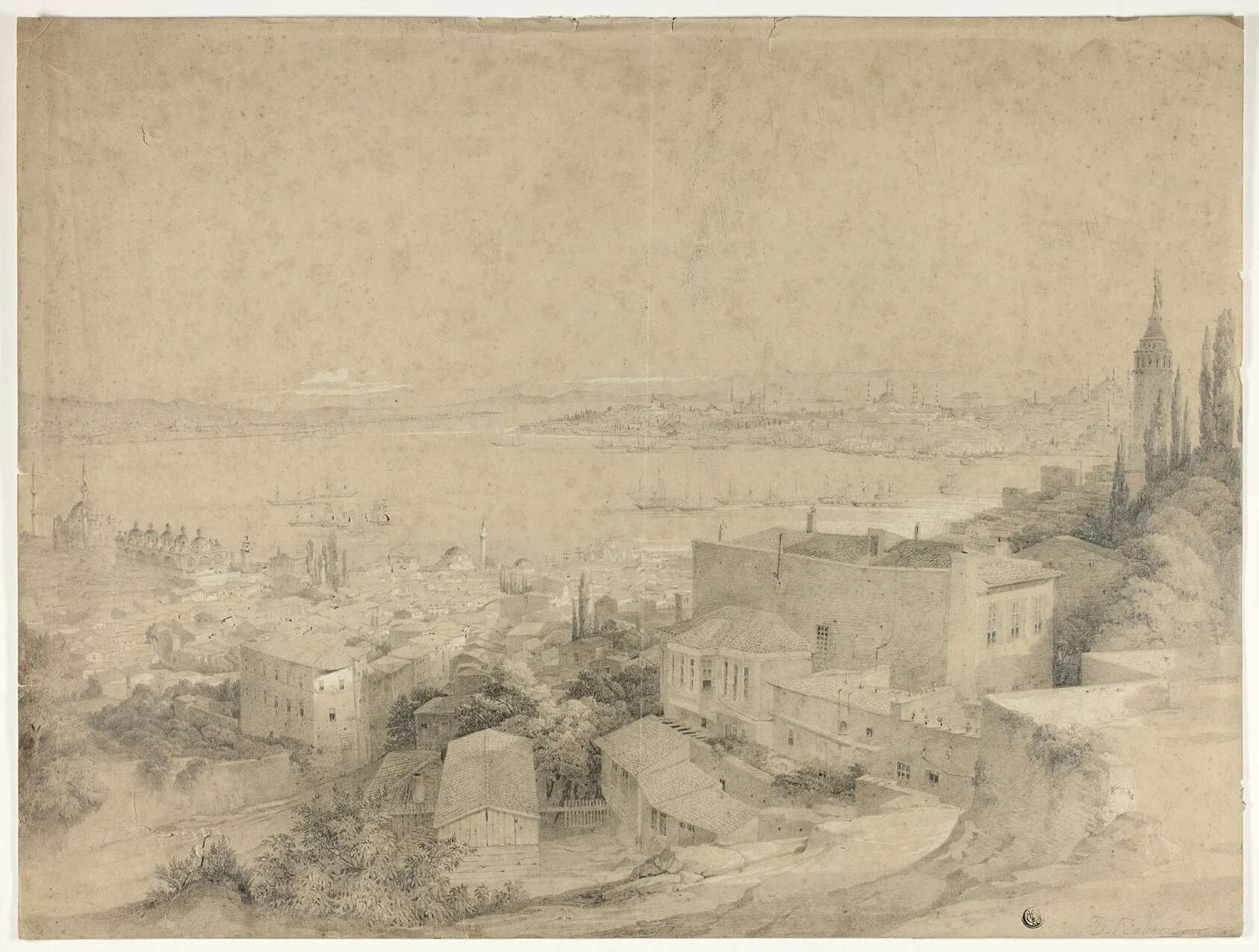
Roberts, Constantinople, n.d.. Graphite, heightened with lead white, on tan wove paper.
David Roberts, Constantinople, graphite with white on tan paper. A whole city stepping back in value.
The Art Institute of Chicago · The Leonora Hall Gurley Memorial Collection
Checklist0 / 1 - 3
A real distance
15 minFrom your photo, draw the layered distance as overlapping planes, five if you can find them. Value does the work; detail stays in the nearest plane only. Set the phone to greyscale and compare.
Checklist0 / 1 - 4
Self-check
5 minTick each item honestly. If one is a no, the session is not finished; go back to that step.
Checklist0 / 3
What it should look like
- A drawing with obvious depth made from value steps and edge softness, with detail only in front.
Where it goes wrong
- Far hills with crisp edges. Edges say near. One soft pass with the side of the pencil along every far edge.
- Drawing far things small and dark. Size without value. Lighten them until they stay back.
Log this session
Start the clock when you pick up the pencil. Stop it when you put it down. Log it. Every session counts toward the box.
Status
How did it go?