Charcoal: The Large Tree, and the souvenir
Charcoal: The Large Tree, and the souvenir
A master copy in Corot's own late medium, then a drawing from memory
Copy the structure of The Large Tree in willow charcoal using side, stump and eraser, then draw it again from memory.
- Difficulty
- Time
- about 1.5 h
- You draw with
- Willow charcoal, medium, Charcoal pencil
Why this one
- Unit 3 of the program: Mass: the Corot Half.
- A charcoal mass with light on top, a lost edge at the base and lifted lights inside it.
- A memory drawing that keeps the design and drops the detail.
From your kit
The whole kit →- 1Willow charcoal, or until it arrives Pitt Matt 12B and 14B on their sides the matt grades are the closest graphite gets to willow. Slip sheet under the hand.
- 2Pitt Matt 14B, knife-sharpened stands in for the charcoal pencil: trunk, branch zig-zag, the one accent.
- 3Kneaded eraser (warm it) and the clean Mono Zero lift the lights out of the mass; the Mono Zero for sky holes and lit edges.
- 4Alpha sketchbook 9 x 6 draw at the book's size and keep the proportions; date the page.
In general, this study asks for
- Drawing pad or toned paper
- Willow charcoal, medium
- Charcoal pencil
- Kneaded eraser
- A stump
- Workable fixative
Watch first
All videos →A single late Corot looked at slowly; watch for the three divisions of light and the lost edges.
YouTube

The plan
5 stages · ~81 min- 1
Read The Large Tree
19 minStudy the sheet with the annotations. It is one dark mass, lit along the top, with a light sky breaking through on the right and the grain of the paper showing everywhere but the core. The museum lists the method: charcoal with stumping, erasing and wet brushwork. You will do the first three.
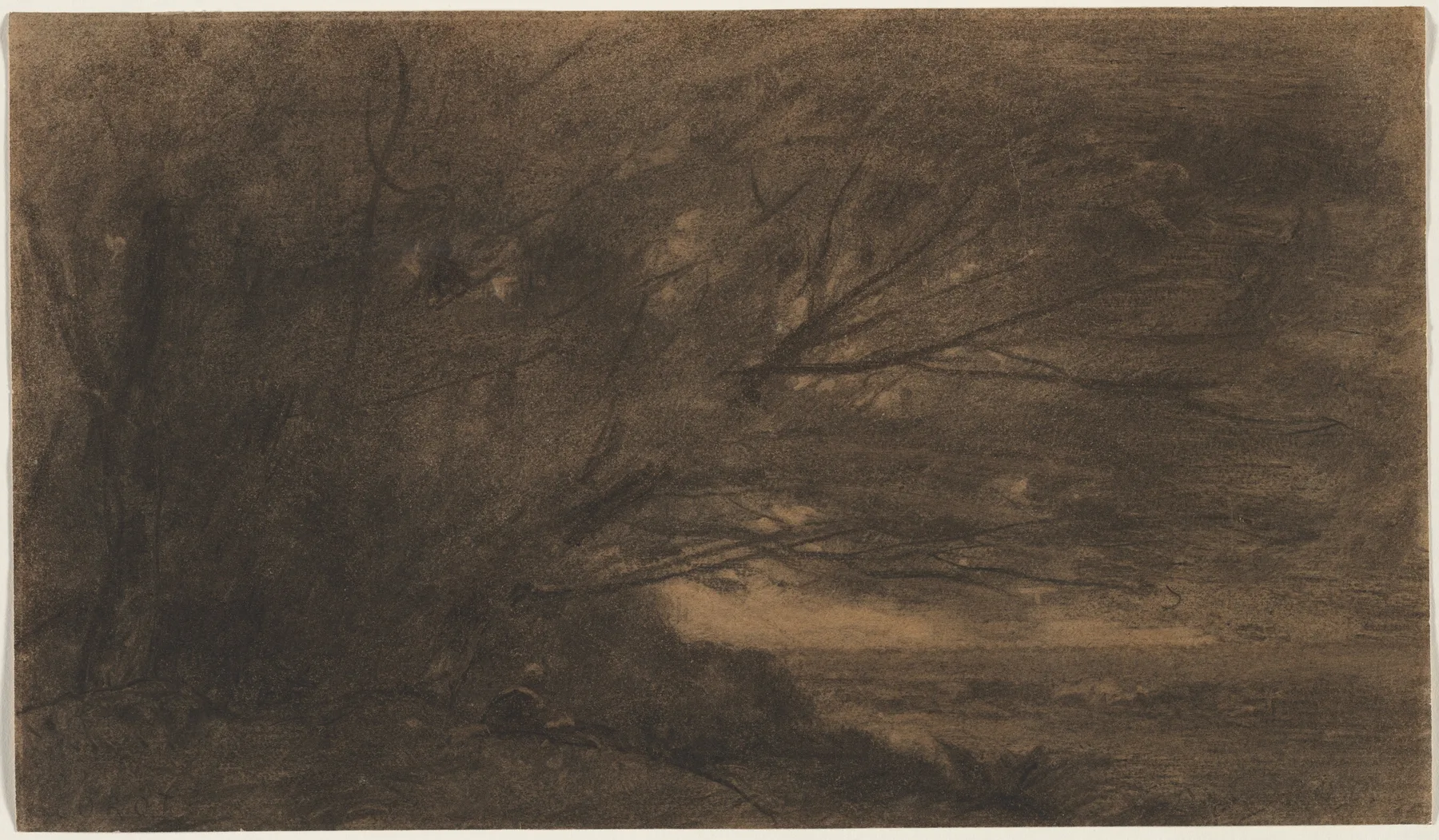
Corot, Landscape (The Large Tree), c. 1865–70. charcoal with stumping, erasing, and wet brushwork on light brown wove paper.
Corot, Landscape (The Large Tree), c. 1865 to 1870.
The Cleveland Museum of Art · Bequest of Muriel Butkin
Checklist0 / 1 - 2
Lay the mass
19 minBreak a stick to two inches. On its side, lay the whole dark mass in one go, lightly first, then deeper where the core is. Lay the ground. Leave the sky as paper. Fifteen minutes, no detail.
Checklist0 / 1 - 3
Soften, lift, accent
19 minStump the edge where the tree's shadow meets the ground until it is lost. Lift the lit tops of the clumps and the sky gap with the kneaded eraser. With the charcoal pencil, draw the trunk and two or three branches zig-zagging up into the mass. Stop. Fix it outdoors.
FigureHard against the sky, soft where it turns, lost into the ground. Checklist0 / 1 - 4
The souvenir
19 minClose the image. Turn your chair. On a fresh sheet, draw The Large Tree from memory, in charcoal, for ten minutes. Then open the image for one minute and say aloud what you got wrong. Close it. Draw it again. The second memory drawing will be simpler and stronger than your copy, and it is yours.
FigureLook, turn, draw, compare, repeat. Checklist0 / 1 - 5
Self-check
5 minTick each item honestly. If one is a no, the session is not finished; go back to that step.
Checklist0 / 5
What it should look like
- A charcoal mass with light on top, a lost edge at the base and lifted lights inside it.
- A memory drawing that keeps the design and drops the detail.
Where it goes wrong
- Everything blended to one grey. The finger went everywhere. Stump only inside the darkest mass and at the lost edge. Lift the lights.
- Peeking during the memory drawing. It turns back into copying. Turn the chair. Close the image. No exceptions.
Log this session
Start the clock when you pick up the pencil. Stop it when you put it down. Log it. Every session counts toward the box.
Status
How did it go?