Eye level and one-point perspective
Eye level and one-point perspective
Your hallway, then a street
Find the eye level, place a vanishing point on it, and draw a corridor and a street in one-point perspective.
- Master
- Charles Meryon
- Difficulty
- Time
- about 1 h
- You draw with
- 2H, HB, 2B
Why this one
- Unit 4 of the program: Line: the Draughtsman's Half.
- A corridor and a street where every receding line meets at one point on the eye level, every vertical is plumb, and every cross-line is level.
From your kit
The whole kit →- 1Grafwood 2H, HB, 2B 2H, HB for layout and line; 2B for the darks. Long points from the Blackwing on everything up to B.
- 2Kneaded eraser and the Mono Zero press-and-lift corrections only; the Mono Zero for a single sharp light.
- 3Alpha sketchbook 9 x 6 draw at the book's size and keep the proportions; date the page.
In general, this study asks for
- Drawing pad
- 2H, HB, 2B
- A hallway or corridor, and a photo of a street seen straight down its length
Watch first
All videos →A street in one point from a blank page. The Old College Wynd set-up.
YouTube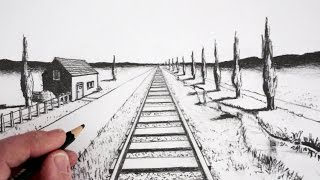

The plan
4 stages · ~56 min- 1
Find your eye level
17 minStand at the end of a hallway. Hold the pencil level at arm's length: whatever it covers on the far wall is your eye level. Notice that the floor lines rise toward it and the ceiling lines fall toward it. Sit on the floor and watch the eye level drop. That line is attached to your eye, not to the room.
FigureAbove: undersides. Below: tops. Checklist0 / 1 - 2
The hallway
17 minDraw the eye-level line faintly across the sheet. Put a dot on it where the hallway's far end is. Sight the angle of the floor's left edge and draw it; it should aim at the dot. Same for the right edge, the ceiling edges, the top of the skirting. Door frames stay plumb. Cross-lines stay level.
FigureEverything receding aims at one point on the eye level. Checklist0 / 1 - 3
A street
17 minFrom the photo, same method. Eye level first (it runs through the heads of any standing figures). Vanishing point. The two building fronts as receding lines. Then window sills and lintels, all aiming at the dot. Meryon's Petit Pont will show you the eye level through the figures on the quay.
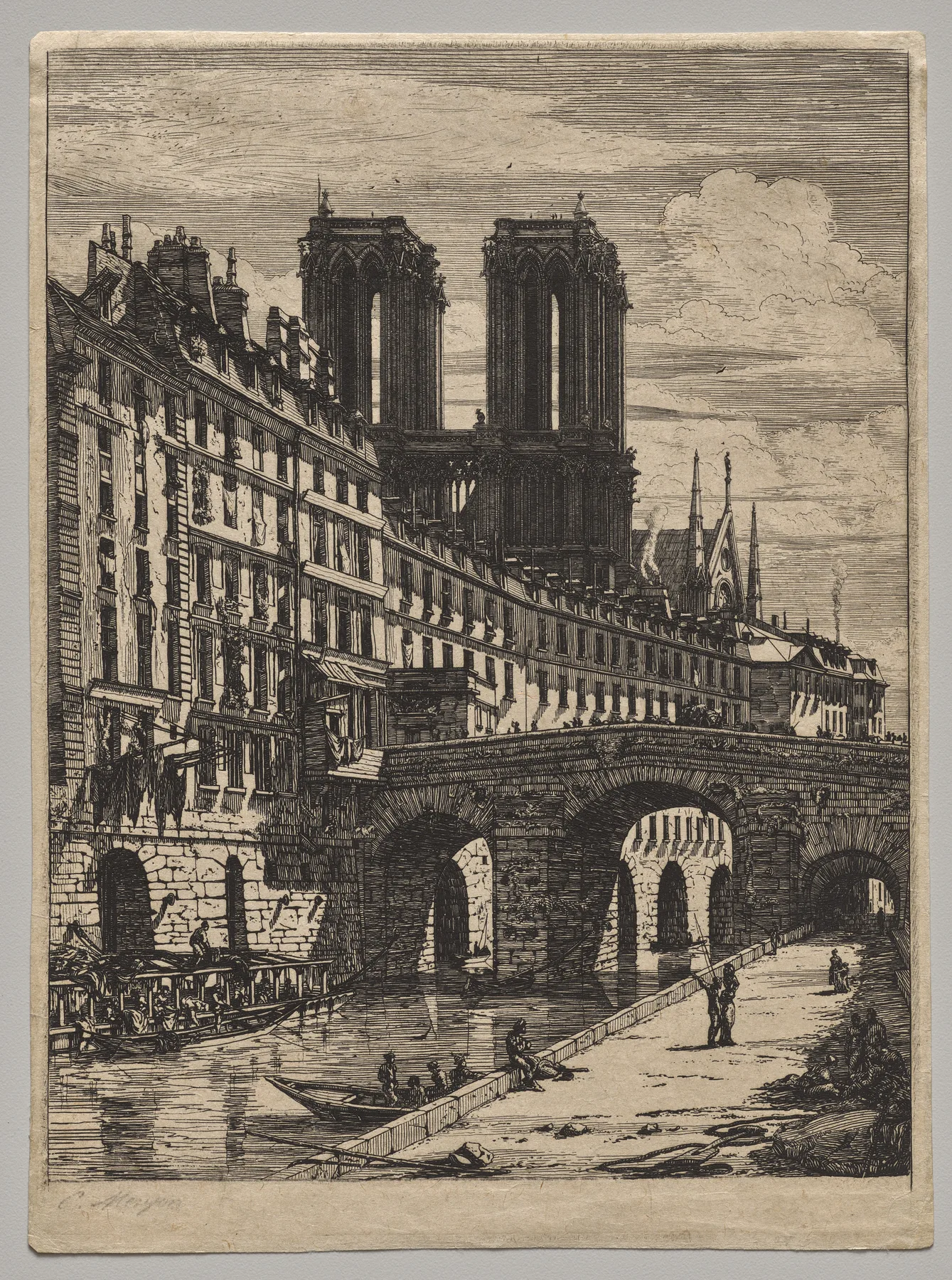
Meryon, The Petit Pont, 1850. etching with engraving.
Meryon, The Petit Pont. The eye level runs through the figures; the quay and the building fronts recede toward it.
The Cleveland Museum of Art · John L. Severance Fund
Checklist0 / 1 - 4
Self-check
5 minTick each item honestly. If one is a no, the session is not finished; go back to that step.
Checklist0 / 3
What it should look like
- A corridor and a street where every receding line meets at one point on the eye level, every vertical is plumb, and every cross-line is level.
Where it goes wrong
- Vanishing point above or below the eye level. Placed by guess. It is on the line. Always.
- Verticals leaning inward. They started converging like the receding lines. Check each against the paper's edge.
Log this session
Start the clock when you pick up the pencil. Stop it when you put it down. Log it. Every session counts toward the box.
Status
How did it go?