Convergence off the page and dividing bays
Convergence off the page and dividing bays
A terrace of windows that shrinks correctly
Place a row of equal windows along a receding wall by construction, with the vanishing point off the page.
- Master
- Joseph Pennell
- Difficulty
- Time
- about 1 h
- You draw with
- 2H, HB
Why this one
- Unit 4 of the program: Line: the Draughtsman's Half.
- A receding wall with six or more windows that get narrower and closer together at a believable rate.
From your kit
The whole kit →- 1Grafwood 2H, HB 2H, HB for layout and line. Long points from the Blackwing on everything up to B.
- 2Kneaded eraser and the Mono Zero press-and-lift corrections only; the Mono Zero for a single sharp light.
- 3Alpha sketchbook 9 x 6 draw at the book's size and keep the proportions; date the page.
In general, this study asks for
- Drawing pad
- 2H, HB
- A photo of a long building face with a row of equal windows, seen obliquely
Watch first
All videos →Longer, covers dividing bays and off-page vanishing points.
YouTube

The plan
4 stages · ~59 min- 1
Two true edges
18 minSight and draw the top and bottom edges of the wall. Draw the near vertical and the far vertical. Divide both verticals into four equal parts and connect the matching marks: four convergence lines, correct without any vanishing point. Sills and lintels will sit on these.
FigureDivide both verticals equally, connect the marks. Checklist0 / 1 - 2
The first bay and the X
18 minSight the width of the first window bay and draw its far edge as a vertical. Draw the bay's diagonals to find its centre. Run a line from that centre along the convergence (through the matching mark on the far vertical): the wall's centre line.
FigureFirst bay by eye, then the diagonal, forever. Checklist0 / 1 - 3
Diagonal to the next bay
18 minFrom the top of the first bay's near edge, draw a line through the centre of its far edge. Where it hits the wall's bottom edge is the far edge of the second bay. Draw that vertical. Repeat. Each bay narrower than the last, by construction, not by guess. Put a window in each between the right convergence lines.
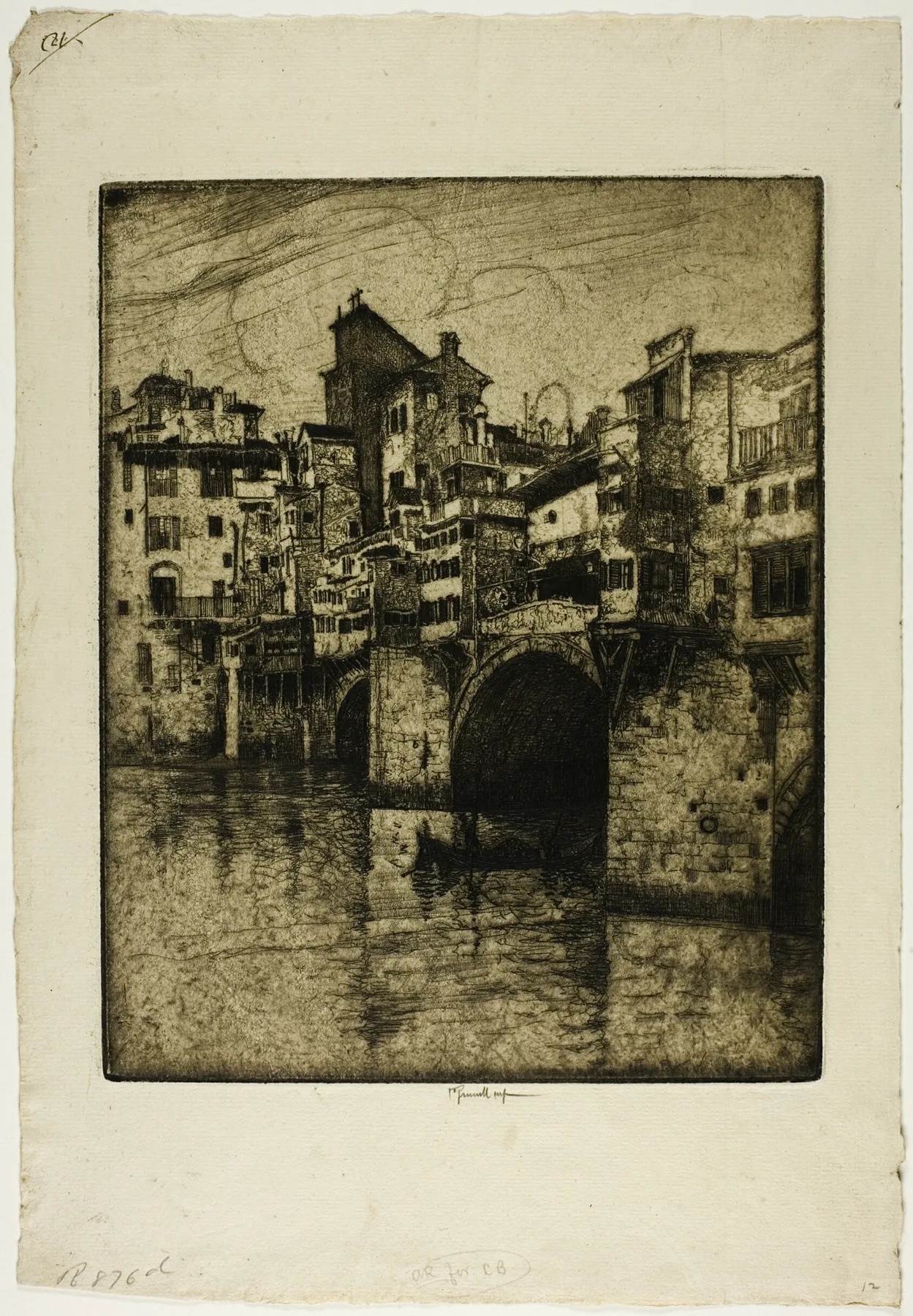
Pennell, Ponte Vecchio, Florence, 1883. Etching on cream laid paper.
Pennell, Ponte Vecchio, Florence. The windows shrink along the bridge at a rate that was constructed.
The Art Institute of Chicago · The Joseph Brooks Fair Collection
Checklist0 / 1 - 4
Self-check
5 minTick each item honestly. If one is a no, the session is not finished; go back to that step.
Checklist0 / 3
What it should look like
- A receding wall with six or more windows that get narrower and closer together at a believable rate.
Where it goes wrong
- Bays measured equal with a ruler. The wall flips flat. Erase and construct.
- The near and far verticals divided into different numbers of parts. The convergence lines fan wrongly. Same count on both.
Log this session
Start the clock when you pick up the pencil. Stop it when you put it down. Log it. Every session counts toward the box.
Status
How did it go?