Roofs and windows
Roofs and windows
A farmhouse: tilted planes and holes in thick walls
Draw a simple house whose roof is a light tilted plane with slates only at the eave, and whose windows are dark voids with reveals and lit sills.
- Master
- Samuel Prout
- Difficulty
- Time
- about 1 h
- You draw with
- 2H, HB, 2B, 6B
Why this one
- Unit 5 of the program: Architecture.
- A house in sunlight whose roof is light, whose windows are deep, and whose walls are thick.
From your kit
The whole kit →- 1Grafwood 2H, HB, 2B, 6B 2H, HB for layout and line; 2B, 6B for the darks. Long points from the Blackwing on everything up to B.
- 2Kneaded eraser and the Mono Zero press-and-lift corrections only; the Mono Zero for a single sharp light.
- 3Alpha sketchbook 9 x 6 draw at the book's size and keep the proportions; date the page.
In general, this study asks for
- Drawing pad
- 2H, HB, 2B, 6B
- Kneaded eraser and precision eraser
- A photo of a farmhouse or cottage in sun
Watch first
All videos →Applied to an old building with a tower.
YouTube How to simplify your light and shadow shapesDrawing Tutorials Online · Shadow shapes as flat masses first. Shown on a portrait, but the principle is identical for a tree or a tower.
 The ultimate guide to two-point perspective drawingCircle Line Art School · Longer, covers dividing bays and off-page vanishing points.
The plan
5 stages · ~65 min- 1
Structure
15 minEye level, envelope, two-point faces, the roof's ridge and eaves converging with the walls. Windows placed by the dividing-bays method along each face. Fifteen minutes.
Checklist0 / 1 - 2
The roof
15 minValue: lighter than the wall below it, however dark the slate, because it tilts to the sky. Rows of slates as faint converging lines. Draw individual slates in the two rows nearest the eave only; the rest is tone with a few broken lines. Compare with the Ulm roofs.
FigureRows converge; near rows drawn, far rows tone. Checklist0 / 1 - 3
The windows
15 minEach window: lay a 7 across the whole opening. Draw the reveal: one inner face lit, one in shadow, to show the wall's thickness. Lift one pane with the precision eraser to catch the sky. Sill: paper on top, a small cast shadow beneath. The lintel's underside dark. Compare with Pennell's stacked windows.
FigureA hole in a thick wall, not a rectangle with a cross. Checklist0 / 1 - 4
Door and audit
15 minThe open door is the darkest thing on the page: 6B, 9. Then squint and check the daylight order: sky, roof, ground, lit wall, shadow wall, cast shadows, openings.
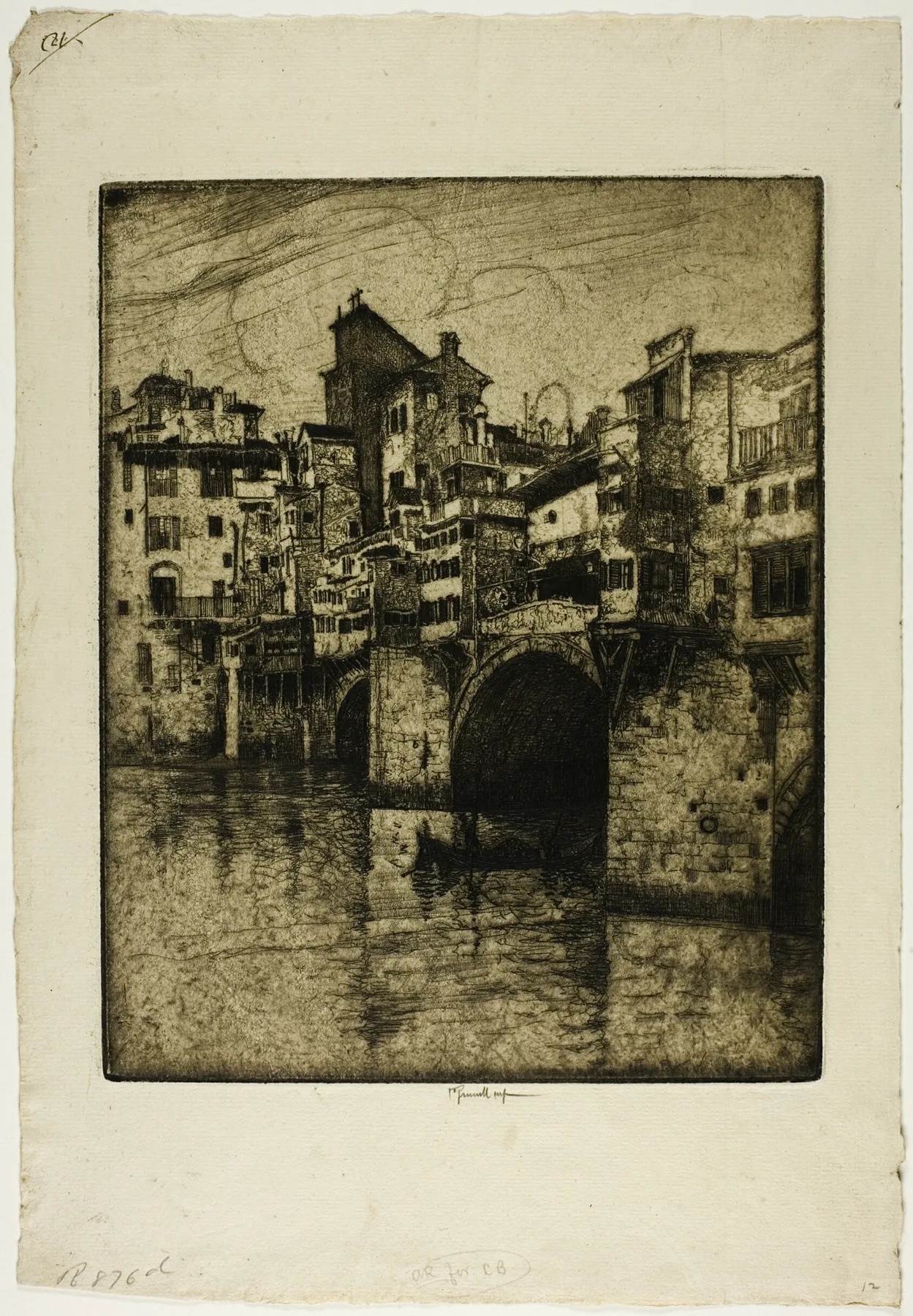
Pennell, Ponte Vecchio, Florence, 1883. Etching on cream laid paper.
Pennell, Ponte Vecchio. Every window a dark void with a lit sill.
The Art Institute of Chicago · The Joseph Brooks Fair Collection
Checklist0 / 1 - 5
Self-check
5 minTick each item honestly. If one is a no, the session is not finished; go back to that step.
Checklist0 / 4
What it should look like
- A house in sunlight whose roof is light, whose windows are deep, and whose walls are thick.
Where it goes wrong
- Windows left white. Glass seems light. Glass shows the dark room. Lay a 7, lift one pane.
- Every slate drawn. Texture felt like finish. Two rows at the eave. Erase the rest to tone.
Log this session
Start the clock when you pick up the pencil. Stop it when you put it down. Log it. Every session counts toward the box.
Status
How did it go?