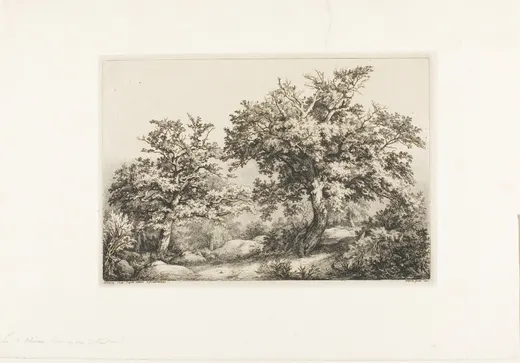
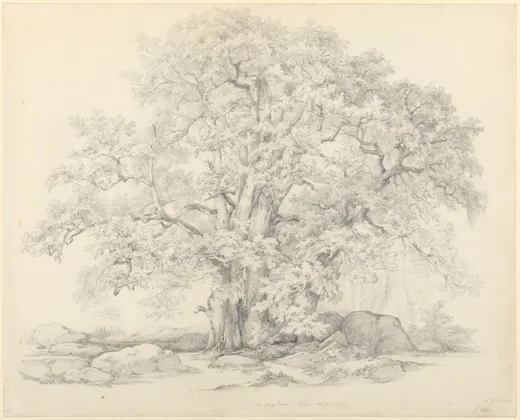
Plant Study
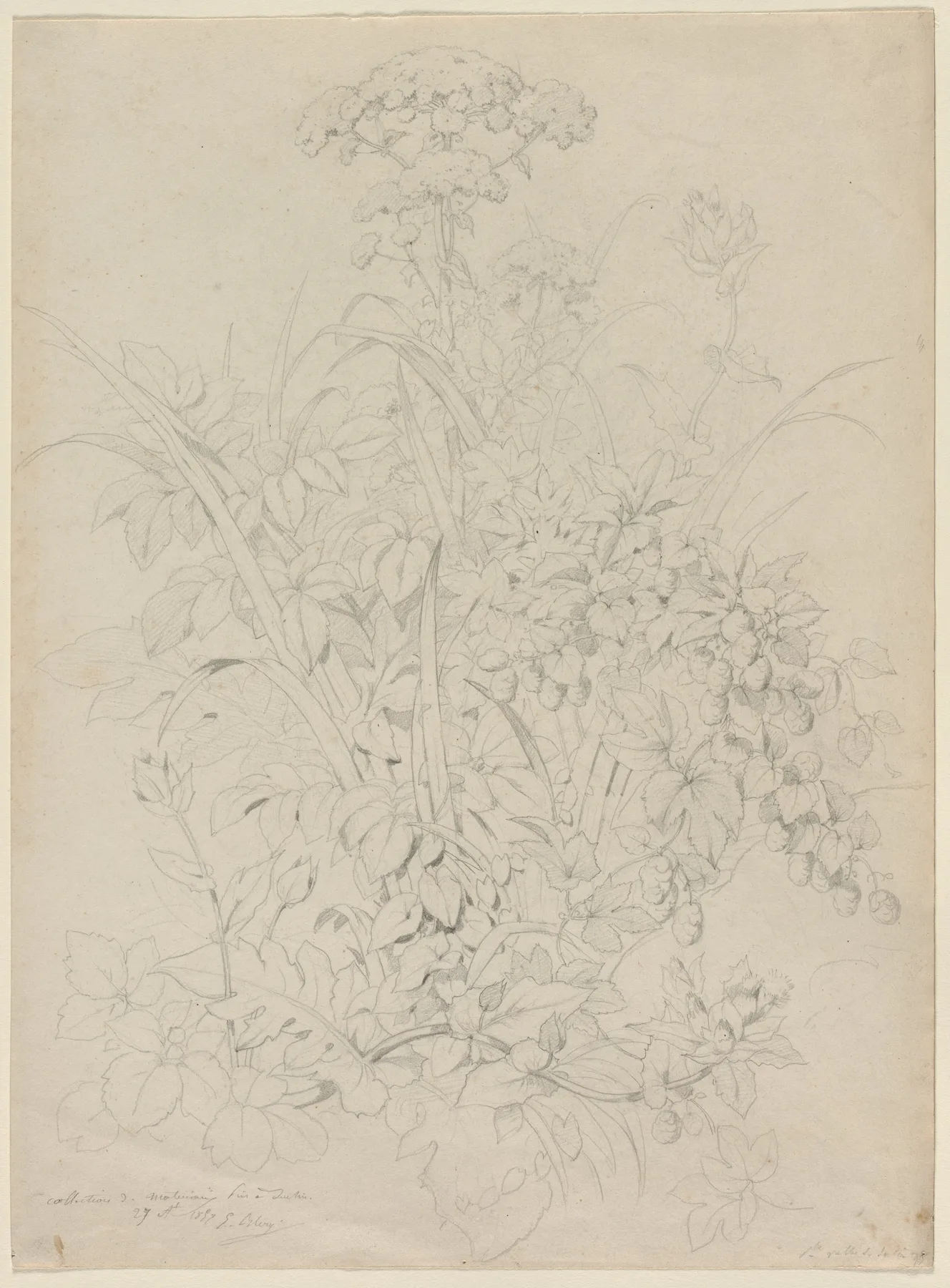
Bléry, Plant Study, 1857. graphite.
Pins mark where to look before you draw.
The Cleveland Museum of Art · John L. Severance Fund
Plant Study
A foreground drawn for its own sake: leaves, stems, flower heads, in graphite
An 1857 graphite drawing of a clump of wild plants, the kind Bléry put in the foreground of every etching. A study in looking: each leaf's shape, how it turns, where it overlaps, drawn with a hard point and no tone to hide behind.
- Master
- Eugène Bléry
- Difficulty
- Time
- about 1.5 h
- You draw with
- 2H, H, HB graphite
Why this one
- The foreground as a subject in itself, so it stops being a scribble in your landscapes.
- Overlap as the depth device: which leaf is in front.
- Hard pencil, pale line, pure looking.
From your kit
The whole kit →- 1Grafwood 2H, H, HB 2H, H, HB for layout and line. Long points from the Blackwing on everything up to B.
- 2Kneaded eraser and the Mono Zero press-and-lift corrections only; the Mono Zero for a single sharp light.
- 3Alpha sketchbook 9 x 6 draw at the book's size and keep the proportions; date the page.
In general, this study asks for
- Drawing pad or smooth cartridge
- 2H and H with long points
- HB for accents
- Kneaded eraser
- Sandpaper block
Watch first
All videos →The negative-shape habit, which places Prout's pinnacles and Corot's branches.
YouTube
The plan
4 stages · ~90 min- 1
The clump's envelope
10 min2H: the whole clump as one shape, the big leaves as simple shapes inside it. Measure the clump's height against its width.
FigureEnvelope first. Checklist0 / 2 - 2
Leaves, with overlap
40 minH: each big leaf drawn as a shape with its turn; where leaves overlap, decide which is in front and stop the back one's line. Near edges a touch heavier.
FigureThe gaps between leaves are shapes too. Checklist0 / 3 - 3
Stems, heads, fade
30 minHB for the nearest stems, 2H for the flower heads so the drawing fades upward. Leave the sheet bare around the clump.
Checklist0 / 2 - 4
Compare
10 minNote, date, box.
Checklist0 / 2
What it should look like
- A clump of plants you could identify.
- Leaves that turn.
- Pale lines, no tone.
Where it goes wrong
- Symbol leaves. You drew the idea of a leaf. Each leaf has a specific shape and a turn. Look longer than you draw.
Log this session
Start the clock when you pick up the pencil. Stop it when you put it down. Log it. Every session counts toward the box.
Status
How did it go?
Before this, ideally