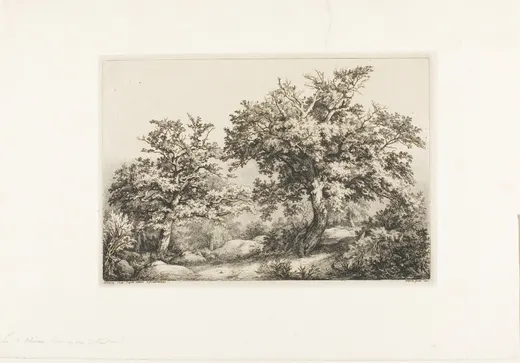
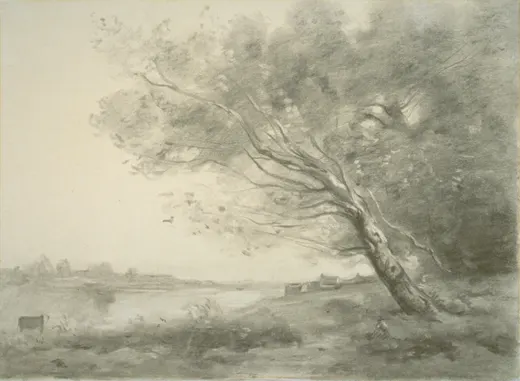
Tree and Rocks in the Forest of Fontainebleau
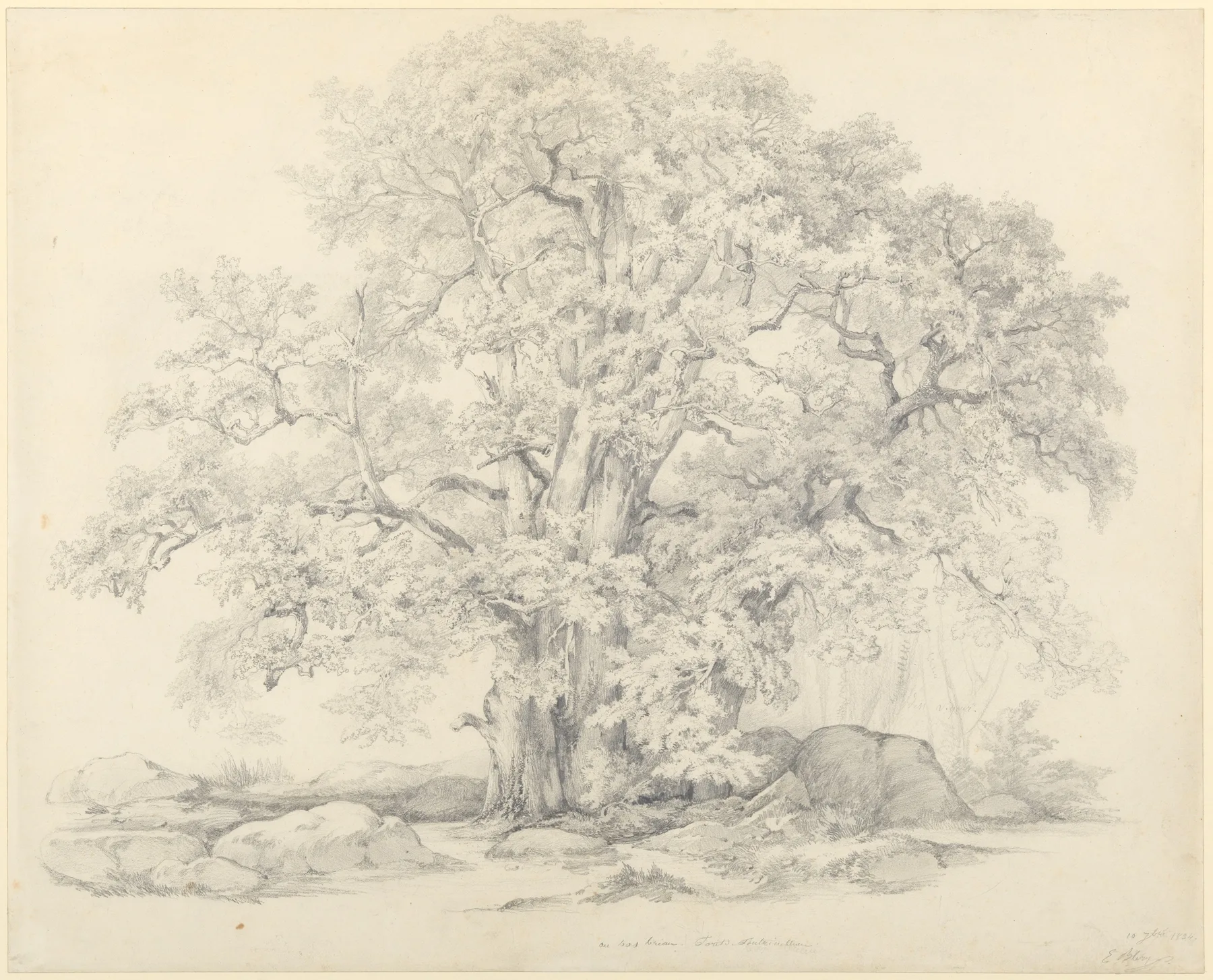
Bléry, Tree and Rocks in the Forest of Fontainebleau, 1834. Graphite.
Pins mark where to look before you draw.
The Metropolitan Museum of Art · Rogers Fund, 1961
Tree and Rocks in the Forest of Fontainebleau
A single oak in pencil: canopy as mass, trunk as structure, rock as ground
An 1834 graphite drawing of one oak on a rocky rise, the canopy drawn as a soft mass, the trunk and the rocks beneath it drawn hard. The pencil version of everything Bléry etched, and the gentlest way into drawing a tree whole.
- Master
- Eugène Bléry
- Difficulty
- Time
- about 2 h
- You draw with
- H, HB, 2B graphite
Why this one
- Soft canopy, hard trunk: two handlings in one tree.
- A rock as the base that stops the tree floating.
- Pencil tone built from short strokes that follow the clumps.
From your kit
The whole kit →- 1Grafwood H, HB, 2B H, HB for layout and line; 2B for the darks. Long points from the Blackwing on everything up to B.
- 2Kneaded eraser and the Mono Zero press-and-lift corrections only; the Mono Zero for a single sharp light.
- 3Alpha sketchbook 9 x 6 draw at the book's size and keep the proportions; date the page.
In general, this study asks for
- Drawing pad or smooth cartridge
- 2H and H with long points
- HB for accents
- Kneaded eraser
- Sandpaper block
Watch first
All videos →Trees as masses in graphite, with the edge texture where it belongs.
YouTube
The plan
4 stages · ~105 min- 1
Mass and base
15 minH: the canopy as one soft shape, the trunk as a line, the rock as a block under it. Check the canopy's width against the trunk's height.
FigureMass, trunk, ground. Checklist0 / 3 - 2
Canopy as soft tone
40 minHB, short strokes following the clumps: the canopy's tone, lit at the top (sparse) and dark beneath (dense). Its edge broken into clump shapes, never a single outline.
FigureTexture at the edge. Checklist0 / 3 - 3
Trunk hard, rock in light
40 min2B: the trunk and main limbs as hard dark lines diving into the soft mass; the rock's shadow side; the ground's few strokes. Keep the trunk the only crisp thing.
FigureInto the mass, not on it. Checklist0 / 3 - 4
Compare
10 minNote, date, box.
Checklist0 / 2
What it should look like
- A soft tree on a hard rock.
- A trunk that disappears into leaves.
- No outline around the canopy.
Where it goes wrong
- An outlined canopy. Habit. The edge is where the strokes stop. Let them stop raggedly.
Log this session
Start the clock when you pick up the pencil. Stop it when you put it down. Log it. Every session counts toward the box.
Status
How did it go?
Before this, ideally