The Two Oaks, Fontainebleau
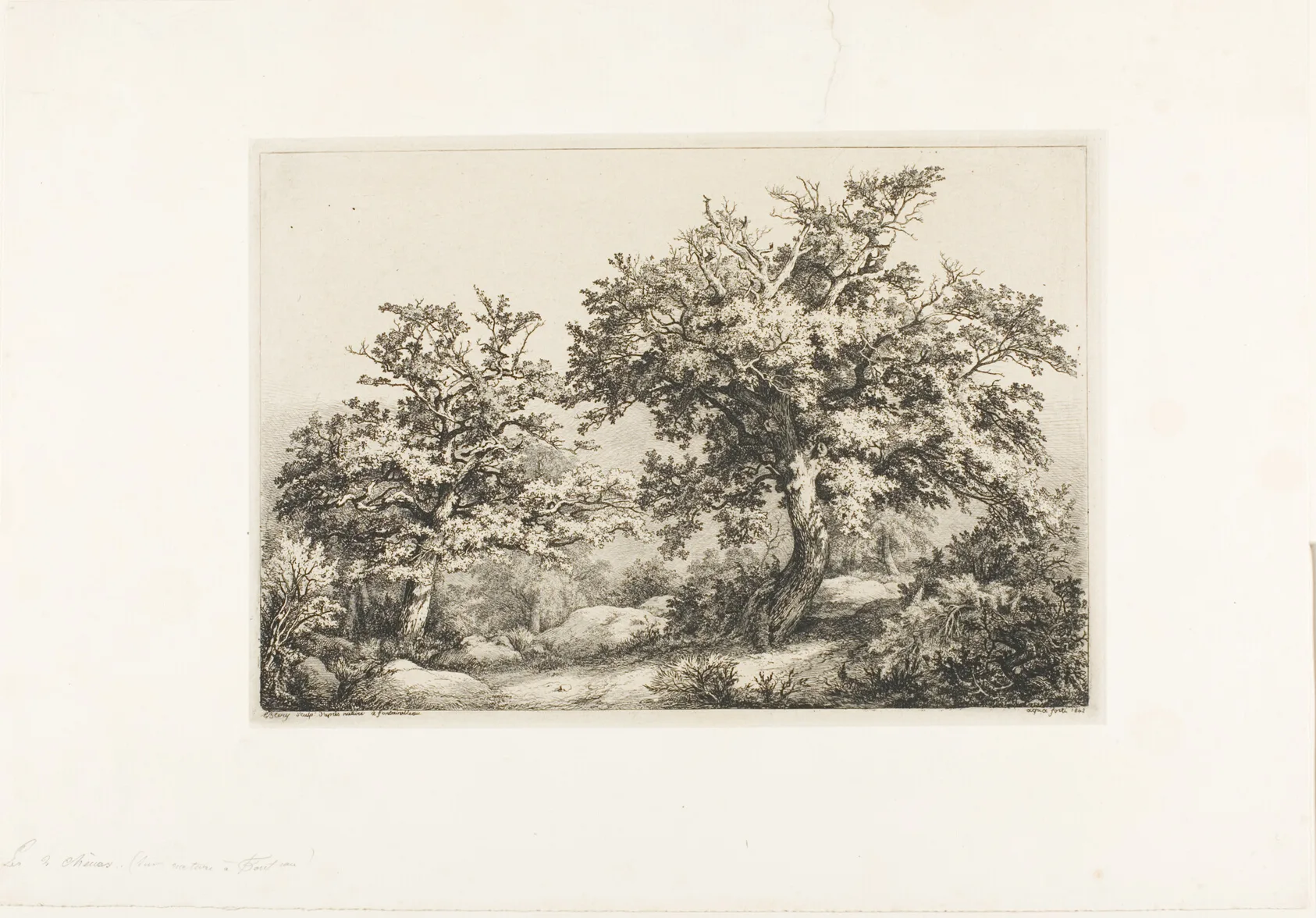
Bléry, The Two Oaks, Fontainebleau, 1842. Etching, roulette, and drypoint on ivory wove chine collé on ivory wove paper.
Pins mark where to look before you draw.
The Art Institute of Chicago · Gift of David Becker
The Two Oaks, Fontainebleau
Two trees drawn leaf-mass by leaf-mass, with the foreground as careful as the canopy
An 1842 etching with roulette and drypoint: two oaks in the forest, foliage built from thousands of short strokes, the ground plants in the foreground drawn as carefully as the trees. Bléry taught Meryon, and you can see where Meryon's patience came from.
In pencilAn etched line is a drawn line. Copy it with hard grades and long points: tone from the spacing and direction of lines, cross-hatching only in the darkest third, no smudging anywhere.
- Master
- Eugène Bléry
- Difficulty
- Time
- about 2.5 h
- You draw with
- H, HB, 2B graphite
Why this one
- Foliage as clumps of short strokes, each clump lit on one side.
- Two trunks whose relationship is the composition.
- A foreground drawn, not scribbled.
From your kit
The whole kit →- 1Grafwood H, HB, 2B H, HB for layout and line; 2B for the darks. Long points from the Blackwing on everything up to B.
- 2Kneaded eraser and the Mono Zero press-and-lift corrections only; the Mono Zero for a single sharp light.
- 3Alpha sketchbook 9 x 6 draw at the book's size and keep the proportions; date the page.
In general, this study asks for
- Drawing pad or smooth cartridge
- 2H and H with long points
- HB for accents
- Kneaded eraser
- Sandpaper block
Watch first
All videos →Clump construction and sky holes.
YouTube How to draw landscapes, trees, grass, foliage, water, using graphite pencilsSmoothie77 · Trees as masses in graphite, with the edge texture where it belongs.
 Printmaking process: intaglioMinneapolis Institute of Art · Four minutes that make every etching in this catalogue legible: ground, needle, acid, ink, wipe, press.
The plan
4 stages · ~125 min- 1
Trunks and their relationship
15 minH: the two trunks, their lean, the gap between them, measured. The canopy's outer envelope as one shape.
FigureMeasure the gap against a trunk's width. Checklist0 / 2 - 2
Clumps
50 minHB: the canopy broken into clumps, each a rounded mass with a lit top (sparse strokes) and a dark underside (dense strokes), the strokes following the curve of the clump. Sky holes between clumps.
FigureClumps inside the mass. Checklist0 / 3 - 3
Foreground and darks
50 min2B: the trunks' shadow sides and the darkest undersides. H, needle point: the foreground plants drawn individually, a leaf at a time, the one place on the sheet where detail is allowed to be complete.
FigureMost detail nearest. Checklist0 / 2 - 4
Compare
10 minNote, date, box.
Checklist0 / 2
What it should look like
- Two oaks that are individuals.
- Foliage with light on it.
- A foreground you could name the plants in.
Where it goes wrong
- Uniform foliage texture. Strokes without a clump to belong to. Draw the clump's rounded mass first; the strokes live on its surface.
Log this session
Start the clock when you pick up the pencil. Stop it when you put it down. Log it. Every session counts toward the box.
Status
How did it go?
Before this, ideally
Related studies
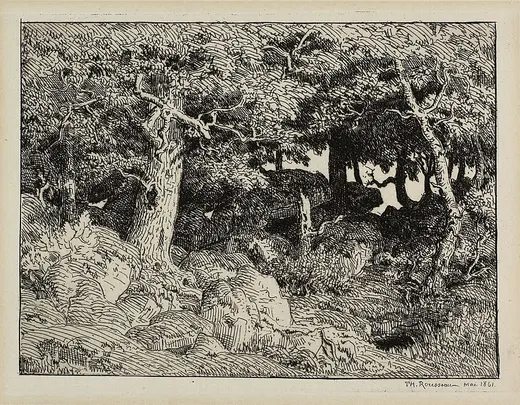 Master study
Rousseau
Oak from Rocks
A tree portrait: every fork followed from root to twig
3h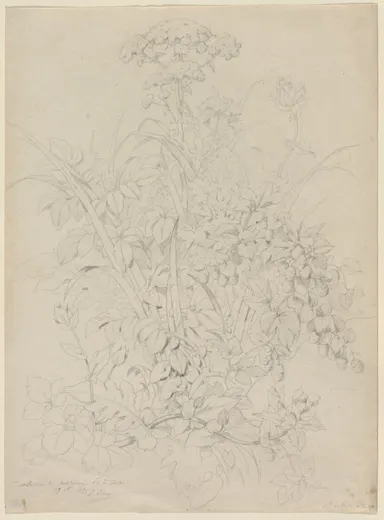 Master study
Bléry
Plant Study
A foreground drawn for its own sake: leaves, stems, flower heads, in graphite
1.5h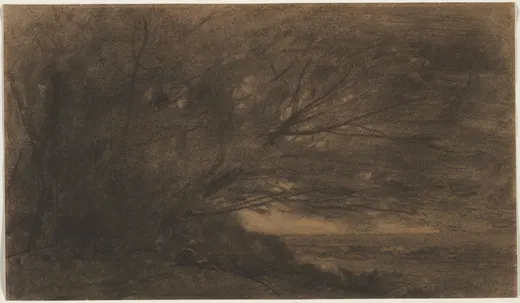 Master study
Corot · The late charcoals
Landscape (The Large Tree)
One dark mass, the lights lifted out
1.5h