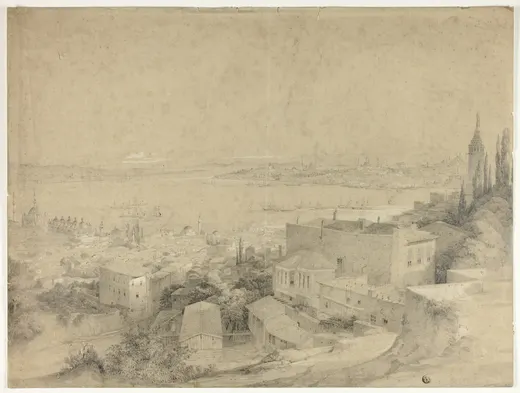
The Mosque, Cordova
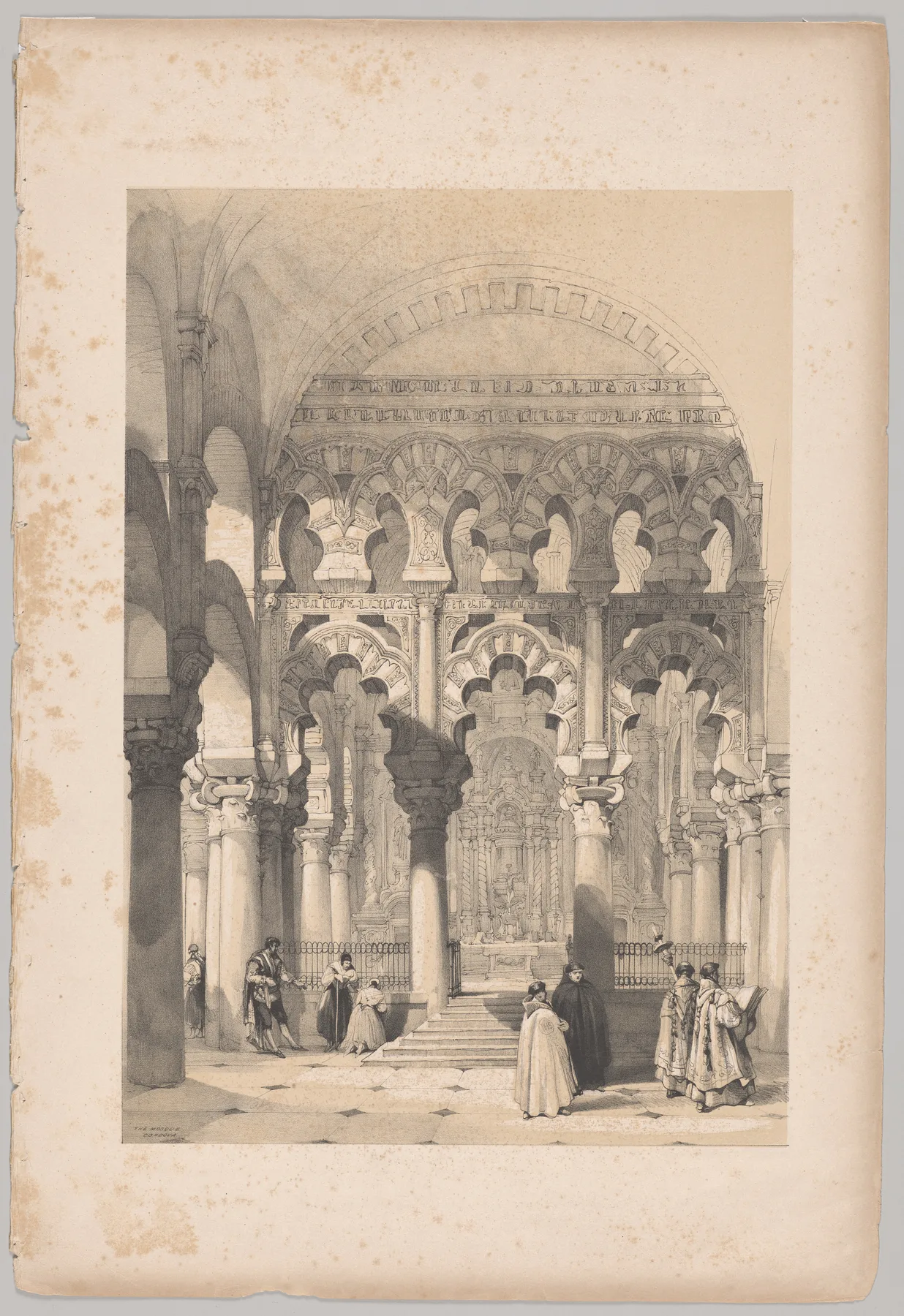
Shotter Boys, Picturesque Sketches in Spain: The Mosque, Cordova, 1837. lithograph.
Pins mark where to look before you draw.
The Cleveland Museum of Art · Bequest of John Bonebrake
The Mosque, Cordova
A forest of arches in perspective, with two figures for scale
From Picturesque Sketches in Spain, 1837: the double horseshoe arches of the Mezquita receding in rows, columns in perspective, two figures at the bottom. The hardest arch problem in the catalogue: round arches in depth, stacked, repeating, and foreshortened.
In pencilA lithograph: copy the line and the flat tones.
- Master
- Thomas Shotter Boys
- Difficulty
- Time
- about 3 h
- You draw with
- H, HB and 2B graphite
Why this one
- Round arches in perspective, in rows, in depth: the summit of the Architecture unit.
- Columns as a measured rhythm that shrinks.
- Figures that tell you the arches are twice a person's height.
From your kit
The whole kit →- 1Grafwood H, HB, 2B H, HB for layout and line; 2B for the darks. Long points from the Blackwing on everything up to B.
- 2Kneaded eraser and the Mono Zero press-and-lift corrections only; the Mono Zero for a single sharp light.
- 3Alpha sketchbook 9 x 6 draw at the book's size and keep the proportions; date the page.
In general, this study asks for
- Drawing pad or smooth cartridge
- 2H and H with long points
- HB for accents
- Kneaded eraser
- Sandpaper block
Watch first
All videos →Two centres, two arcs, in ninety seconds.
YouTube

The plan
3 stages · ~120 min- 1
Eye level, point, columns
20 minEye level low through the figures. Vanishing point where the aisle ends. The columns as plumb verticals whose spacing shrinks toward the point, found by diagonals.
FigureSpacing that shrinks correctly. Checklist0 / 2 - 2
Arches in perspective
60 minFor each arch: the springing line converging to the point, the crown found at the bay's centre, then the half-ellipse through them. The farther the arch, the flatter the ellipse. Build the nearest row fully, then let the rows behind be lighter and shorter.
FigureAn arch in perspective is a half-ellipse. Checklist0 / 3 - 3
Tone, figures, compare
40 minHB: the shadow sides of the columns and the dark under the arches as flat tone, deeper toward the far end. 2B: the two figures. Compare, note, date, box.
Checklist0 / 3
What it should look like
- Arches that recede convincingly as a forest.
- Columns that stay plumb and shrink.
- Two small people under big arches.
Where it goes wrong
- Pointed-looking arches. The ellipse was drawn as two curves meeting. Draw the whole ellipse lightly, then keep the top half.
Log this session
Start the clock when you pick up the pencil. Stop it when you put it down. Log it. Every session counts toward the box.
Status
How did it go?
Before this, ideally