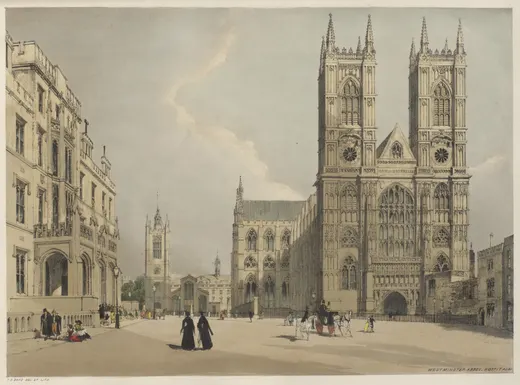
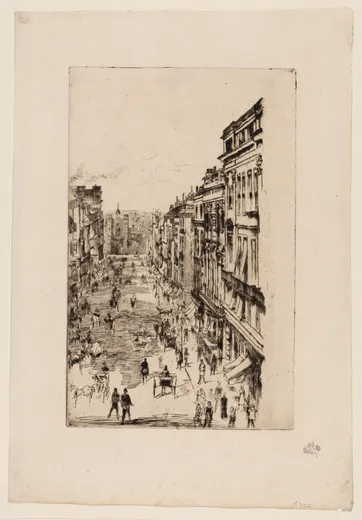
Regent Street toward the Quadrant
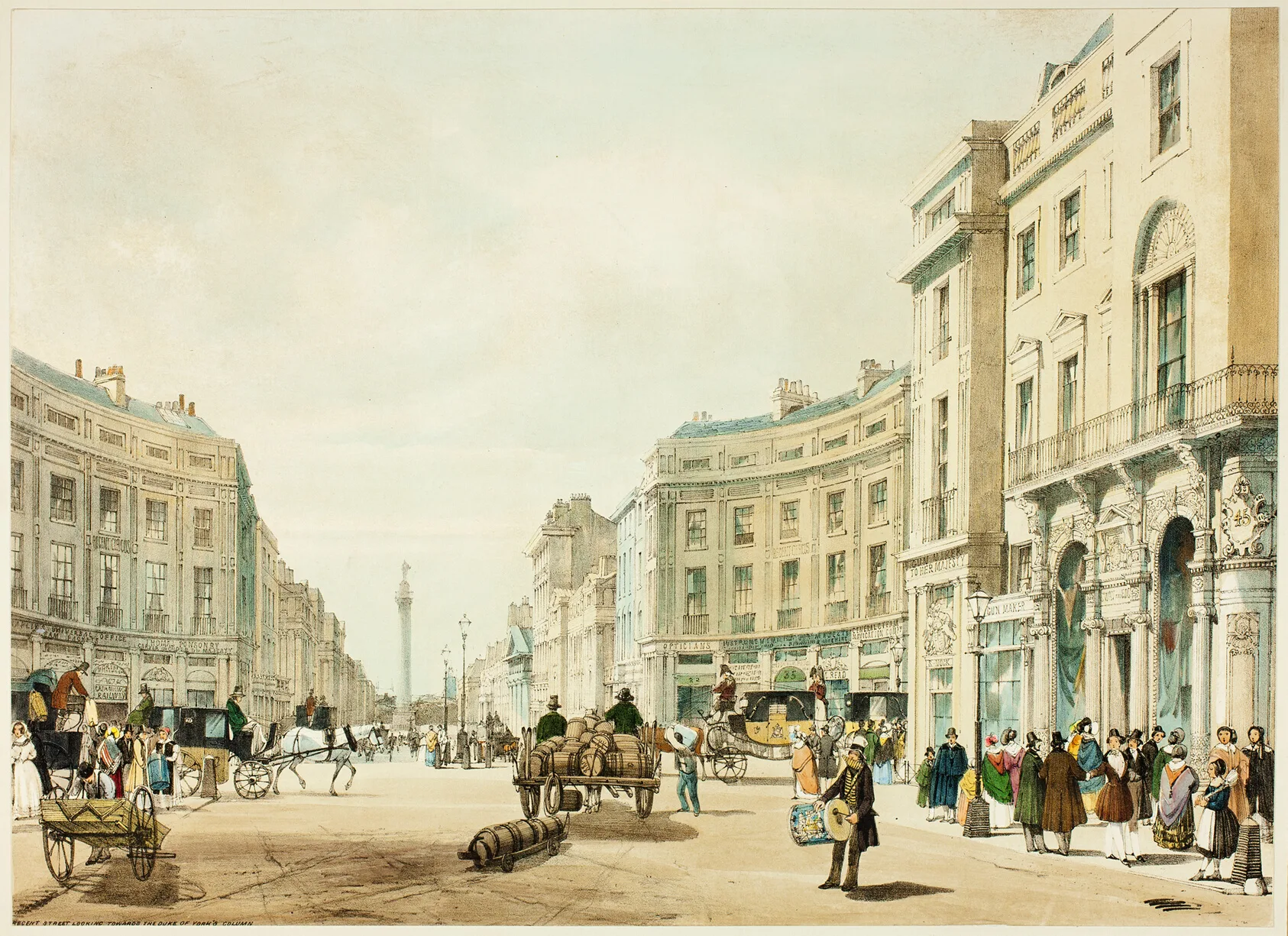
Shotter Boys, Regent Street Looking Towards the Duke of York's Column, plate twelve from Original Views of London as It Is, 1842. Hand-colored lithograph on paper.
Pins mark where to look before you draw.
The Art Institute of Chicago · Gift of Mrs. James Ward Thorne
Regent Street toward the Quadrant
A curved street, a straight facade, and the vanishing point that moves
Nash's Regent Street in 1842, carriages and shoppers, the long stucco facades receding to the Quadrant's curve. Boys handles the hardest street problem: a facade that is straight for a while and then bends, so its vanishing point slides along the eye level.
In pencilA tinted lithograph: copy the line and the flat tones, not the colour.
- Master
- Thomas Shotter Boys
- Difficulty
- Time
- about 2.5 h
- You draw with
- H, HB and 2B graphite
Why this one
- A straight facade in one-point that turns into a curve.
- Stucco as flat planes with window rhythm, no stone texture.
- A street crowd and carriages used to pace the recession.
From your kit
The whole kit →- 1Grafwood H, HB, 2B H, HB for layout and line; 2B for the darks. Long points from the Blackwing on everything up to B.
- 2Kneaded eraser and the Mono Zero press-and-lift corrections only; the Mono Zero for a single sharp light.
- 3Alpha sketchbook 9 x 6 draw at the book's size and keep the proportions; date the page.
In general, this study asks for
- Drawing pad or smooth cartridge
- 2H and H with long points
- HB for accents
- Kneaded eraser
- Sandpaper block
Watch first
All videos →A street in one point from a blank page. The Old College Wynd set-up.
YouTube
The plan
4 stages · ~115 min- 1
Eye level and the first vanishing point
15 minEye level through the heads. Mark the vanishing point for the straight stretch of facade where its cornice and kerb meet.
FigureOne point for the straight stretch. Checklist0 / 2 - 2
The bend
30 minWhere the street curves, the cornice changes direction. Mark a second vanishing point a little along the eye level and converge the curved stretch to it. Two or three points along the line make a curve.
FigurePoints that move along the eye level. Checklist0 / 3 - 3
Bays, windows, crowd
60 minH: bays by diagonals, windows in rhythm, plumb verticals throughout. HB: flat tones on the shaded side. 2B: carriages as boxes, figures as marks, the darkest accents under the colonnade.
FigureEqual bays by diagonals. Checklist0 / 3 - 4
Compare
10 minNote, date, box.
Checklist0 / 2
What it should look like
- A street that recedes straight and then turns.
- Facades that stay plumb all the way.
- People and carriages that shrink in step.
Where it goes wrong
- Verticals that lean with the curve. The eye follows the cornice. Verticals are plumb in every perspective here. Check each with the pencil.
Log this session
Start the clock when you pick up the pencil. Stop it when you put it down. Log it. Every session counts toward the box.
Status
How did it go?